
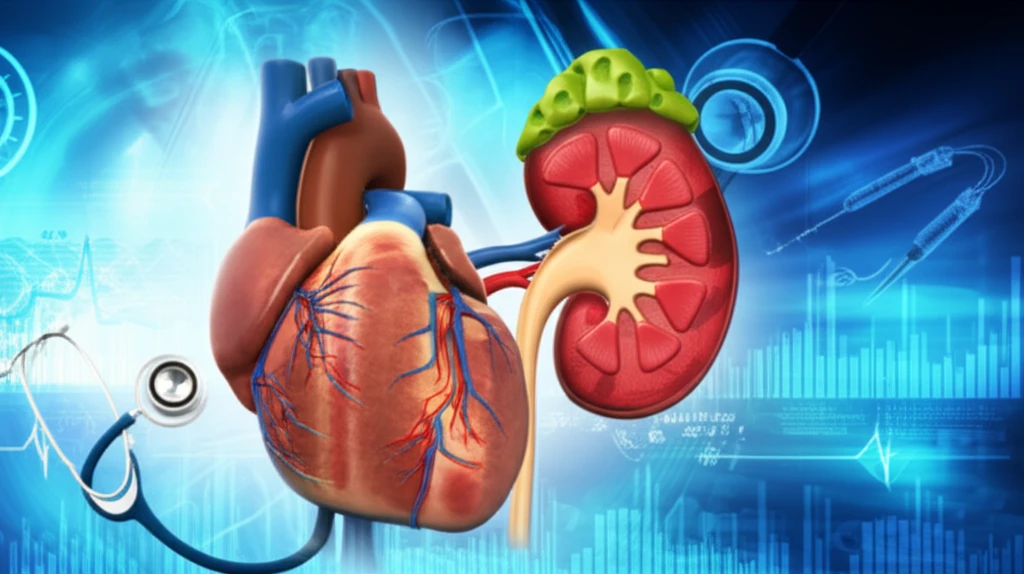
Illustration of a heart and kidney intertwined, symbolizing the relationship between heart and kidney health. Medical instruments and charts in the background.

Heart Health Showdown: Surgery vs. Medicine - What's Best for Your Kidneys?

"Groundbreaking Study Reveals Long-Term Outcomes for Patients with Stable Coronary Disease and Chronic Kidney Dysfunction."


Navigating heart health can feel like traversing a complex maze, especially when you're also dealing with kidney issues. The relationship between heart disease and chronic kidney disease (CKD) is well-established, but finding the best course of treatment has always been a challenge. Now, a groundbreaking study offers some clarity, providing valuable insights into the long-term outcomes of different treatment strategies for patients with both conditions.

The research, a 10-year follow-up of the Medicine, Angioplasty, or Surgery Study II trial, compared the effects of medical treatment (MT) alone, percutaneous coronary intervention (PCI), and coronary artery bypass graft surgery (CABG) in patients with stable coronary artery disease (CAD) and varying degrees of CKD. This study is a deep dive into the world of cardiac care and renal health.

This article breaks down the key findings of this important study, offering a clear, concise overview of what the research means for you, your loved ones, and anyone concerned about their heart and kidney health. We'll explore the nuances of each treatment approach and highlight the factors that can influence the best possible outcome.

Decoding the Study: Key Findings and Their Implications

Illustration of a heart and kidney intertwined, symbolizing the relationship between heart and kidney health. Medical instruments and charts in the background.

The study's findings paint a compelling picture of the interplay between heart disease treatment and kidney function. One of the most significant takeaways is the impact of different treatment approaches on patient outcomes over a decade. The study categorized patients into groups based on their kidney function: preserved kidney function, mild CKD, and moderate CKD. Researchers then assessed the occurrence of major cardiac events, including overall death and myocardial infarction (heart attack).

For those with mild CKD, the study found that both PCI and CABG were associated with lower rates of adverse events compared to MT alone. This suggests that invasive procedures, when appropriate, may offer a survival advantage over medication alone in this patient population. However, the study also noted that in the moderate CKD group, the differences between treatment strategies were not as clear, underscoring the need for further research in this area.

  • Mild CKD: Both PCI and CABG showed better outcomes than medical treatment alone.
  • Moderate CKD: Differences between treatments were less pronounced, highlighting the need for more research.
  • Overall Mortality: Higher mortality rates were observed in the MT group compared to PCI and CABG in the mild CKD group.
The results underscore the need for a personalized approach to heart disease treatment, considering both the severity of heart disease and the degree of kidney dysfunction. The study's insights are particularly relevant for healthcare providers and individuals making critical decisions about their heart health, helping to ensure informed choices that lead to the best possible outcomes.

Taking Charge of Your Heart and Kidney Health

The findings of the MASS II trial's 10-year follow-up are a significant step forward in understanding how to best treat heart disease in individuals with chronic kidney problems. These new insights empower you to have more informed conversations with your healthcare providers and make proactive choices about your health. As research continues, the future of cardiac care will offer more personalized and effective treatments, improving the quality of life for millions around the globe. Remember, your health is your most valuable asset. Stay informed, stay proactive, and stay well.

About this Article -

This article was crafted using a human-AI hybrid and collaborative approach. AI assisted our team with initial drafting, research insights, identifying key questions, and image generation. Our human editors guided topic selection, defined the angle, structured the content, ensured factual accuracy and relevance, refined the tone, and conducted thorough editing to deliver helpful, high-quality information.See our About page for more information.

This article is based on research published under:

DOI-LINK: 10.1093/ndt/gfy379, Alternate LINK

Title: Long-Term Outcomes Of Patients With Stable Coronary Disease And Chronic Kidney Dysfunction: 10-Year Follow-Up Of The Medicine, Angioplasty, Or Surgery Study Ii Trial

Subject: Transplantation

Journal: Nephrology Dialysis Transplantation

Publisher: Oxford University Press (OUP)

Authors: Eduardo Gomes Lima, David M Charytan, Whady Hueb, Diogo Freitas Cardoso De Azevedo, Cibele Larrosa Garzillo, Desiderio Favarato, Jaime Paula Pessoa Linhares Filho, Eduardo Bello Martins, Daniel Valente Batista, Paulo Cury Rezende, Alexandre Ciappina Hueb, José Antonio Franchini Ramires, Roberto Kalil Filho

Published: 2018-12-24

Everything You Need To Know

1

What were the main treatment approaches compared in the MASS II trial's 10-year follow-up regarding patients with both heart and kidney issues?

The Medicine, Angioplasty, or Surgery Study II (MASS II) trial's 10-year follow-up compared three primary treatment approaches: medical treatment (MT) alone, percutaneous coronary intervention (PCI), and coronary artery bypass graft surgery (CABG). The study assessed the long-term outcomes of these treatments in patients who had both stable coronary artery disease (CAD) and varying degrees of chronic kidney disease (CKD). By categorizing patients based on their kidney function – preserved, mild CKD, and moderate CKD – the study sought to determine the most effective treatment strategy for this complex patient population. The study is missing information on specific medications given during the MT treatment. The trial underscores a move toward personalized medicine by assessing each treatment based on individual conditions.

2

How did the outcomes of PCI and CABG compare to medical treatment alone for patients with mild chronic kidney disease (CKD) in the study?

For patients with mild CKD, both percutaneous coronary intervention (PCI) and coronary artery bypass graft surgery (CABG) were associated with lower rates of adverse cardiac events compared to medical treatment (MT) alone. This suggests that in individuals with mild kidney dysfunction, invasive procedures such as PCI and CABG may offer a survival advantage over medication-based management. These findings indicate that active intervention could be beneficial for patients with both coronary artery disease (CAD) and mild CKD. This aspect is critical since it influences clinical decision-making, potentially favoring interventional strategies over medical management in this specific population. Further investigation might explore whether particular medications within the medical treatment (MT) group could enhance outcomes, thereby offering an alternative to invasive procedures.

3

What were the overall mortality trends observed in the MASS II trial follow-up based on the treatment approach and the severity of chronic kidney disease?

The MASS II trial's 10-year follow-up showed higher mortality rates in the medical treatment (MT) group compared to both the percutaneous coronary intervention (PCI) and coronary artery bypass graft surgery (CABG) groups, specifically in patients with mild chronic kidney disease (CKD). While the study didn't pinpoint the exact causes of death, it suggests that invasive treatments might offer a protective effect against mortality in this subgroup. For those with moderate CKD, the differences in mortality among the treatment groups were less clear. This nuanced finding emphasizes the need for careful risk stratification and personalized treatment decisions, taking into account both cardiac and renal function. Future studies could explore the specific mechanisms driving these mortality differences to refine treatment strategies further.

4

In the context of heart disease and chronic kidney disease (CKD), why is it important to have a personalized treatment approach?

A personalized treatment approach is crucial due to the complex interplay between heart disease and chronic kidney disease (CKD). The MASS II trial highlighted that the effectiveness of different treatments – medical treatment (MT) alone, percutaneous coronary intervention (PCI), and coronary artery bypass graft surgery (CABG) – can vary depending on the severity of kidney dysfunction. This underscores the need to consider both the extent of coronary artery disease (CAD) and the degree of CKD when determining the most appropriate treatment strategy. Personalized treatment ensures that decisions are tailored to individual patient characteristics, optimizing outcomes and minimizing potential risks. Further research into genetic predispositions and biomarkers could enhance this personalization, enabling even more targeted and effective interventions.

5

What implications do the MASS II trial results have for patients with both heart and kidney conditions, and how can they take charge of their health?

The MASS II trial results suggest that patients with mild chronic kidney disease (CKD) and stable coronary artery disease (CAD) may benefit from percutaneous coronary intervention (PCI) or coronary artery bypass graft surgery (CABG) over medical treatment (MT) alone. However, those with moderate CKD require more nuanced treatment decisions. Patients can take charge of their health by staying informed about the latest research, actively participating in discussions with their healthcare providers, and making proactive choices about their treatment options. This includes understanding the potential benefits and risks of each approach, as well as the importance of lifestyle modifications, such as diet and exercise, to support both heart and kidney health. Additionally, continuous monitoring and management of risk factors, such as hypertension and diabetes, are critical components of proactive care. The study implies the need for additional psychological support for patients undergoing these treatments and future studies can focus on patient-reported outcomes.

Newsletter Subscribe

Subscribe to get the latest articles and insights directly in your inbox.