
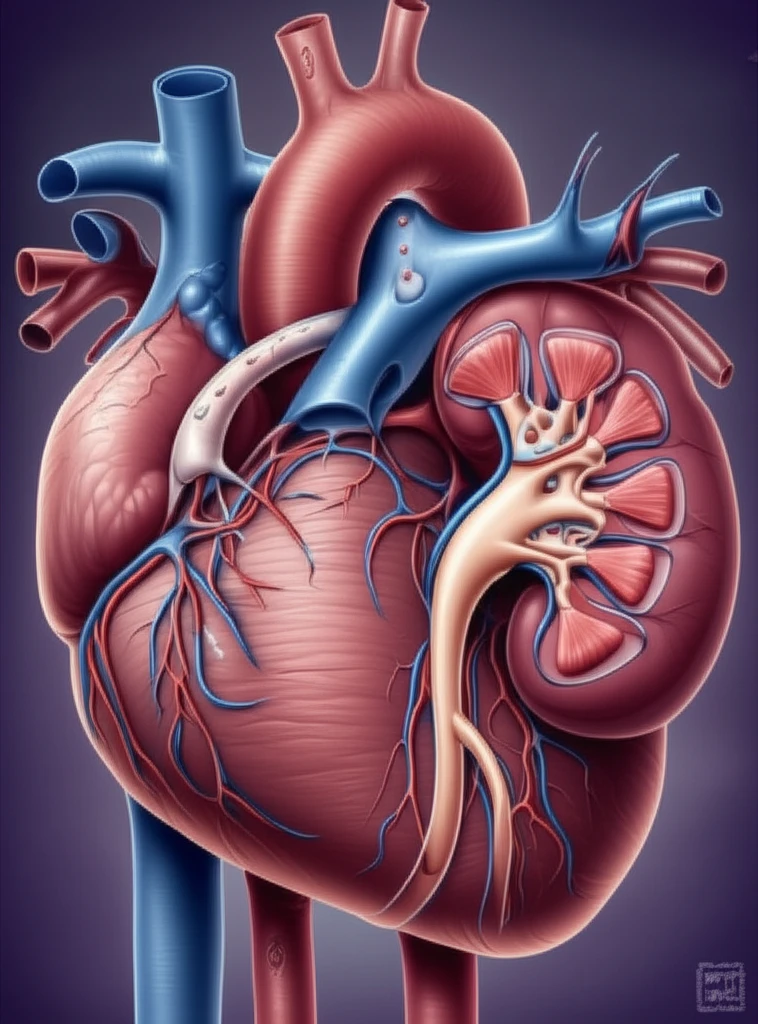
Heart and kidney intertwined, symbolizing treatment options.

Heart Health Showdown: Is Angioplasty or Bypass Better When Kidneys Are Struggling?

"New research dives deep into the best ways to keep your heart ticking when kidney disease complicates the picture."


When heart troubles and kidney problems team up, it's like navigating a maze with extra twists. Both conditions can worsen each other, making treatment choices a real head-scratcher for doctors and patients alike. Chronic kidney disease (CKD) throws a wrench into the works of stable coronary artery disease (CAD), demanding a closer look at how we manage heart health when kidneys aren't at their best.

For years, experts have been trying to nail down the safest, most effective ways to treat CAD in people with CKD. Should it be medication, a minimally invasive angioplasty, or open-heart bypass surgery? The answer isn't clear-cut, and solid research has been surprisingly scarce. This is particularly true when looking at the long-term effects of these treatments.

Now, a detailed study from the Medicine, Angioplasty, or Surgery Study II (MASS II) trial is shedding light on this complex issue. By tracking patients for a decade, researchers have uncovered critical insights into how different treatment strategies impact those with stable heart disease and varying degrees of kidney dysfunction. Let's break down what this means for you and your heart (and kidney) health.

The Million-Dollar Question: How Do Heart Treatments Stack Up for Kidney Patients?

Heart and kidney intertwined, symbolizing treatment options.

The MASS II trial sorted 611 patients into groups based on their kidney function, ranging from normal to mild or moderate CKD. These patients were then randomly assigned to one of three treatment paths: medication alone, angioplasty (PCI), or bypass surgery (CABG). The goal? To see which approach led to the best long-term outcomes, focusing on major events like death and heart attacks.

Here’s a quick look at how the patients were divided based on kidney function, measured by estimated glomerular filtration rate (eGFR):

  • Preserved Renal Function: eGFR ≥90 mL/min/1.73 m² (112 patients)
  • Mild CKD: eGFR 89–60 mL/min/1.73 m² (349 patients)
  • Moderate CKD: eGFR 59–30 mL/min/1.73 m² (150 patients)
After following these patients for a decade, some interesting patterns emerged. The primary endpoint, a combination of overall death and heart attack, occurred at different rates depending on kidney function: preserved eGFR (29.5%), mild CKD (32.4%), and moderate CKD (44.7%). This alone highlights how risk grows as kidney function declines. But here's where it gets really interesting when comparing treatment types.

The Bottom Line: Taking Care of Your Heart and Kidneys

The MASS II trial gives us valuable insights: CAD linked with CKD leads to a worse outcome, whatever the treatment and interventional treatments like PCI or CABG seem to lower the rate of problems, compared to just sticking to medication, particularly for those with mild CKD. Remember, this is just one piece of the puzzle. The best path forward depends on your unique health profile. Working closely with your healthcare team is key to creating a treatment plan that protects both your heart and your kidneys.

About this Article -

This article was crafted using a human-AI hybrid and collaborative approach. AI assisted our team with initial drafting, research insights, identifying key questions, and image generation. Our human editors guided topic selection, defined the angle, structured the content, ensured factual accuracy and relevance, refined the tone, and conducted thorough editing to deliver helpful, high-quality information.See our About page for more information.

Everything You Need To Know

1

What are the main treatment options for individuals experiencing both heart and kidney issues, as explored in the Medicine, Angioplasty, or Surgery Study II (MASS II) trial?

The Medicine, Angioplasty, or Surgery Study II (MASS II) trial investigated three primary treatment options for individuals with both stable coronary artery disease (CAD) and chronic kidney disease (CKD): medication alone, percutaneous coronary intervention (PCI) or angioplasty, and coronary artery bypass grafting (CABG) or bypass surgery. The study aimed to determine which of these approaches provides the best long-term outcomes for patients with varying degrees of kidney dysfunction, focusing on major adverse events like death and heart attacks. The effectiveness of each treatment was evaluated based on the patient's estimated glomerular filtration rate (eGFR), a measure of kidney function.

2

How does chronic kidney disease (CKD) complicate the treatment of stable coronary artery disease (CAD), and what makes treatment decisions challenging?

Chronic kidney disease (CKD) significantly complicates the treatment of stable coronary artery disease (CAD) because the two conditions can worsen each other. Treatment decisions become challenging due to the lack of clear-cut evidence regarding the safest and most effective treatment strategies. Factors such as the severity of CKD, measured by estimated glomerular filtration rate (eGFR), must be considered when choosing between medication, angioplasty (PCI), or bypass surgery (CABG). The Medicine, Angioplasty, or Surgery Study II (MASS II) trial addresses this challenge by providing long-term data on the impact of these treatments on patients with varying degrees of kidney dysfunction.

3

According to the Medicine, Angioplasty, or Surgery Study II (MASS II) trial, how does kidney function, measured by estimated glomerular filtration rate (eGFR), impact the risk of major adverse events like death and heart attack in patients with stable coronary artery disease (CAD)?

The Medicine, Angioplasty, or Surgery Study II (MASS II) trial demonstrated that the risk of major adverse events, such as death and heart attack, increases as kidney function declines in patients with stable coronary artery disease (CAD). The study categorized patients based on their estimated glomerular filtration rate (eGFR) into groups with preserved renal function (eGFR ≥90 mL/min/1.73 m²), mild CKD (eGFR 89–60 mL/min/1.73 m²), and moderate CKD (eGFR 59–30 mL/min/1.73 m²). The primary endpoint, a combination of overall death and heart attack, occurred at rates of 29.5% in those with preserved eGFR, 32.4% in those with mild CKD, and 44.7% in those with moderate CKD, clearly indicating a higher risk associated with reduced kidney function.

4

In the Medicine, Angioplasty, or Surgery Study II (MASS II) trial, how did interventional treatments like angioplasty (PCI) and bypass surgery (CABG) compare to medication alone in managing stable coronary artery disease (CAD) for patients with chronic kidney disease (CKD)?

The Medicine, Angioplasty, or Surgery Study II (MASS II) trial suggests that interventional treatments such as angioplasty (PCI) and bypass surgery (CABG) may lower the rate of problems compared to medication alone, particularly for those with mild chronic kidney disease (CKD). While the study emphasizes that the best treatment path depends on an individual's unique health profile, the findings indicate a potential benefit of PCI and CABG in reducing major adverse events in patients with stable coronary artery disease (CAD) and mild CKD, as measured by estimated glomerular filtration rate (eGFR). Further personalized assessment is still needed.

5

What key takeaway does the Medicine, Angioplasty, or Surgery Study II (MASS II) trial offer regarding the management of heart and kidney health, and why is a collaborative approach with healthcare professionals essential?

A key takeaway from the Medicine, Angioplasty, or Surgery Study II (MASS II) trial is that stable coronary artery disease (CAD) linked with chronic kidney disease (CKD) leads to worse outcomes, regardless of the treatment approach. While interventional treatments like percutaneous coronary intervention (PCI) and coronary artery bypass grafting (CABG) may offer benefits, the best path forward depends on an individual's unique health profile, including their estimated glomerular filtration rate (eGFR). Therefore, a collaborative approach with a healthcare team is essential to create a personalized treatment plan that effectively protects both heart and kidney health. This collaborative approach ensures all aspects of the patient's condition are considered, leading to more informed and effective treatment decisions.

Newsletter Subscribe

Subscribe to get the latest articles and insights directly in your inbox.