
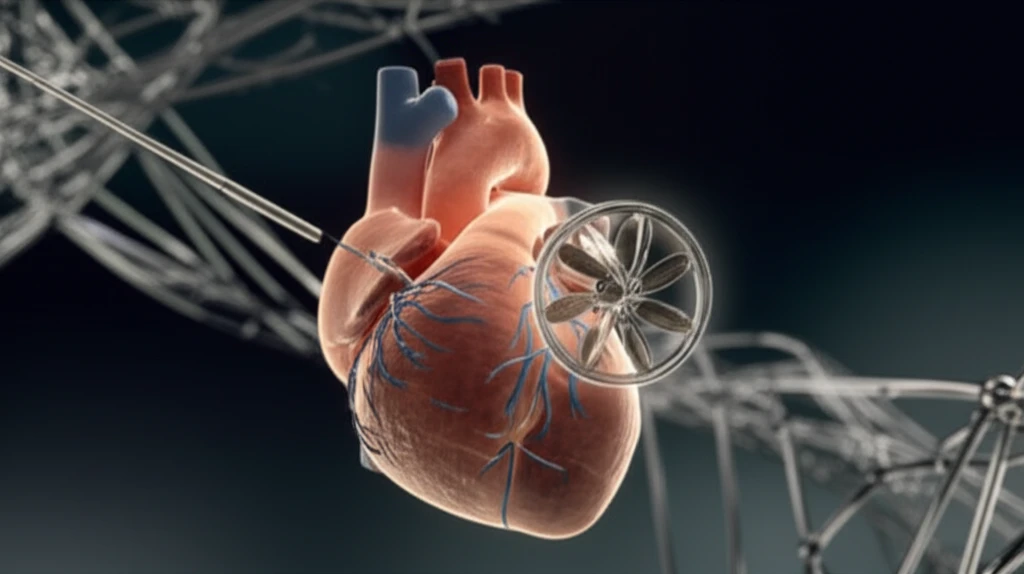
Illustration of heart with magnesium scaffolds and TAVI valve.

Heart Health Revolution: Innovative Treatments Reshape Cardiac Care

"Explore the latest advancements in cardiac treatments, from magnesium scaffolds to cutting-edge valve therapies, offering new hope for patients worldwide."


The landscape of cardiac care is undergoing a significant transformation, driven by groundbreaking innovations and technological advancements. These developments promise to enhance treatment efficacy, reduce patient risk, and improve overall outcomes for individuals facing a range of heart conditions. Let's delve into some of the most exciting breakthroughs that are reshaping the future of cardiology.

One promising area of advancement is the development of bioabsorbable magnesium scaffolds. Traditional drug-eluting stents (DES), while effective, have limitations in fully realizing the 'leave nothing behind' concept. However, innovative magnesium scaffolds are emerging as a potential solution, offering improved mechanical handling and a shorter resorption time. These scaffolds aim to minimize complications and promote better long-term healing.

Beyond scaffolds, transcatheter aortic valve implantation (TAVI) has revolutionized the treatment of severe aortic stenosis, particularly for high-risk patients who are not suitable candidates for open-heart surgery. TAVI procedures have seen exponential growth in recent years, driven by advancements in techniques, improved device designs, and better patient selection. This minimally invasive approach offers a less invasive alternative with comparable mortality rates to traditional valve replacement.

Magnesium Scaffolds: A New Dawn for Stent Technology?

Illustration of heart with magnesium scaffolds and TAVI valve.

Magnesium scaffolds represent a significant leap forward in stent technology. Unlike traditional metal stents that remain permanently implanted, magnesium scaffolds are designed to dissolve naturally over time. This bioabsorbable property offers several potential advantages, including reduced risk of long-term complications such as stent thrombosis and restenosis. Moreover, magnesium's biocompatibility promotes better vessel healing and reduces inflammation.

Professor Michael Haude, a leading expert in cardiology, emphasizes the importance of meticulous implantation techniques, including optical coherence tomography and lesion preparation, to maximize the benefits of magnesium scaffolds. While magnesium scaffolds hold great promise, careful patient selection is crucial to minimize the risk of subacute scaffold thrombosis, particularly in small vessels or complex stenoses.

  • Shorter Resorption Time: Dissolves within six to twelve months.
  • Improved Handling: Easier to deploy compared to polylactid scaffolds.
  • Promising Clinical Data: BIOSOLVE-II study shows favorable outcomes with reduced lumen loss.
  • Minimal Hyperplasia: Intravascular ultrasound shows minimal neointimal hyperplasia.
Clinical studies, such as the BIOSOLVE-II trial, have demonstrated the potential of magnesium scaffolds in treating coronary artery disease. The trial showed a late lumen loss of just 0.27 mm after six months, which is a very promising result. Further analysis revealed a good preservation of the scaffold area with minimal neointimal hyperplasia and no intraluminal masses. While the technology is still evolving, these early results suggest that magnesium scaffolds could become a valuable tool in the fight against heart disease.

Transforming Aortic Stenosis Treatment: The Rise of TAVI

TAVI has emerged as a game-changing alternative to traditional surgical aortic valve replacement, especially for patients deemed high-risk or inoperable. This minimally invasive procedure involves inserting a new valve through a catheter, typically inserted through the femoral artery. The TAVI procedure has several benefits, including shorter hospital stays, quicker recovery times, and reduced risk of complications compared to open-heart surgery. As TAVI technology continues to advance and patient selection criteria expand, it is poised to become the standard of care for a broader range of patients with aortic stenosis.

About this Article -

This article was crafted using a human-AI hybrid and collaborative approach. AI assisted our team with initial drafting, research insights, identifying key questions, and image generation. Our human editors guided topic selection, defined the angle, structured the content, ensured factual accuracy and relevance, refined the tone, and conducted thorough editing to deliver helpful, high-quality information.See our About page for more information.

This article is based on research published under:

DOI-LINK: 10.1007/s15027-016-0887-x, Alternate LINK

Title: Neuer Magnesium-Scaffold Weckt Hoffnungen

Subject: General Medicine

Journal: CardioVasc

Publisher: Springer Science and Business Media LLC

Authors: Michael Lohmann

Published: 2016-05-01

Everything You Need To Know

1

What are the key advantages of using bioabsorbable magnesium scaffolds compared to traditional drug-eluting stents in treating coronary artery disease?

Magnesium scaffolds offer several advantages over traditional drug-eluting stents (DES). Firstly, they are designed to dissolve naturally over time, unlike DES which remain permanently implanted. This bioabsorbable property potentially reduces the risk of long-term complications, such as stent thrombosis and restenosis. Secondly, magnesium scaffolds are known for their biocompatibility, which promotes better vessel healing and reduces inflammation. Furthermore, magnesium scaffolds have a shorter resorption time, dissolving within six to twelve months, and exhibit improved mechanical handling during deployment. Clinical data, like that from the BIOSOLVE-II study, shows favorable outcomes, with minimal late lumen loss and minimal neointimal hyperplasia, indicating a positive impact on vessel health.

2

How has transcatheter aortic valve implantation (TAVI) revolutionized the treatment of aortic stenosis, and who are the ideal candidates for this procedure?

TAVI has revolutionized the treatment of severe aortic stenosis by providing a less invasive alternative to traditional surgical aortic valve replacement. The procedure involves inserting a new valve through a catheter, typically inserted through the femoral artery. This minimally invasive approach offers several benefits, including shorter hospital stays, quicker recovery times, and reduced risk of complications compared to open-heart surgery. TAVI is particularly beneficial for high-risk patients or those who are not suitable candidates for open-heart surgery due to their health condition or other factors. As TAVI technology advances and patient selection criteria expand, more individuals can benefit from this treatment, making it a standard of care for a broader range of patients with aortic stenosis.

3

What is the significance of the BIOSOLVE-II study in evaluating the effectiveness of magnesium scaffolds?

The BIOSOLVE-II study is a significant clinical trial that evaluates the effectiveness of magnesium scaffolds in treating coronary artery disease. The study's findings are promising, showing a late lumen loss of only 0.27 mm after six months, which suggests that the magnesium scaffolds are effective in maintaining vessel patency. The study also revealed a good preservation of the scaffold area with minimal neointimal hyperplasia and no intraluminal masses. These results are crucial as they provide evidence of the safety and efficacy of magnesium scaffolds, positioning them as a potentially valuable tool in the fight against heart disease. The study's outcomes provide essential data for future research and clinical applications of magnesium scaffolds.

4

Can you explain the procedure of transcatheter aortic valve implantation (TAVI) and how it differs from traditional valve replacement?

The transcatheter aortic valve implantation (TAVI) procedure is a minimally invasive technique used to treat aortic stenosis. In TAVI, a new valve is inserted through a catheter, typically through the femoral artery in the leg, and guided to the heart. This method contrasts with traditional surgical aortic valve replacement, which involves open-heart surgery. TAVI offers several advantages over open-heart surgery, including smaller incisions, shorter hospital stays, faster recovery times, and a reduced risk of complications. Because TAVI is less invasive, it is particularly beneficial for high-risk patients or those not suitable for traditional surgery.

5

What are the potential risks and considerations associated with the use of magnesium scaffolds, and how can these be mitigated?

While magnesium scaffolds hold great promise, there are potential risks associated with their use. One of the key considerations is the risk of subacute scaffold thrombosis, particularly in small vessels or complex stenoses. To mitigate this risk, careful patient selection is crucial. Leading experts, like Professor Michael Haude, emphasize the importance of meticulous implantation techniques, including the use of optical coherence tomography and careful lesion preparation, to optimize the benefits of the magnesium scaffolds. Furthermore, the evolving nature of the technology requires ongoing research and clinical trials to refine techniques and improve patient outcomes, ensuring that the benefits of these innovative scaffolds are maximized while minimizing potential risks.

Newsletter Subscribe

Subscribe to get the latest articles and insights directly in your inbox.