
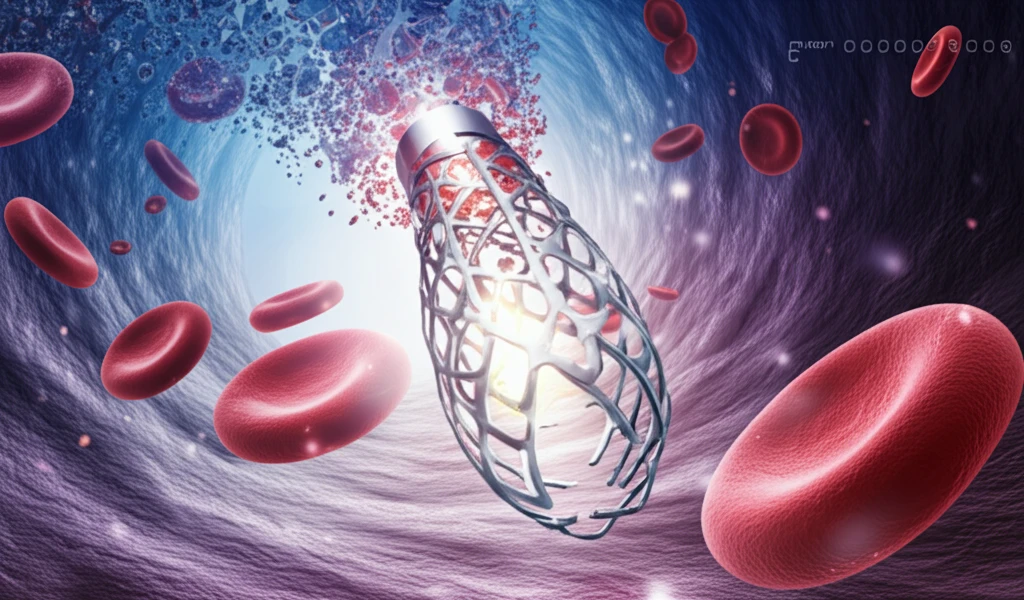
Heart Health Revolution: Are Bioresorbable Stents the Future of Angioplasty?

"Uncover the latest advancements in bioresorbable stent technology and how they're transforming the treatment of coronary artery disease, offering new hope for long-term heart health."
Coronary artery disease (CAD) remains a leading cause of morbidity and mortality worldwide. Angioplasty, a procedure to widen narrowed or blocked arteries, has become a standard treatment, often involving the placement of stents to keep the arteries open. Traditional metal stents, while effective, can sometimes lead to long-term complications such as late stent thrombosis and neoatherosclerosis, prompting the development of bioresorbable stents as an innovative alternative.
Bioresorbable stents, also known as bioabsorbable scaffolds, represent a paradigm shift in interventional cardiology. These devices are designed to provide temporary support to the artery, gradually dissolving over time as the artery heals. The idea is that once the artery has regained its natural ability to stay open, the scaffold is no longer needed and disappears, leaving no permanent implant behind.
Recent studies and clinical trials have focused on evaluating the safety and efficacy of various bioresorbable scaffolds, including those made from magnesium alloys and poly-L-lactic acid (PLLA). Researchers are keenly interested in whether these new scaffolds can reduce the risk of long-term complications compared to traditional drug-eluting stents (DES).
Market Growth and Clinical Milestones
The global bioresorbable coronary stents market is forecast to grow from USD 178.94 million in 2026 to USD 257.8 million by 2035, representing a compound annual growth rate of 4.14%. Newer metal-based stents are expected to steepen the adoption curve as more clinical data becomes available. While the technology has made great strides, only three bioresorbable stents have achieved CE marking to date, and none has received US FDA approval for use in the United States.
Overcoming the Metallic Cage
Traditional metallic stents—both bare-metal and drug-eluting—remain permanently implanted in the artery, creating what researchers describe as a 'metallic cage' that can limit natural vessel function. Bioresorbable scaffold stents (BRS) were developed as a solution to this limitation, providing short-term scaffolding of the vessel before dissolving and leaving nothing behind. Braided stent designs are considered the standard for gastrointestinal self-expanding stents and offer improved results in peripheral vascular applications.
From Dentistry to Interventional Cardiology
The term 'stent' traces back to Charles Stent, a 19th-century English dentist who advanced denture-making techniques. The era of coronary stenting began in 1986 when Jacques Puel and Ulrich Sigwart performed the first coronary stent implantation to prevent vessel closure during coronary angioplasty. The original bare-metal stent was later fitted with a drug-eluting polymer to reduce restenosis and thrombosis, and subsequent designs replaced that durable polymer with bioresorbable materials.
The Promise of Bioresorbable Stents: Key Research Findings
Several abstracts presented at recent cardiology conferences shed light on the performance of bioresorbable stents in real-world settings and complex lesions. One notable study is a registry designed to evaluate the clinical performance and long-term safety of the Resorbable Magnesium Scaffold (Magmaris) in up to 1065 subjects across multiple sites in Europe and Asia-Pacific. Preliminary data from the first 400 subjects showed a low rate of target lesion failure (TLF) at 6 months, indicating a promising safety profile.
- Low rates of target lesion failure (TLF) at 6-month follow-up.
- A low rate of definite/probable scaffold thrombosis.
- Insights into specific adverse events such as scaffold recoil and intraluminal scaffold dismantling.
- Comparable MACE (major adverse cardiac events) rates with new-generation DES.
Metallic Stents Show Promise Over Polymer Designs
Polymer-based bioresorbable stents exhibited suboptimal performance in clinical trials due to deficient mechanical properties, which limited their clinical adoption. In contrast, metallic bioresorbable stents with improved mechanical strength have advanced into clinical use and demonstrated more promising outcomes. A systematic review of magnesium-based bioresorbable stents evaluated both mechanical and corrosion properties across 37 qualifying reviews selected from 4,194 initial publications.
Limitations in Critical Applications
While bioresorbable stents lower the risk of long-term complications caused by permanent metal implants, their applicability remains constrained in certain clinical scenarios. In low-birth-weight infants with aortic coarctation, for instance, bioresorbable scaffolds showed significant early stent failure due to loss of radial force, making them unsuitable as long-term bridge-to-surgery solutions. Current bioresorbable stents may therefore have limited utility in very-low body-weight pediatric patients who require sustained vascular support.
Weighing Scaffold Against Permanent Stents
Bioresorbable scaffolds were designed to overcome the limitations of permanent drug-eluting stents, which remain in the body indefinitely and can trigger late complications such as very late stent thrombosis. In the BIOSOLVE-I study, researchers assessed the long-term safety and performance of a drug-eluting absorbable metal scaffold over three years of follow-up. Meta-analyses have compared bioresorbable vascular scaffolds against drug-eluting stents in the treatment of coronary heart disease, with conflicting results to date regarding superiority.
Looking Ahead: The Future of Bioresorbable Stents
Bioresorbable stents represent a significant advancement in the treatment of coronary artery disease. While long-term data is still being collected, the initial results are promising, suggesting that these devices could potentially reduce the risk of late complications associated with traditional metal stents. As technology evolves and more clinical evidence becomes available, bioresorbable stents may become an increasingly important tool in the fight against heart disease, improving outcomes and quality of life for patients around the world.
Expert Opinions on Stent Selection
Mayo Clinic interventional cardiologists, including Gurpreet Sandhu, Malcolm Bell, and Rajiv Gulati, have weighed in on the relative merits of bare-metal, drug-eluting, and bioresorbable stents in clinical practice. Interventionalists at the CRT 2018 conference acknowledged that published results with bioresorbable stents have been disappointing, yet most considered the technology to have strong potential to eventually prevail over drug-eluting stents. A key question remains whether bioresorbable options can provide sufficient mechanical support to reduce restenosis and prevent negative remodeling or vessel shrinkage after percutaneous coronary intervention.
Market Expansion and Technological Innovation
The future outlook for the bioresorbable stent system market is highly promising, driven by ongoing technological innovation and increasing clinical adoption. Market analysts expect continued growth in the fully bioresorbable stents segment through 2033, supported by expanding applications beyond coronary interventions. Integration of bioresorbable stents into comprehensive cardiovascular care pathways, combined with digital health tools for patient monitoring, is expected to sustain long-term market expansion.
Cost Barriers and Resurgent Interest
One of the primary constraints hindering market expansion is the high cost associated with advanced bioresorbable materials and their manufacturing processes. Despite past challenges, bioresorbable stents are back in the spotlight thanks to significant progress from multiple medtech companies, with the latest generation demonstrating improved structural integrity, durability, and clinical efficacy. Originally designed to provide mechanical support and drug delivery over one to two years before gradually dissolving, bioresorbable stents are now being explored for use in peripheral arterial disease and below-the-knee arterial applications.
Clinical Experience in Complex Cases
Real-world clinical experience with bioresorbable stents extends to challenging scenarios such as saphenous vein graft intervention, where bioresorbable vascular scaffolds have been deployed under optical coherence tomography guidance. Magnesium-based bioresorbable Magmaris stents are rapidly resorbed in the body, though only a few randomized studies have evaluated their efficacy specifically in patients with acute coronary syndrome. Some bioresorbable stents remain commercially available, but the field still awaits results from the ABSORB IV trial to further clarify their clinical role.