
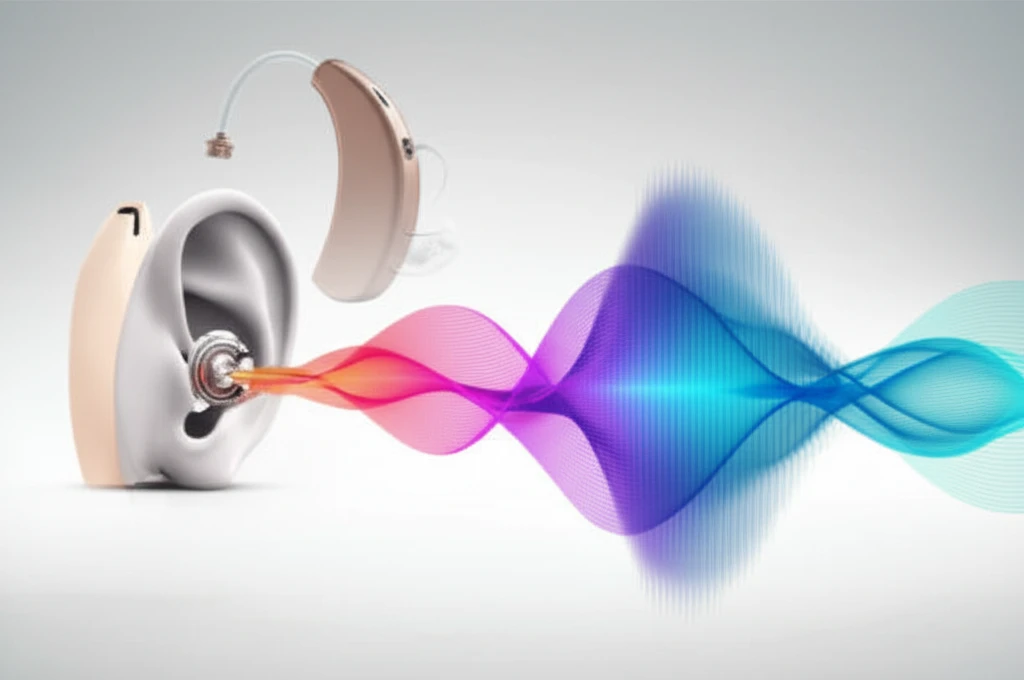
Hear Better: Active Middle Ear Implants vs. Hearing Aids

"Discover how active middle ear implants offer superior hearing for individuals with sloping high-frequency hearing loss, surpassing the limitations of traditional hearing aids."
Sloping high-frequency hearing loss, characterized by intact hearing at lower frequencies but diminished hearing at higher frequencies, affects many individuals. This condition makes it difficult to discern speech against background noise, impacting daily communication. Traditional hearing aids (HAs) often fall short in providing adequate relief, leading to user dissatisfaction due to issues like occlusion, discomfort, and limited benefit at higher frequencies.
While open-fitting HAs have attempted to address these limitations, their effectiveness remains restricted for sloping high-frequency loss due to decreased amplification above 4 kHz. Hybrid cochlear implantation presents a potential solution, but it carries risks, including potential loss of residual hearing. This is where active middle ear implants (AMEIs) emerge as a compelling alternative.
This article explores the benefits of AMEIs, specifically the Vibrant Soundbridge, over traditional HAs for individuals with sloping high-frequency hearing loss. By examining objective and subjective assessments, we'll uncover how AMEIs offer improved hearing outcomes and greater satisfaction, providing a better alternative for treating this specific type of hearing impairment.
Active Middle Ear Implants: A Superior Solution for High-Frequency Hearing Loss?
A study was conducted involving individuals with sloping high-frequency hearing loss who had previously used hearing aids. These participants underwent vibroplasty, a procedure where the Vibrant Soundbridge (VSB) AMEI was implanted. Researchers then compared the outcomes of AMEIs with those of conventional HAs, using both objective tests (pure-tone audiograms, word recognition tests, and the Korean version of the Hearing in Noise Test (K-HINT)) and subjective questionnaires (Abbreviated Profile of Hearing Aid Benefit (APHAB)).
- Improved High-Frequency Hearing Gain: AMEIs demonstrated a significantly better hearing gain at frequencies of 2 kHz and above, critical for those with sloping high-frequency hearing loss.
- Enhanced Word Recognition: While not statistically significant, AMEIs showed a trend toward superior word recognition scores compared to HAs. Importantly, the most comfortable hearing level (MCL) for word recognition was significantly lower with AMEIs, indicating greater listening comfort.
- Better Speech Recognition in Noise: The K-HINT scores revealed that individuals with AMEIs exhibited greater speech recognition in both quiet and noisy environments compared to those using HAs.
- Increased Satisfaction: APHAB scores demonstrated higher satisfaction levels with AMEIs across all subscales, indicating improved ease of communication, reduced background noise interference, and less aversiveness.
The Future of Hearing Solutions: AMEIs as a Promising Alternative
The study's results show that active middle ear implants offer a compelling alternative to traditional hearing aids for individuals with sloping high-frequency hearing loss. The improved hearing gain, enhanced speech recognition, and increased satisfaction reported by AMEI users highlight the potential of this technology to address the limitations of conventional amplification methods.
While this study provides valuable insights, it's important to acknowledge certain limitations, such as the relatively small sample size and the retrospective nature of the analysis. Future research with larger cohorts and prospective designs will further solidify the benefits of AMEIs and refine patient selection criteria.
For individuals struggling with the challenges of sloping high-frequency hearing loss, active middle ear implants represent a promising avenue for improved hearing and a better quality of life. Consulting with an audiologist and exploring the possibility of AMEI implantation could be a significant step toward regaining confident communication and enjoying the richness of sound.