
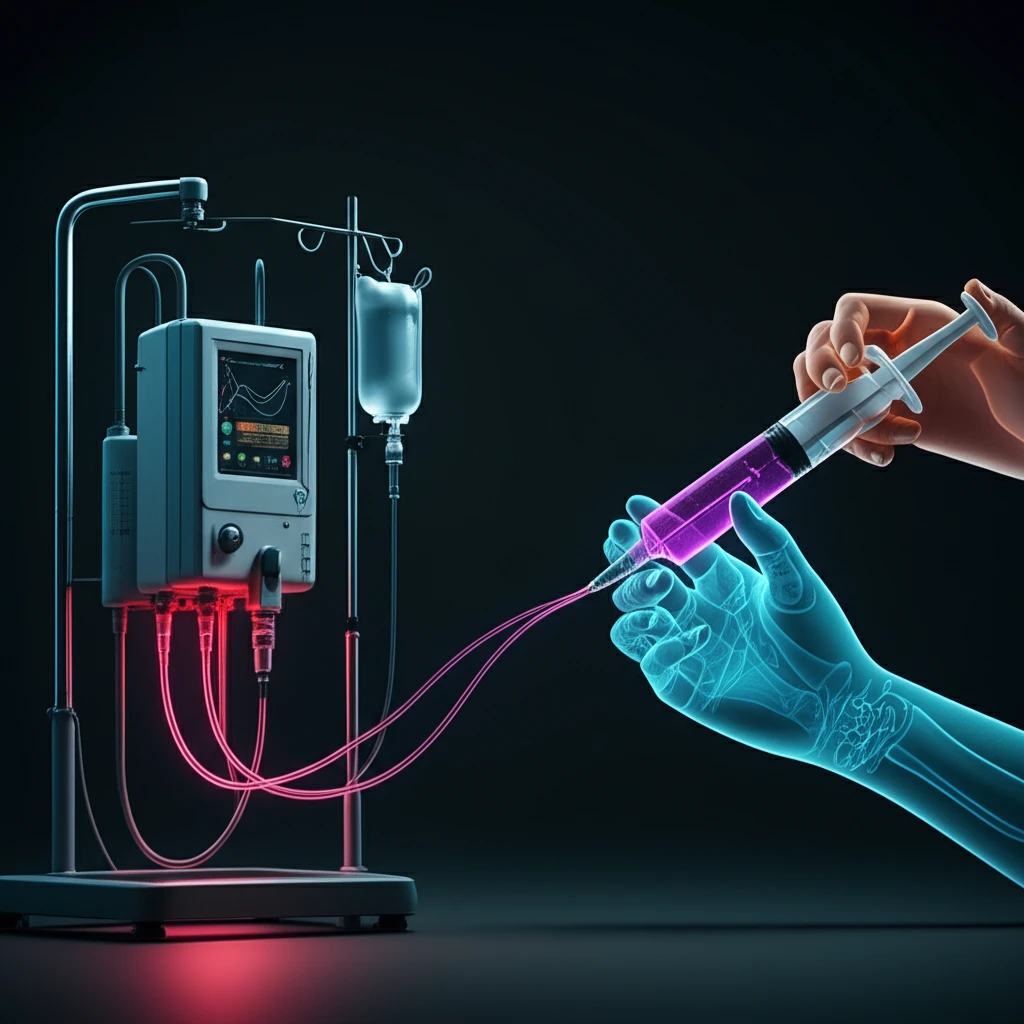
Contrast injector competing with hand injection

Hand vs. Injector: Which Method Delivers the Best MRI Image Quality?

"A head-to-head comparison reveals the impact of contrast agent administration techniques on MRI results."


In the world of medical imaging, particularly contrast-enhanced magnetic resonance angiography (CE-MRA), the quest for sharper, clearer images is ongoing. These images rely on gadolinium-based contrast agents (GBCAs) to highlight blood vessels. The quality of these images depends significantly on how the GBCA is administered, affecting the vascular bolus geometry—the width and peak of the contrast bolus—and the timing of image acquisition. Achieving optimal contrast enhancement is crucial for accurate diagnoses.

Traditionally, both hand injections and automated power injectors have been used to administer GBCAs. Hand injections are common but can be inconsistent due to variations in technique. Power injectors, on the other hand, promise more controlled and consistent delivery. Understanding the impact of each method on image quality can lead to better diagnostic outcomes.

This article will explore a recent study comparing hand injection and injector-based GBCA administration in MRA. The aim is to evaluate how each method affects vascular bolus shape, image quality, and the overall visualization of target vessels, providing insights for medical professionals seeking to optimize their MRA techniques.

Injector vs. Hand Injection: A Detailed Comparison

Contrast injector competing with hand injection

A study published in Magnetic Resonance Insights compared the two methods of contrast agent administration: hand injection and power injection. The study involved administering gadobutrol, a common GBCA, to minipigs using three different protocols:

The following protocols were used during the study:

  • Protocol A: Hand injection by one experienced technician.
  • Protocol B: Hand injection by six less-experienced technicians.
  • Protocol C: Power injector administration.
Following the procedures, the arterial bolus shape was measured and quantified using test bolus measurements. The team performed a head and neck MRA to compare the quality and signal enhancement from each protocol.

The Verdict: Why Injector-Based Administration Wins

The study revealed significant differences between the two methods. Injector-based administration resulted in a shorter time to peak enhancement and lower variation in bolus geometry. MRA imaging also showed a significantly higher signal-to-noise ratio (SNR) with injector-based administration compared to hand injections.

Specifically, the study highlighted:

In conclusion, injector-based GBCA administration offers a more standardized bolus shape, higher vascular contrast, and robust visualization of target vessels. Therefore, the use of power injectors should be strongly considered for MRA procedures.

About this Article -

This article was crafted using a human-AI hybrid and collaborative approach. AI assisted our team with initial drafting, research insights, identifying key questions, and image generation. Our human editors guided topic selection, defined the angle, structured the content, ensured factual accuracy and relevance, refined the tone, and conducted thorough editing to deliver helpful, high-quality information.See our About page for more information.

This article is based on research published under:

DOI-LINK: 10.1177/1178623x17705894, Alternate LINK

Title: The Impact Of Injector-Based Contrast Agent Administration On Bolus Shape And Magnetic Resonance Angiography Image Quality

Subject: General Medicine

Journal: Magnetic Resonance Insights

Publisher: SAGE Publications

Authors: Gregor Jost, Jan Endrikat, Hubertus Pietsch

Published: 2017-01-01

Everything You Need To Know

1

What's the key difference between hand injections and injector-based administration?

The primary difference lies in the method of administering gadolinium-based contrast agents (GBCAs). Hand injections rely on manual technique, which can vary significantly depending on the experience of the person performing the injection. Power injectors, conversely, provide a more controlled and consistent delivery of the GBCA. This automated process helps to standardize the administration, leading to more predictable results in MRI imaging, especially in contrast-enhanced magnetic resonance angiography (CE-MRA).

2

Why is the method of contrast agent administration so important for MRI image quality?

In the context of medical imaging, particularly contrast-enhanced magnetic resonance angiography (CE-MRA), the quality of the images is paramount for accurate diagnosis. The width and peak of the contrast bolus are critical in achieving optimal contrast enhancement. Injector-based administration results in a shorter time to peak enhancement and lower variation in bolus geometry, providing better image quality. Hand injections can lead to inconsistent bolus geometries, potentially affecting the clarity and diagnostic value of the images. This highlights the importance of technique standardization in medical imaging.

3

What makes injector-based administration superior to hand injections?

The significance of injector-based administration is evident in the study's findings. Injector-based administration showed a significantly higher signal-to-noise ratio (SNR) compared to hand injections. SNR is a measure of image quality, with a higher SNR indicating a clearer image. This is because the power injector provides more precise control over the GBCA delivery, resulting in a more consistent bolus. The study reveals that using a power injector ensures more consistent and higher quality imaging results, which directly benefits the ability to visualize and diagnose conditions affecting blood vessels. This leads to more accurate diagnoses.

4

What are the implications of using injector-based administration in medical practice?

The implications of these findings are significant for medical professionals. The choice of administration method can directly impact the quality of the images and the accuracy of the diagnoses. The study shows that the power injector is superior to hand injections, as evidenced by a shorter time to peak enhancement, less variation in bolus geometry, and a higher signal-to-noise ratio (SNR). These factors combine to produce higher-quality images, which allows for better visualization of the blood vessels. Therefore, medical professionals aiming to optimize their CE-MRA techniques should consider power injectors to improve the quality of their images and enhance patient outcomes.

5

What methods were compared in the study and what were the key findings?

The study compared hand injection and power injection using gadobutrol. The protocols included hand injections by experienced and less experienced technicians and power injector administration. The arterial bolus shape was measured using test bolus measurements. Head and neck MRA was used to compare the quality and signal enhancement of each protocol. The study found that injector-based administration resulted in a shorter time to peak enhancement, lower variation in bolus geometry, and a significantly higher signal-to-noise ratio (SNR) compared to hand injections.

Newsletter Subscribe

Subscribe to get the latest articles and insights directly in your inbox.