
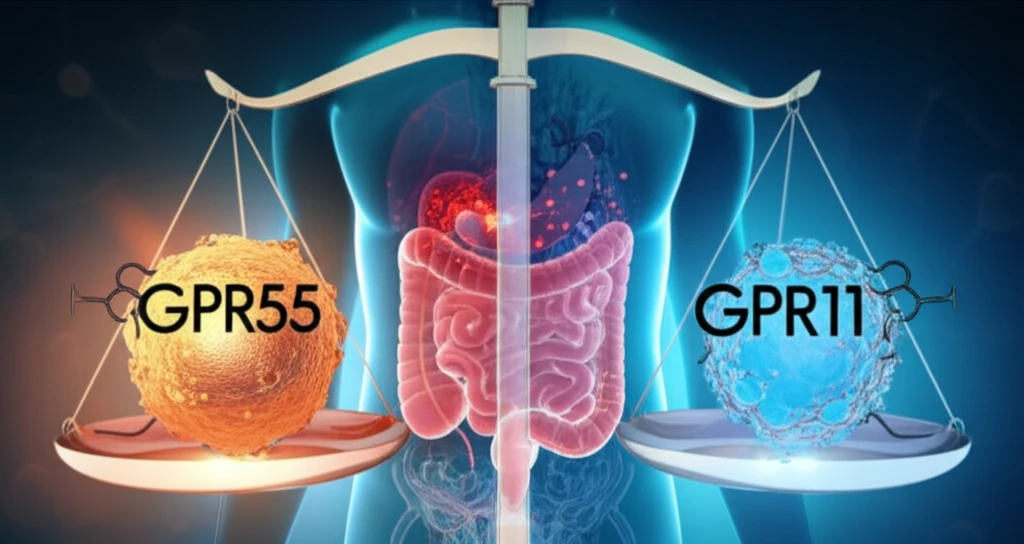
Balanced scale representing GPR55 and CB1 receptors in colorectal cancer prevention.

Gut Instincts: How a Hidden Receptor Could Be Your Key to Colorectal Cancer Prevention

"Unlocking the Secrets of GPR55 and Cannabinoid Receptors in the Fight Against Colorectal Cancer"


Colorectal cancer (CRC) remains a major health challenge, demanding innovative approaches beyond traditional treatments. Recent studies highlight the crucial role of the tumor microenvironment – the complex ecosystem surrounding cancer cells – in CRC development and progression. Within this environment, inflammatory mediators, immune cells, and their receptors interact in ways that can either fuel or suppress tumor growth.

Among the key players in this intricate network are cannabinoid receptors, particularly CB1 and GPR55. While CB1 has been shown to have anti-tumor effects in the gut, the function of GPR55 has remained largely unclear. New research is shedding light on GPR55's role in promoting CRC and how it interacts with CB1, offering potential new avenues for prevention and treatment.

This article explores the groundbreaking findings that reveal the complex interplay between GPR55 and CB1 in colorectal cancer. Learn how these receptors influence tumor growth, inflammation, and the immune response, and what this could mean for the future of CRC prevention and therapy.

The Surprising Role of GPR55: From Inflammation to Tumor Growth

Balanced scale representing GPR55 and CB1 receptors in colorectal cancer prevention.

The study published in the International Journal of Cancer uncovers a previously underappreciated role for GPR55 in promoting colorectal cancer. Researchers using mouse models discovered that GPR55 encourages tumor growth by altering the balance of immune cells within the tumor microenvironment. Specifically, GPR55 promotes the accumulation of myeloid-derived suppressor cells (MDSCs), which suppress the anti-tumor activity of T cells. It also modulates levels of key inflammatory mediators like COX-2 and STAT3, known to drive cancer progression.

In essence, GPR55 appears to create a microenvironment that favors tumor development. When GPR55 was removed, the researchers observed the opposite effect: increased numbers of cytotoxic T cells (immune cells that kill cancer cells) and reduced levels of tumor-promoting inflammatory molecules.

Here’s a quick breakdown of the key findings:
  • GPR55 promotes colorectal cancer growth in mouse models.
  • GPR55 influences the balance of immune cells in the tumor microenvironment.
  • GPR55 modulates inflammatory mediators known to drive cancer progression.
Interestingly, when researchers tried to manipulate GPR55 directly in colon cancer cell lines, they didn't see any effect on cell proliferation. This suggests that GPR55's primary influence on CRC is through modulating the tumor microenvironment rather than directly affecting cancer cell growth.

Balancing the Gut: A New Frontier in CRC Prevention?

These findings open exciting new avenues for colorectal cancer prevention and treatment. Targeting GPR55 to modulate the tumor microenvironment could represent a novel therapeutic strategy. Furthermore, the discovery that CB1 and GPR55 have opposing roles highlights the potential of balancing the endocannabinoid system in the gut to prevent or slow CRC development. While further research is needed to fully understand the clinical implications, these findings offer a promising glimpse into the future of CRC therapy.

About this Article -

This article was crafted using a human-AI hybrid and collaborative approach. AI assisted our team with initial drafting, research insights, identifying key questions, and image generation. Our human editors guided topic selection, defined the angle, structured the content, ensured factual accuracy and relevance, refined the tone, and conducted thorough editing to deliver helpful, high-quality information.See our About page for more information.

This article is based on research published under:

DOI-LINK: 10.1002/ijc.31030, Alternate LINK

Title: G Protein-Coupled Receptor Gpr55 Promotes Colorectal Cancer And Has Opposing Effects To Cannabinoid Receptor 1

Subject: Cancer Research

Journal: International Journal of Cancer

Publisher: Wiley

Authors: Carina Hasenoehrl, David Feuersinger, Eva M Sturm, Thomas Bärnthaler, Ellen Heitzer, Ricarda Graf, Magdalena Grill, Martin Pichler, Stephan Beck, Lee Butcher, Dominique Thomas, Nerea Ferreirós, Rufina Schuligoi, Caroline Schweiger, Johannes Haybaeck, Rudolf Schicho

Published: 2017-09-21

Everything You Need To Know

1

What role does GPR55 play in colorectal cancer?

The study shows that GPR55 actively encourages the growth of colorectal cancer. This is achieved by influencing the environment around the tumor, specifically by increasing the presence of myeloid-derived suppressor cells (MDSCs), which hinder the function of T cells, vital for fighting cancer. Also, GPR55 alters the levels of inflammatory mediators like COX-2 and STAT3, substances known to accelerate cancer's progression. By manipulating the tumor microenvironment, GPR55 creates conditions favorable for the cancer to thrive. When researchers removed GPR55, they observed a shift towards an environment that suppressed tumor growth, with more cytotoxic T cells and reduced levels of tumor-promoting inflammatory molecules.

2

How do CB1 and GPR55 differ in relation to colorectal cancer?

CB1 and GPR55 are both types of cannabinoid receptors. CB1 has been found to have anti-tumor effects in the gut, working to potentially slow or prevent the growth of colorectal cancer. GPR55, conversely, has been shown to promote the progression of the cancer. The key difference is their function within the tumor microenvironment and how they interact with other elements of the immune system. The balance between these two receptors could be crucial in preventing or managing colorectal cancer.

3

Why is GPR55 considered important in the context of colorectal cancer?

GPR55's importance lies in its influence over the tumor microenvironment, a critical aspect of colorectal cancer development and progression. By manipulating the immune cells and inflammatory mediators in this environment, GPR55 can either support or hinder tumor growth. This makes GPR55 a potential target for therapeutic strategies, as modulating its activity could shift the balance towards an environment that suppresses tumor growth. The ability to target GPR55 offers a new perspective on how to prevent and treat colorectal cancer by focusing on the environment that supports the cancer's existence.

4

What are the implications of these findings on GPR55?

The implications of these findings are significant. They offer new potential avenues for the prevention and treatment of colorectal cancer by targeting GPR55. By understanding how GPR55 interacts with the tumor microenvironment and other receptors, researchers could develop strategies to modulate its activity. This approach could involve drugs or therapies that either block GPR55's function or enhance the activity of CB1, aiming to restore a healthy balance within the gut. The ultimate goal is to create an environment where tumor growth is suppressed, and the body's own immune defenses are strengthened.

5

What is the significance of the tumor microenvironment in colorectal cancer?

The tumor microenvironment is the complex ecosystem surrounding cancer cells, comprising immune cells, inflammatory mediators, and their receptors. This environment significantly influences colorectal cancer's development and progression. The interaction of these elements, especially the activity of receptors like GPR55 and CB1, determines whether the environment supports or suppresses tumor growth. Understanding and potentially manipulating this microenvironment is a key focus in developing new strategies for preventing and treating colorectal cancer, as it offers a way to directly impact the conditions that facilitate tumor development.

Newsletter Subscribe

Subscribe to get the latest articles and insights directly in your inbox.