
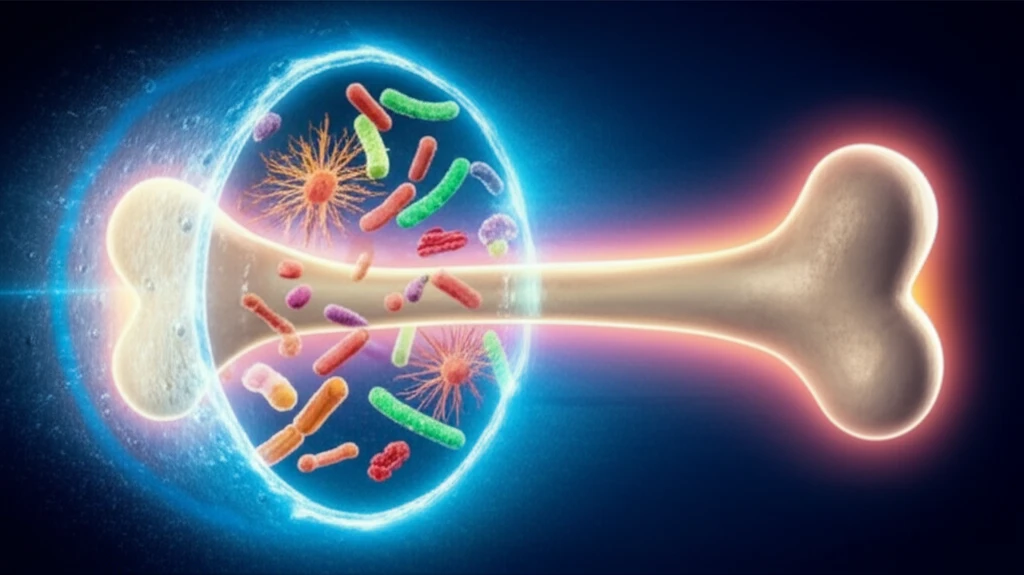
Gut Health Glow-Up: How Butyrate Boosts Your Bones

"New research reveals the surprising link between gut bacteria, butyrate production, and stronger bones, offering a natural approach to osteoporosis prevention."
Osteoporosis, characterized by weakened bones and increased fracture risk, poses a significant threat to public health. Traditional treatments have limitations, making the exploration of new, natural interventions crucial. Recent studies highlight the gut microbiome's surprising influence on bone health, with specific bacteria and their metabolic byproducts playing a vital role.
One such byproduct, butyrate, a short-chain fatty acid (SCFA) produced by beneficial gut bacteria, has emerged as a promising player in bone metabolism. While previous research touched on the connection between the gut and bone, a new study published in Immunity dives deep into the mechanisms through which butyrate stimulates bone formation.
This article unpacks the groundbreaking research, translating complex findings into accessible insights for anyone seeking to understand the gut-bone axis and its potential for natural osteoporosis prevention. Learn how butyrate, fueled by specific gut bacteria, orchestrates a symphony of cellular interactions to build stronger, healthier bones.
The Growing Butyrate Market
The global butyrate market has drawn significant commercial interest, though estimates vary between research firms. One report valued the market at approximately USD 285 million in 2024, projecting growth to USD 520 million by 2033 at a compound annual growth rate of 6.9%. Another analysis offered a considerably higher valuation of USD 1.20 billion in 2025, with a projected reach of USD 2.40 billion by 2033 at an 8.8% CAGR. These divergent figures likely reflect differences in market scope definitions and measurement methodologies across reporting agencies.
Measuring Butyrate: Analytical Methods and Their Constraints
Quantifying butyrate in biological and environmental samples requires specialized analytical techniques, with mass spectrometry paired with deuterated internal standards providing the precision needed for robust scientific investigation. Researchers also use metagenomic sequencing and 16S rRNA amplicon data to estimate butyrate production capacity from microbial community profiles, though both approaches face limitations in deriving complete functional information from fecal DNA. Selective butyrate production via anaerobic fermentation remains an area where optimal conditions and mechanisms are still being decoded, suggesting that current production methods are not yet fully refined.
From Chevreul to Chromatin Biology
Butyric acid was first observed in impure form in 1814 by French chemist Michel Eugène Chevreul, who had purified it sufficiently for characterization by 1818. The compound is naturally produced through gut flora-mediated fermentation of dietary fibers and is found in foods such as butter, cheese, legumes, fruits, nuts, cereals, and whole grains. A pivotal modern discovery established butyrate as a histone deacetylase inhibitor, promoting histone acetylation and influencing gene expression involved in cell differentiation and apoptosis.
Butyrate: The Bone-Building Gut Metabolite
The Immunity study, led by researchers at Emory University, investigated the impact of Lactobacillus rhamnosus GG (LGG), a common probiotic, on bone homeostasis in young mice. The findings revealed that LGG supplementation increased trabecular bone volume, the spongy inner part of bones, due to increased bone formation.
- Expands Treg Cell Pool: Butyrate increases the number of regulatory T cells (Tregs) in both the gut and bone marrow.
- Upregulates Wnt10b: Tregs stimulate CD8+ T cells to produce Wnt10b, an osteogenic Wnt ligand crucial for bone formation.
- Activates Wnt Signaling: Wnt10b activates Wnt signaling in osteoblasts, the bone-building cells, leading to increased bone formation.
Evolving Understanding of Butyrate's Role
Current research on butyrate's physiological roles continues to expand, though the pace and direction of findings remain subject to ongoing investigation. While early studies established butyrate as a key energy source for colonocytes and an HDAC inhibitor, the full spectrum of its systemic effects is still being mapped. Newer lines of inquiry are exploring connections between butyrate signaling and pathways beyond the gut, though these remain in relatively early stages of validation.
Limitations and Unresolved Questions
Despite promising findings, butyrate research faces legitimate challenges and areas of uncertainty. Quantification across studies is complicated by methodological differences, and translating in vitro or animal model results to human clinical outcomes has proven non-trivial. The assumption that higher butyrate levels universally correlate with better health outcomes may oversimplify a more complex biological picture that varies by individual and context.
Butyrate Among Short-Chain Fatty Acids
Butyrate is one of several short-chain fatty acids produced during gut fermentation, alongside propionate and acetate, each with distinct metabolic roles. While all three are considered important to gut health, butyrate has received particular attention for its anti-inflammatory properties and its role as a primary fuel source for colonocytes. However, comparative clinical data directly pitting these molecules against each other in bone health contexts remain limited, making definitive ranking difficult at present.
The Future of Bone Health: Targeting the Gut
This groundbreaking research opens new avenues for preventing and treating osteoporosis. By focusing on the gut microbiome and its production of butyrate, we may be able to develop more natural and effective interventions.
Pulling the Threads Together
The body of evidence linking butyrate to gut and systemic health has grown substantially, with researchers increasingly recognizing its multi-faceted biological roles. Expert commentary generally positions butyrate as a promising but not yet fully validated intervention for conditions extending beyond the gastrointestinal tract. As with many nutritional bioactives, the gap between mechanistic plausibility and robust clinical proof of efficacy remains an active area of scholarly discussion.
Where Butyrate Research May Be Headed
Future research directions likely include more rigorous clinical trials designed to establish causal links between butyrate supplementation and specific health outcomes. Advances in analytical methods and microbiome profiling may enable more precise characterization of individual butyrate production capacity. The development of targeted delivery systems and optimized fermentation strategies could also expand the practical applications of butyrate-based interventions.
Scaling Butyrate Interventions
Translating butyrate research into widely accessible health solutions faces several systemic hurdles, including standardization of production and quality control across supplement products. Individual variability in gut microbiome composition means that butyrate responses are unlikely to be uniform across populations. Additionally, regulatory frameworks for microbiome-targeted interventions are still evolving, creating uncertainty for both researchers and product developers.
Butyrate in Clinical Practice and Patient Lives
Short-chain fatty acids like butyrate, produced through gut microbiota fermentation of dietary fibers and proteins, are increasingly recognized as crucial to human health, with regulatory impacts on both gut and immune functions. A randomized, double-blind, placebo-controlled study conducted over six weeks evaluated the real-world effects of a butyrate supplement, representing a step toward clinical validation. Separately, one-year real-world data on adjunctive oral calcium butyrate at 900 mg per day found it to be safe and well tolerated, with improvements observed across clinical, biomarker, and endoscopic outcomes in patients treated with biologics and JAK inhibitors.
While further research is needed to fully understand the optimal strategies for boosting butyrate production, here are some potential approaches: <ul> <li><b>Probiotic Supplementation:</b> Consider incorporating LGG or other butyrate-promoting probiotics into your diet.</li> <li><b>Dietary Changes:</b> Consume a diet rich in fiber, prebiotics, and resistant starch to fuel butyrate-producing bacteria.</li> <li><b>Lifestyle Factors:</b> Manage stress and prioritize sleep, as these factors can influence the gut microbiome.</li> </ul>
The gut-bone axis is a fascinating area of ongoing research, and butyrate is just one piece of the puzzle. By embracing a holistic approach that considers the interplay between diet, gut health, and immunity, we can unlock new strategies for building stronger bones and preventing osteoporosis.