
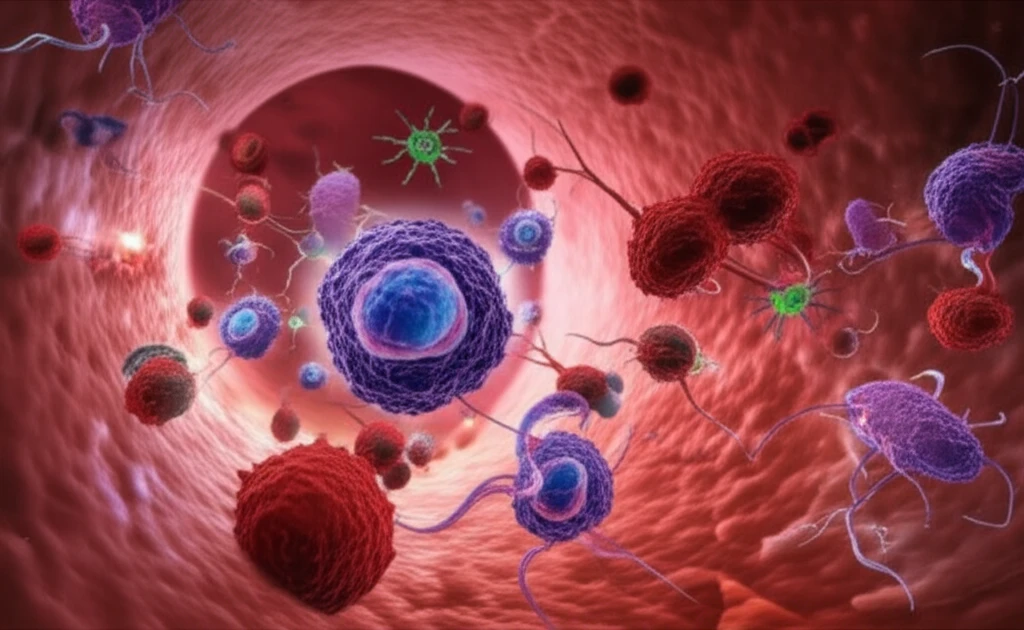
Specialized immune cells fighting colorectal cancer

Gut Guardians: How Specialized Immune Cells Fight Colorectal Cancer

"New research unveils how CD19loCD27hi plasmablasts use interleukin-10 to tame harmful inflammation and improve survival rates in colorectal cancer patients."


Colorectal cancer (CRC) is a major health challenge, and our immune system plays a complex role in its development. While much attention has been given to T cells, regulatory B cells (Bregs) are emerging as key players in controlling inflammation and influencing the course of the disease. Bregs are known to communicate with other immune cells and release substances that can dampen down excessive immune responses.

Previous studies have shown that the presence of certain immune cells, specifically CD20+ and CD138+ cells, in and around colorectal tumors is associated with better survival rates. Expanding on this, researchers have discovered that tumors in CRC patients are often rich in CD19loCD27hi plasmablasts, a unique type of Breg that produces interleukin-10 (IL-10). IL-10 is a powerful anti-inflammatory molecule, suggesting that these plasmablasts might be working to suppress harmful immune reactions within the tumor.

To understand the role of CD19loCD27hi plasmablasts in CRC, a new study has investigated how these cells function and what effects they have on other immune cells. The research focuses on how these plasmablasts, through the production of IL-10, can suppress inflammation and potentially improve outcomes in CRC patients.

Unlocking the Secrets of CD19loCD27hi Plasmablasts: A Step-by-Step Investigation

Specialized immune cells fighting colorectal cancer

To better understand these unique plasmablasts, the researchers first needed a way to study them in the lab. They developed a method to stimulate ordinary B cells from patient blood samples to transform them into cells resembling the tumor-infiltrating plasmablasts. This involved co-culturing the B cells with Caco-2 cells (a common colorectal cancer cell line) and heat-killed bacteria.

The researchers found that these lab-generated plasmablasts shared key characteristics with those found in actual tumors: they produced high levels of IL-10 and similar amounts of other substances. This allowed them to study the plasmablasts' effects on other immune cells, particularly T cells.

  • Suppressing Harmful Inflammation: The scientists discovered that CD19loCD27hi plasmablasts could significantly reduce the production of IL-17A, a molecule that promotes inflammation, by other immune cells.
  • Targeting a Key Inflammatory Driver: The plasmablasts also suppressed RORyt, a protein that drives the development of Th17 cells, which are major contributors to inflammation in CRC.
  • IL-10: The Key Mediator: Through experiments that blocked IL-10, the researchers confirmed that IL-10 production was the primary way these plasmablasts suppressed inflammation.
To confirm these findings in real patients, the researchers examined tumor samples and survival data. They found that patients with high levels of IL-10-producing CD19loCD27hi plasmablasts in their tumors had lower levels of IL-17A and lived longer. This suggests that these plasmablasts really do play a protective role in CRC by suppressing harmful inflammation.

The Promise of Immune-Based Therapies for Colorectal Cancer

This research highlights the potential of harnessing the immune system to fight colorectal cancer. By understanding how specific immune cells like CD19loCD27hi plasmablasts can suppress inflammation and improve outcomes, researchers can develop new therapies that boost these beneficial immune responses. Future studies will focus on how to enhance the activity of these plasmablasts or develop drugs that mimic their anti-inflammatory effects, offering new hope for more effective CRC treatments.

About this Article -

This article was crafted using a human-AI hybrid and collaborative approach. AI assisted our team with initial drafting, research insights, identifying key questions, and image generation. Our human editors guided topic selection, defined the angle, structured the content, ensured factual accuracy and relevance, refined the tone, and conducted thorough editing to deliver helpful, high-quality information.See our About page for more information.

Everything You Need To Know

1

What are CD19loCD27hi plasmablasts, and why are they important in colorectal cancer?

CD19loCD27hi plasmablasts are a specific type of regulatory B cell (Breg) found in colorectal tumors. These plasmablasts are unique because they produce high levels of interleukin-10 (IL-10), a powerful anti-inflammatory molecule. Their significance lies in their ability to suppress harmful immune reactions within the tumor, potentially improving outcomes for colorectal cancer patients. The presence of these plasmablasts, and the IL-10 they produce, are associated with lower levels of pro-inflammatory molecules and improved survival rates.

2

What is interleukin-10 (IL-10), and what role does it play in colorectal cancer?

Interleukin-10 (IL-10) is a molecule that has anti-inflammatory properties, and it is produced by CD19loCD27hi plasmablasts. It is important because it helps to dampen down excessive immune responses. IL-10 suppresses the production of molecules like IL-17A and inhibits proteins like RORyt, both of which contribute to inflammation in colorectal cancer. This suppression of inflammation is linked to improved outcomes for patients.

3

What are regulatory B cells (Bregs), and how do they relate to CD19loCD27hi plasmablasts?

Regulatory B cells (Bregs) are a type of immune cell that plays a crucial role in controlling inflammation. Unlike other immune cells that might promote inflammation to fight off threats, Bregs release substances that can dampen down excessive immune responses. This is particularly important in conditions like colorectal cancer, where uncontrolled inflammation can worsen the disease. CD19loCD27hi plasmablasts are a specific type of Breg, highlighting the diversity and specialized functions within the Breg cell population.

4

How exactly do CD19loCD27hi plasmablasts suppress inflammation in colorectal cancer, according to the research?

The research showed that CD19loCD27hi plasmablasts suppress inflammation by reducing the production of IL-17A, a molecule that promotes inflammation, and by targeting RORyt, a protein that drives the development of Th17 cells (major contributors to inflammation in CRC). The key mediator in this process is interleukin-10 (IL-10), produced by the plasmablasts. When IL-10 was blocked in experiments, the anti-inflammatory effects of the plasmablasts were significantly reduced, confirming IL-10's central role.

5

What are the potential implications of this research for developing new treatments for colorectal cancer?

The discovery of how CD19loCD27hi plasmablasts use interleukin-10 (IL-10) to suppress inflammation opens new avenues for developing immune-based therapies for colorectal cancer. By understanding how these immune cells can improve outcomes, researchers can explore ways to boost their activity or mimic their anti-inflammatory effects with drugs. Future treatments might focus on enhancing the function of these beneficial plasmablasts to create more effective strategies against colorectal cancer.

Newsletter Subscribe

Subscribe to get the latest articles and insights directly in your inbox.