
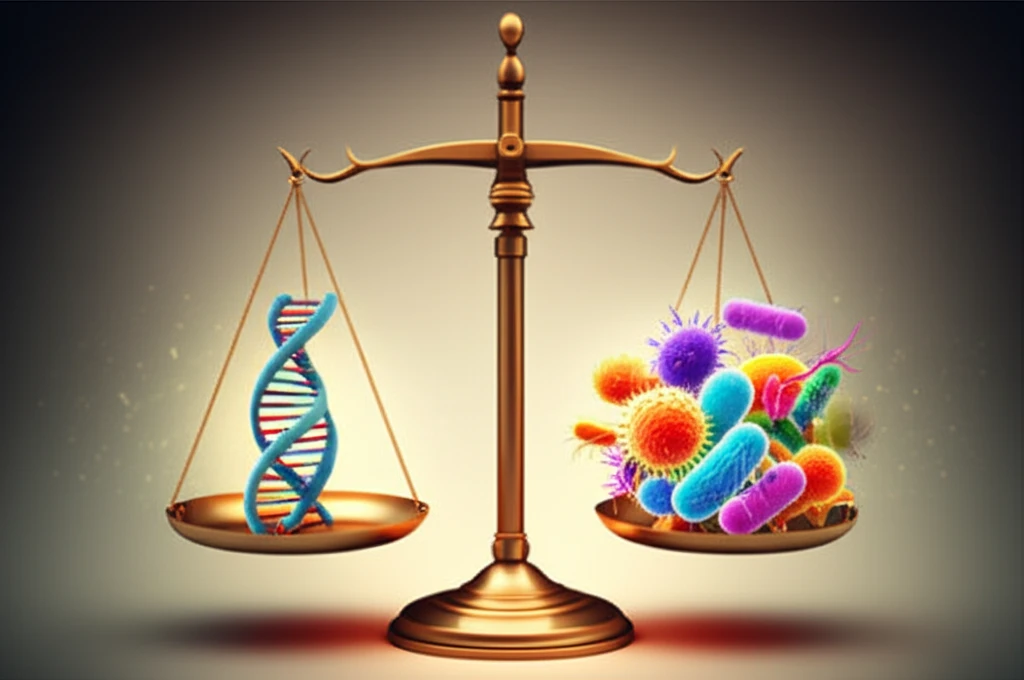
A balanced scale representing the influence of genes and gut microbiome on gut health.

Gut Check: How Your Microbiome and Genes Team Up Against Inflammation

"Unraveling the Mysteries of NOD2, Microbiota, and the Quest for a Balanced Immune System"


For years, scientists have been trying to understand why some people are more prone to inflammatory bowel diseases (IBD) like Crohn's disease. It turns out, it's not just about what you eat; your genes and the trillions of bacteria living in your gut, known as the microbiome, play starring roles.

Recent research has shone a spotlight on the NOD2 gene and its connection to gut health. NOD2 helps your body recognize and respond to bacteria. When this gene has mutations, it can disrupt the delicate balance of your gut's ecosystem, potentially increasing the risk of Crohn's disease. But there's more to the story than just genes.

This article dives into a fascinating study that explores how NOD2 deficiency interacts with variations in gut microbiota, favoring the expansion of specific regulatory cells that can influence inflammation. Understanding this complex relationship opens new doors for potential therapies aimed at re-establishing a healthy gut and taming inflammatory responses.

The NOD2-Microbiota Connection: A Balancing Act

A balanced scale representing the influence of genes and gut microbiome on gut health.

The study begins with a fundamental question: How does a faulty NOD2 gene affect the community of microbes living in the gut? Researchers used mice with and without a functioning NOD2 gene (Nod2-/- and Nod2+/+, respectively) to investigate this link. They analyzed the gut microbiota composition of these mice under different conditions, including when the mice were housed separately or together (co-housed) and after inducing colitis, an inflammation of the colon.

What they discovered was that NOD2 deficiency leads to distinct changes in the gut's microbial makeup. Specifically, Nod2-/- mice tended to have an enrichment of bacteria from the Rikenellaceae family, including Rikenella and Alistipes. Interestingly, this microbial shift was associated with an increased proportion of CD4+ LAP+ Foxp3- regulatory cells in the gut lining.

  • Rikenellaceae Enrichment: Higher levels of Rikenella and Alistipes in Nod2-/- mice.
  • Regulatory Cell Expansion: Increased proportion of CD4+ LAP+ Foxp3- regulatory cells, which help to suppress inflammation.
  • Reduced Colitis Severity: Nod2-/- mice initially experienced less severe colitis.
The researchers also found that environmental factors, particularly housing conditions, significantly impacted these interactions. When Nod2+/+ mice were co-housed with Nod2-/- mice, they acquired some of the Rikenellaceae bacteria and exhibited an increase in CD4+ LAP+ Foxp3- cells, suggesting that the gut microbiota can be transferred and influence the immune system.

Re-establishing Harmony: A Potential Therapeutic Avenue

This research provides a compelling argument that the gut microbiome is a key player in the development and management of inflammatory bowel diseases. It emphasizes that simply targeting genes like NOD2 might not be enough; we also need to consider the complex interactions within the gut's microbial community.

The study suggests a potential therapeutic avenue: re-establishing eubiosis, or a balanced gut microbiome, in individuals with NOD2 polymorphisms. This could involve strategies like:

<ul> <li>Targeted probiotics: Introducing beneficial bacteria like Alistipes or those that promote CD4+ LAP+ Foxp3- cell expansion.</li> <li>Dietary interventions: Consuming foods that support a healthy gut microbiome.</li> <li>Fecal microbiota transplantation (FMT): Transferring a healthy gut microbiome from a donor to a recipient.</li> </ul>

About this Article -

This article was crafted using a human-AI hybrid and collaborative approach. AI assisted our team with initial drafting, research insights, identifying key questions, and image generation. Our human editors guided topic selection, defined the angle, structured the content, ensured factual accuracy and relevance, refined the tone, and conducted thorough editing to deliver helpful, high-quality information.See our About page for more information.

This article is based on research published under:

DOI-LINK: 10.1038/s41598-018-32583-z, Alternate LINK

Title: Nod2 Deficiency In Mice Is Associated With Microbiota Variation Favouring The Expansion Of Mucosal Cd4+ Lap+ Regulatory Cells

Subject: Multidisciplinary

Journal: Scientific Reports

Publisher: Springer Science and Business Media LLC

Authors: A. Butera, M. Di Paola, L. Pavarini, F. Strati, M. Pindo, M. Sanchez, D. Cavalieri, M. Boirivant, C. De Filippo

Published: 2018-09-24

Everything You Need To Know

1

What exactly does the NOD2 gene do in the gut, and how do mutations in this gene affect the gut's ecosystem?

The NOD2 gene plays a crucial role in helping the body recognize and respond to bacteria. When the NOD2 gene has mutations, it can disrupt the balance of the gut's ecosystem. Research indicates that NOD2 deficiency leads to distinct changes in the gut's microbial makeup, such as an enrichment of bacteria from the Rikenellaceae family, including *Rikenella* and *Alistipes*. This microbial shift is associated with an increased proportion of CD4+ LAP+ Foxp3- regulatory cells in the gut lining, which can influence inflammation. This can alter the normal immune response in the gut.

2

What were the key differences in the gut microbiota composition and immune response observed in mice with and without a functioning NOD2 gene (Nod2-/- and Nod2+/+)?

The research showed that mice deficient in NOD2 (Nod2-/-) tended to have higher levels of bacteria from the Rikenellaceae family, including *Rikenella* and *Alistipes*. These mice also exhibited an increased proportion of CD4+ LAP+ Foxp3- regulatory cells. These regulatory cells help suppress inflammation. Interestingly, Nod2-/- mice initially experienced less severe colitis, an inflammation of the colon.

3

How did environmental factors, such as housing conditions, impact the interactions between the NOD2 gene and gut microbiota in the study?

The study found that when Nod2+/+ mice were co-housed with Nod2-/- mice, they acquired some of the Rikenellaceae bacteria. This acquisition led to an increase in CD4+ LAP+ Foxp3- cells in the Nod2+/+ mice. This suggests that the gut microbiota can be transferred between individuals and that this transfer can influence the immune system, highlighting the impact of environmental factors on gut health.

4

What are the implications of this research for developing new therapies for inflammatory bowel diseases (IBD), and why is it important to consider the gut microbiome?

The findings emphasize that simply targeting genes like NOD2 might not be sufficient. We also need to consider the complex interactions within the gut's microbial community to manage inflammatory bowel diseases effectively. Future therapeutic strategies could involve manipulating the gut microbiome to re-establish a healthy balance and promote the growth of beneficial bacteria, potentially leading to more effective treatments for IBD and related conditions.

5

What role do CD4+ LAP+ Foxp3- regulatory cells play in the gut, and why was there an increased proportion of these cells in Nod2-/- mice?

Regulatory cells like CD4+ LAP+ Foxp3- cells help to suppress inflammation in the gut. The increase in these cells observed in Nod2-/- mice suggests a compensatory mechanism to counteract the potential for increased inflammation due to NOD2 deficiency. By expanding these regulatory cells, the body may be attempting to maintain a balance and prevent excessive inflammation in the gut lining. Further research is needed to fully understand the long-term effects and implications of this expansion.

Newsletter Subscribe

Subscribe to get the latest articles and insights directly in your inbox.