
Gut Check: How Your Body's Fat Absorption System Could Be the Key to Better Health

"New research uncovers the hidden role of VEGFR-3 signaling in regulating triglyceride retention and absorption in the intestine, potentially unlocking future treatments for metabolic disorders."
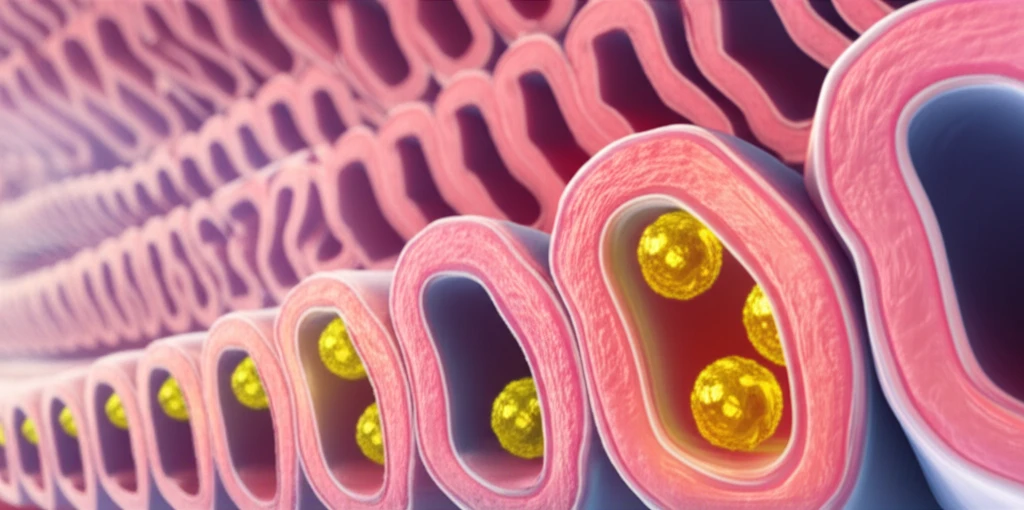
Imagine a sophisticated highway system inside your body, dedicated to transporting fats from the food you eat to where they're needed for energy and other essential functions. This system relies on tiny vessels in your intestines called lacteals, which absorb dietary fats packaged as chylomicrons. For years, scientists believed this was a passive process, but now they're discovering it's a highly regulated and dynamic operation.
At the heart of this regulation is a crucial molecule called Vascular Endothelial Growth Factor-C (VEGF-C). This major lymphangiogenic factor is known to maintain lacteal function, but the precise role of its partner, the tyrosine kinase VEGF receptor 3 (VEGFR-3), in fat absorption has remained a mystery. New research is shedding light on this critical interaction.
A recent study published in Frontiers in Physiology has uncovered how VEGFR-3 signaling plays a pivotal role in triglyceride (TG) absorption and distribution within the body. The research team used a unique mouse model, called Chy, with a specific mutation that inactivates VEGFR-3. The results revealed a surprising connection between VEGFR-3 signaling and how our bodies process dietary fats, offering new insights into potential therapeutic targets for metabolic disorders.
Why Fat Absorption Matters
Fat absorption is a central part of how the body obtains energy and handles dietary lipids. Its effects may extend beyond digestion because lipid processing is connected with broader metabolic health. The scale and impact of these relationships remain areas of active study.
A Complex Biological Process
The body's fat-absorption system depends on multiple coordinated steps rather than a single mechanism. This makes it difficult to reduce the process to one universally effective intervention or dietary rule. Accepted approaches may therefore help some people while offering limited insight into individual differences.
From Intestine to Circulation
Lipid absorption involves uptake across the brush border membrane into enterocytes, followed by intracellular transfer to metabolic sites or movement across the basolateral membrane into lymph or portal blood. Dietary lipids are also important energy sources; one cited overview reports that fats provide 9 calories per gram and that dietary lipids are generally recommended to supply 20–35% of daily calories. More recent work has focused on triglyceride-rich lipoproteins, which transport bulk lipids into circulation and are produced, secreted, and regulated through several mechanisms.
The VEGFR-3 Connection: How it Impacts Fat Processing
The study's findings revealed that when VEGFR-3 is not functioning correctly, it leads to a cascade of effects that disrupt the normal fat absorption process. Specifically, the researchers observed:
- Fat Retention: Triglycerides tend to accumulate within the cells lining the small intestine (enterocytes).
- Reduced Plasma TG Levels: After a meal, the levels of triglycerides in the blood are lower than normal.
- Increased Fecal Excretion: More free fatty acids (FFAs) and triglycerides are excreted in the stool.
- Nitric Oxide Reduction: Levels of nitric oxide (NO), a molecule needed for chylomicron mobilization, are significantly reduced in the intestine after a fat-rich meal.
New Research on Triglyceride Absorption
Recent reviews examine how dietary triglyceride absorption may contribute to obesity and metabolic diseases. They describe intestinal lipid absorption as an orderly but complex series of steps, rather than a simple transfer of fat into the body. Other recent work is addressing hypertriglyceridemia and current and emerging therapies, while a Cell Reports study reports that intestinal HuR promotes fat absorption by regulating DGAT2, MGAT2, and APOB.
Limits of Simple Solutions
Fat absorption cannot be treated as a one-dimensional health target because it supports essential energy needs while also being studied in connection with metabolic disease. Interventions that alter absorption may therefore involve trade-offs, and their effects may not be uniform across people. The available evidence also does not establish that changing absorption alone is a complete solution for obesity or other metabolic conditions.
Different Ways to View Fat Absorption
One perspective emphasizes fat absorption as a necessary source of energy and nutrient handling. Another focuses on how the same system may influence obesity, triglyceride disorders, and related metabolic problems. Comparing these perspectives suggests that the biological process is neither inherently beneficial nor harmful; its significance depends on the broader metabolic context.
The Future of Fat Absorption Research: Targeting VEGFR-3
This research opens up new avenues for understanding and potentially treating metabolic disorders related to fat malabsorption. By identifying VEGFR-3 signaling as a key regulator in this process, scientists can now focus on developing targeted therapies to improve fat processing in the gut.
Structure Shapes Absorption
Triglyceride-rich lipoproteins include chylomicron remnants produced by intestinal cells from dietary lipid and very low-density lipoproteins synthesized by the liver. Their triglyceride is processed by an enzyme that trims triglyceride from these particles. Fat structure also matters: the stereospecific placement of fatty acids on triacylglycerol can influence absorption, and long-chain fatty acids in the external sn-1 and sn-3 positions may impair fat absorption and alter the physiological response to dietary fats.
Research and Market Directions
Future research is likely to continue examining how dietary triglyceride absorption relates to obesity and metabolic diseases. Commercial interest is also expanding: one market report forecasts lipid-market trends and competitive developments through 2035. Another report highlights medium-chain triglyceride supplements linked to ketogenic-diet adoption and cognitive-enhancement trends, as well as phospholipid formulations aimed at cellular membrane optimization.
Lipid Metabolism and Disease
Lipid metabolism is essential for cellular homeostasis, but its disruption has been linked to cancer, cardiovascular disease, and diabetes. Dietary fats, especially triglycerides, are absorbed through a series of coordinated intestinal steps. Research on this system therefore sits at the intersection of basic physiology, nutrition, and chronic-disease biology.
Triglycerides in Everyday Health
A National Lipid Association case study examines aerobic exercise and triglyceride reduction. It presents elevated triglycerides as an independent cardiovascular risk that deserves attention. The case study connects a real-world exercise intervention with the broader goal of reducing cardiovascular risk.
One potential strategy could involve finding ways to enhance VEGFR-3 signaling in individuals with impaired fat absorption. This might involve developing drugs or other interventions that stimulate VEGFR-3 activity or increase the production of nitric oxide, which is essential for chylomicron mobilization.
While more research is needed to fully understand the implications of these findings, this study provides a valuable foundation for future investigations into the role of VEGFR-3 in metabolic health. By unlocking the secrets of fat absorption in the gut, we may be able to develop new strategies to combat obesity, improve nutrient utilization, and promote overall well-being.