
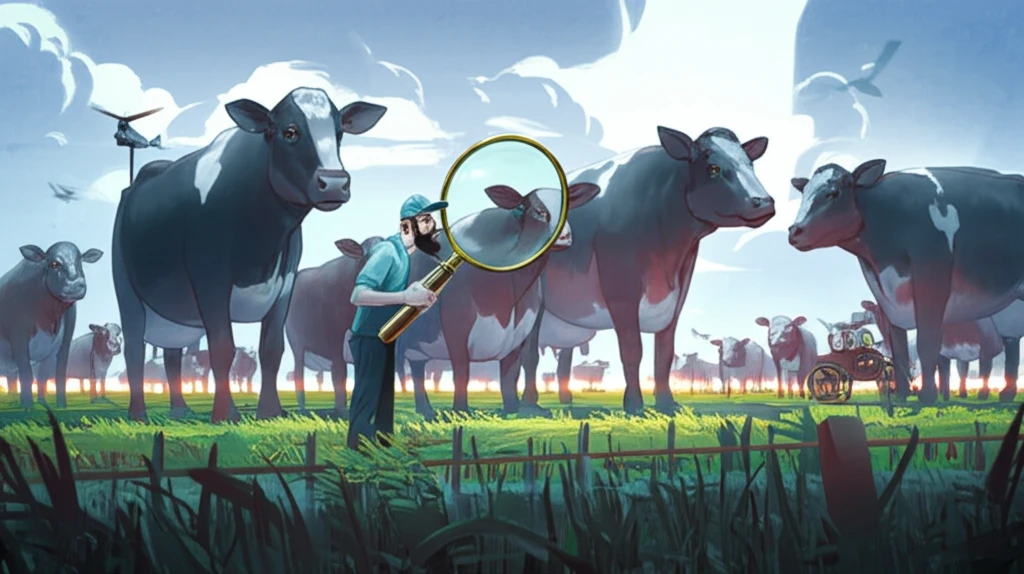
Growing Pains? How to Optimize Inventory with Imperfect Items and Livestock

"Tired of inventory models that don't reflect real life? Discover a new approach to manage growing items like livestock with imperfect quality and boost your bottom line."
Traditional inventory management models often fall short when applied to industries dealing with growing items, like livestock. These models typically assume static inventory and perfect quality, failing to capture the dynamic nature of biological growth and the inevitable presence of variations in quality. The classic Economic Order Quantity (EOQ) model, while foundational, needs adaptation to address these complexities.
Imagine managing a livestock farm. Newborn animals are ordered, nurtured, and grow over time, but not all reach the desired quality. Some may be healthier, gain weight faster, or meet market standards better than others. This inherent variability challenges conventional inventory strategies, demanding a more nuanced approach.
This article explores an enhanced inventory model designed specifically for growing items with quality variations. It will help you understand how to optimize inventory levels, manage costs, and maximize profit when dealing with the dual challenges of biological growth and imperfect quality. Prepare to discover actionable strategies that can transform your inventory management from a guessing game into a science.
Livestock Inventory at Scale: The Numbers Behind U.S. Agribusiness
The USDA's National Agricultural Statistics Service publishes biannual reports containing inventory numbers, values, and size group estimates for all cattle and calves across the United States, broken down by class and state. These data sets also include statistics on cattle on feed, small grain pasture grazing, and calf crop data, providing a comprehensive snapshot of the nation's livestock holdings. For agribusinesses, accurate livestock counts are the backbone of successful operations, underpinning strategic planning, resource allocation, regulatory compliance, traceability, and financial decision-making. The scale of this data—spanning millions of head across thousands of operations—underscores why reliable inventory management is foundational to the livestock sector's economic health.
How Livestock Inventory Is Managed Today—and Where It Falls Short
Livestock management systems encompass a range of practices addressing herd size, resource availability, and the roles of individuals in tasks such as feeding, sanitation, and animal care. Modern approaches increasingly incorporate identification, vital signs monitoring, and location tracking technologies to improve oversight and data accuracy. However, traditional inventory management methods—including manual record-keeping and spreadsheet-based systems—are widely acknowledged to be prone to errors and inefficiencies. These legacy approaches struggle to keep pace with the complexity and volume of data generated in contemporary livestock operations, highlighting a growing need for more robust, digitally integrated solutions.
A Brief Look at Livestock Inventory History
While the precise milestones that shaped modern livestock inventory management are difficult to pin down without dedicated historical research, the evolution from manual headcounts and paper ledgers to digital tracking systems has been a defining arc in agricultural practice. Government efforts to systematically catalog livestock populations—such as those maintained by the USDA over many decades—represent foundational steps in establishing standardized methods. The shift toward technology-assisted monitoring and data-driven decision-making accelerated in recent decades, but the journey from informal record-keeping to today's sophisticated systems has been gradual and uneven across the industry.
What Factors Should You Consider When Managing Growing Inventory?
Managing growing inventory requires a more sophisticated approach that considers several key factors. Unlike static items, growing inventory changes in quantity and quality over time, introducing complexities that standard models overlook.
- Growth Rate: Understanding the growth patterns of your items is crucial. Is the growth linear, exponential, or logistic? Different growth curves impact how you forecast inventory levels and plan replenishment cycles.
- Quality Variation: Acknowledge that not all items will meet the desired quality standards. Implement screening processes to identify and separate high and low-quality items, and adjust your inventory strategy accordingly.
- Feeding Costs: For livestock, feeding costs represent a significant portion of the total cost. Optimize feeding strategies to balance growth and cost-effectiveness.
- Holding Costs: Consider the costs associated with storing and maintaining your inventory. These costs can vary depending on the item's size, weight, and storage requirements.
- Demand: Accurately forecasting demand is essential to avoid shortages or overstocking. Account for seasonal variations and market trends.
Where Current Research Stands
Research into livestock inventory optimization remains an active and evolving field, though specific recent findings and systematic reviews were not available in the sources examined for this section. The broader literature suggests continued interest in integrating sensor technologies, data analytics, and digital management platforms to address longstanding inefficiencies. Without access to dedicated recent studies or reviews, definitive claims about the state of the art in this area should be treated as tentative and subject to further verification through peer-reviewed sources.
When Inventory Optimization Doesn't Deliver
The promise of optimized livestock inventory management is not without its skeptics and practical failures. While specific counterarguments and documented failures were not available in the sources reviewed for this section, the general challenge of technology adoption in agriculture—including high costs, infrastructure gaps, and resistance to change among producers—is well recognized across the industry. It is reasonable to expect that some inventory management solutions have fallen short of their goals, particularly in smaller or resource-limited operations where the investment may not yield proportionate returns.
Comparing Inventory Approaches Across Operations
Comparative analysis of livestock inventory methods across different scales, regions, and production systems is an area where more structured research would add significant value. The sources reviewed for this section did not provide specific comparative data, but the diversity of livestock operations—from small family farms to large industrial enterprises—suggests that no single inventory approach is universally optimal. Factors such as herd size, species mix, geographic constraints, and available technology all influence which inventory management strategy is most effective.
Future of Inventory for Growing Items
This enhanced inventory model offers a practical solution for managing growing items with quality variations. By considering factors like growth rate, quality, and costs, businesses can optimize their inventory strategies and maximize profitability. Future research could explore incorporating more advanced factors such as time-sensitive inflation, trade credit, and fluctuating demand to create even more accurate models.
Pulling the Threads Together
The challenge of optimizing livestock inventory with imperfect items—animals that vary in health, age, productivity, and market value—sits at the intersection of data science, animal husbandry, and supply chain management. While the sources reviewed for this section did not include dedicated expert commentary, the broader picture that emerges is one of an industry in transition. Traditional methods are being supplemented, though not yet universally replaced, by digital tools and analytics-driven approaches. The gap between what is technically possible and what is widely adopted in practice remains a defining tension in the field.
What's Next for Livestock Inventory Management
The USDA's August 2025 Livestock, Dairy, and Poultry Outlook projects a 4 percent year-over-year decline in U.S. beef production for 2025, with output lowered to 25.926 billion pounds due to slower-than-expected cattle slaughter and lower carcass weights. This tightening of supply underscores the importance of efficient inventory management as producers navigate shifting market conditions. Industry forecasts point to significant growth in the livestock management software and monitoring markets through 2026 and beyond, driven by demand for efficiency gains and sustainability improvements. The livestock industry continues to evolve rapidly as technology advances and sustainability pressures intensify, suggesting that smart, data-driven practices will become increasingly central to operational strategy.
The Bigger Picture: Systemic Challenges in Livestock Inventory
Meeting the food demands of a growing global population without degrading the natural systems we depend on is one of the defining challenges of our time, and livestock management sits squarely at the center of it. This requires more than incremental fixes—it demands long-term planning, coordinated global action, and a clear vision for where livestock management needs to go. For livestock production managers, inventory management is a strategic function that directly impacts profitability and animal welfare, extending beyond mere tracking of inputs. Efficient management of supplies—from feed and medications to equipment—has tangible effects on both the bottom line and animal health outcomes.
Inventory Management in Practice: Lessons from the Field
Real-world case studies consistently demonstrate that strategic inventory management can boost efficiency and profitability, though the specifics vary widely across industries and operational contexts. In livestock operations, the human element—from daily decision-making by producers to cross-functional coordination among managers—plays a critical role in whether inventory systems succeed or fail. The transition from manual tracking to data-driven, mobile-enabled systems reflects a broader trend toward digital integration that has reshaped inventory practices across sectors. These real-world examples underscore that technology alone is not a silver bullet; successful implementation depends on aligning tools with the practical realities of the people who use them every day.