
Balancing Act: How Cattle Grazing Can Coexist with Forest Health

"Discover sustainable grazing practices that protect Argentina's Nothofagus forests, ensuring biodiversity and economic stability."
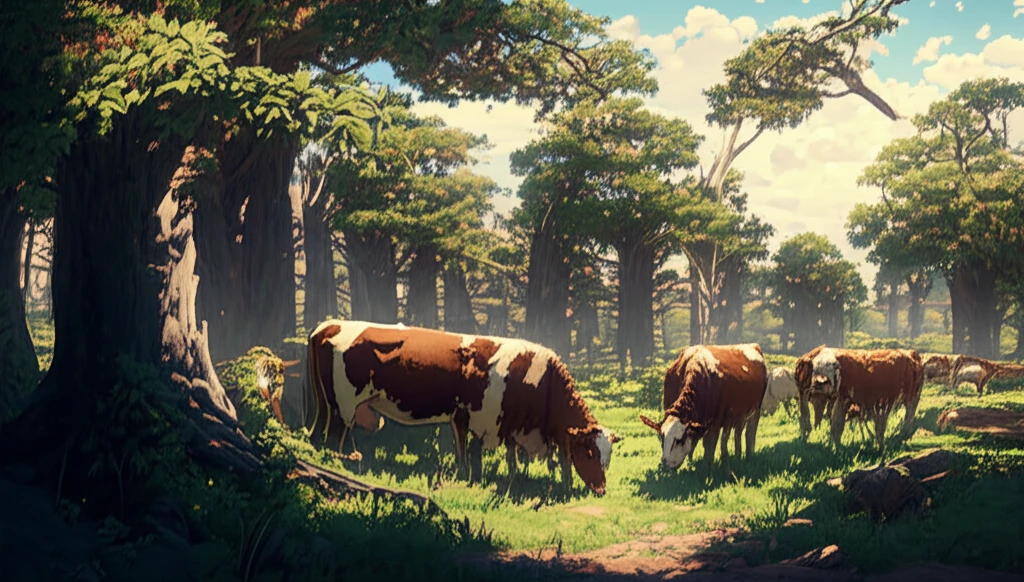
In the Argentinian province of Chubut, the landscape is defined by a delicate balance. Here, extensive cattle rearing, a cornerstone of the local economy, intertwines with the region’s unique Nothofagus antarctica forests, also known as ñire. These silvopastoral systems, where livestock graze under the forest canopy, face a critical challenge: how to reconcile the economic benefits of cattle grazing with the long-term health and sustainability of these precious woodlands.
Cattle browsing can inflict damage on young ñire trees, hindering regeneration and threatening the very existence of these forests. The crux of the matter lies in finding a harmonious middle ground, a management approach that allows both cattle and trees to thrive. Researchers have been diligently investigating this issue, seeking to understand how grazing intensity and tree height influence the regeneration of ñire forests. Their goal? To develop strategies that ensure both sustainable livestock production and the preservation of these vital ecosystems.
This article delves into a compelling study conducted in Chubut, Argentina, examining the effects of cattle browsing on ñire tree regeneration. By exploring the relationship between cattle stocking rates, tree height, and forest health, we uncover valuable insights into achieving a sustainable balance. Join us as we explore the innovative approaches that could safeguard these unique landscapes for generations to come.
Data-Driven Grazing for Tough Times
Advances in remotely sensed data and enhanced access to them by ranchers and public land managers are improving calculations of stocking rates across vast rangeland environments, according to Washington State University researchers. The hunger for such tools is evident: a field day on sustainable grazing drew huge numbers of farmers looking to combat dry conditions. Consistent pasture growth is described as the lifeblood of profitable dairy and beef farming, and optimized grazing management can significantly increase pasture production while enhancing sustainability. Alongside these practical measures, researchers are exploring "regenerative" protocols that seek to mimic the structure and functions of wild grazing ecosystems as a way to restore functionality to agricultural grazing land.
Rotational Methods and Their Biodiversity Ceiling
Rotational grazing, which divides pasture into sections and rotates animals to prevent overgrazing and allow grass regeneration, is the standard approach for most farms seeking balanced production and soil health. Cell grazing offers an even finer-grained variant, with many small paddocks that allow precise control of rest periods. Practitioners can gauge limits in the field using simple indicators such as ground cover or leaf area index to identify sustainable grazing thresholds. Yet research suggests biodiversity sets a hard ceiling: with biodiversity-friendly grazing intensities of 0–20% biomass removal depending on aridity, production would fall to 9–13% and 26–40% of current grassland-based milk and meat output, respectively.
A Centuries-Old Practice, Formally Stewarded
Domestic livestock have been grazing western landscapes for centuries, with herders tending flocks on national grasslands such as North Dakota's Sheyenne National Grassland. Grazing lands still cover about 40% of the United States, encompassing iconic ecosystems and important wildlife habitat. A notable modern milestone is the use of grazing as a management tool in place of herbicide: a University of Maryland study of prescribed grazing to control common reed in Maryland wetlands is one of the first of its kind in the U.S., preceded by only one published North American study that used goats. At a smaller scale, grazing sheep between vineyard rows is now part of a sustainable farming approach that keeps weeds down and soil healthy.
The Science of Coexistence: Grazing and Forest Regeneration
The study, conducted across three livestock rearing settlements in Chubut, focused on how cattle browsing impacts ñire tree regeneration over time, relative to both stocking rate and plant height. The findings reveal that managing cattle under low stocking rates during the summer months (less than 0.4 livestock units per hectare) allows young trees to escape the brunt of browsing, provided they reach a minimum average height of 1.6 meters. Under these conditions, ñire saplings demonstrate a remarkable ability to tolerate grazing, exhibiting compensatory growth to recover from the plant structures removed by cattle.
- Low stocking rates promote sapling survival.
- Saplings exhibit compensatory growth under controlled grazing.
- High stocking rates suppress tree regeneration.
- Long-term exclusions may be required for recovery in overgrazed areas.
Modeling, Reviews, and Climate Stress
Recent grazing research leans heavily on modeling and systematic review. The Sustainable Grazing Systems Pasture Model simulated the growth of three pasture species differing in root depth and root distribution under three climate scenarios at two sites. On the Qinghai-Xizang Plateau, a new study integrates the latest findings to review the multidimensional impacts of grazing on alpine grassland ecosystems and their sustainable management, providing a scientific basis for policy. A systematic review of livestock grazing's effects on soil erosion tracks key trends, shows how different grazing intensities affect soil, pinpoints knowledge gaps, and identifies practical strategies to reduce erosion. A systems-based analysis also explores whether holistic grazing management can serve as a scalable niche for greater resilience and sustainability in an era of climate change.
Anecdote Versus Management Failure
Some scientists rebuke grazing critics who, in the words of one account, rely on speculative anecdotes to discredit an industry rooted in what large mammals naturally do: graze. At the same time, real failures are not hard to find, and they are usually attributable to management rather than grazing per se. Overgrazing is often a function of time, not just animal numbers, so allowing animals to graze too long or returning them before vegetation recovers represents a failure of grazing strategy, compounded by poor land management planning and insufficient education. The corrective, according to agricultural media, is a definition of sustainable grazing that balances the needs of livestock with the wellbeing of the pasture.
Rotational, Rational, and Silvopastoral Alternatives
Head-to-head comparisons of grazing systems reveal consistent advantages for managed alternatives over continuous grazing. One estimate holds that rotational grazing can increase pasture productivity by up to 30% compared with continuous systems. Voisin Rational Grazing is likewise advanced as a sustainable alternative that promotes highly sustainable animal productivity and farm profitability while maintaining a positive environmental footprint. Studies comparing alternative to traditional management also find generally greater understorey floristic species richness and diversity under alternatives, though outcomes depend on the season and scale of sampling. Separate analyses weigh silvopasture against traditional grazing across environmental impact, economic benefits, and livestock health and well-being.
Looking Ahead: Sustainable Land Management in Practice
The insights gleaned from this research offer a pathway towards more sustainable land management practices in the Patagonian region. By implementing adaptive strategies that consider both ecological and economic factors, stakeholders can work together to create resilient landscapes that benefit both nature and local communities. Monitoring sapling height and adjusting stocking rates as needed will be critical to maintaining the delicate balance between cattle grazing and forest health. Ultimately, the future of Chubut’s Nothofagus forests depends on a commitment to sustainable practices that prioritize long-term ecological integrity.
Vetting the Expertise Behind the Models
Expert opinion is commonly used to parameterize models of herbivory, which is why researchers set out to assess its quality, seeking expert views on seasonal sheep preferences for plant species and seasonal plant response to grazing. The same study, available through multiple academic repositories, underscores that the reliability of grazing models depends on the reliability of the expert judgments feeding into them. Practical synthesis of research on sheep systems points toward integrated management: sustainable sheep production combines low-cost feeding and housing, controlled grazing, creation of high-quality pastures, and integrated management of diseases and parasites.
Climate Projections, Technology, and Standards
Climate projections are reshaping where sustainable grazing will be viable. Research on the Qinghai-Xizang Plateau finds that projected humidification under future climate change can increase gross primary productivity, thereby expanding sustainable grazing areas in the plateau's drylands. Institutional alignment is also advancing: as a founding member of the U.S. Roundtable for Sustainable Beef, The Nature Conservancy is working alongside industry leaders to embed conservation into beef production. On the ground, future trends include wider adoption of smart technology such as drones and AI for efficient land monitoring, a growing emphasis on rotational grazing and soil conservation, and expanded farmer education programs.
Variability, Ecosystem Services, and Support Networks
Because grazing systems differ strongly in management intensity and outcomes, land-use researchers define sustainable grazing as grazing that benefits multiple environmental ecosystem services. Variability is the central systemic challenge: in northern Australia, rainfall variability is a major obstacle to sustainable grazing management, further complicated by large, spatially heterogeneous paddocks, and the latest evidence offers recommendations for managing temporal and spatial variability. Broader support infrastructure matters too, with organizations such as American Farmland Trust promoting sustainable grazing as part of protecting water, soil, and farm businesses.
Practitioners, Tools, and Collaboration
On the ground, real-world case studies document the transformative power of rotational grazing, but practitioners stress that success hinges on robust grazing monitoring techniques and the ability to adapt plans in real time, aided by grazing management apps and similar tools. The underlying science has likewise shaped practice: the intermediate disturbance hypothesis and grazing optimization theory have had profound impacts on the study and conservation of grassland biodiversity and productivity. The human element extends to cooperation, as documented in a case study of collaborative groups working on sustainable grazing issues, published in the journal Human-Wildlife Interactions.