
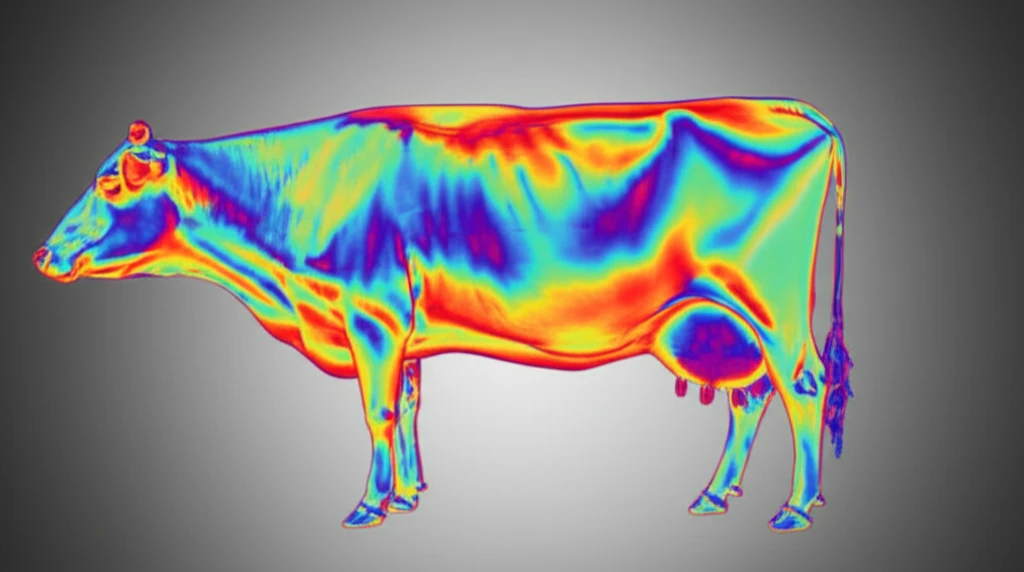
Infrared thermography image of a dairy cow's udder showing potential mastitis inflammation.

Got Mastitis? Infrared Tech Offers New Insights for Dairy Farmers

"Explore how infrared thermography (IRT) can complement traditional methods for detecting and managing mastitis in dairy cows."


Mastitis remains a persistent challenge for dairy farmers, impacting milk quality and animal health. Early and accurate detection is crucial for effective treatment and prevention. While traditional bacteriological methods are the gold standard, researchers are exploring alternative tools to aid in the fight against this costly disease.

One such tool is infrared thermography (IRT), which measures surface temperature. The idea is that inflammation caused by mastitis might cause temperature changes detectable by IRT. While IRT is non-invasive and quick, its reliability in detecting mastitis needs careful evaluation.

This article delves into a study that compared IRT readings with bacteriological results obtained from CHROMagar Mastitis plates and the PathoProof Mastitis Complete-16 Kit. By analyzing the association between these methods, we can gain a better understanding of IRT's potential as a complementary tool for mastitis detection and management.

IRT vs. Traditional Methods: A Closer Look

Infrared thermography image of a dairy cow's udder showing potential mastitis inflammation.

The study evaluated individual mammary quarters (n = 23) with subclinical mastitis from two dairy herds in Puerto Rico. Milk samples were collected and analyzed using both traditional bacteriological methods (CHROMagar and PathoProof kits) and IRT. Temperature and relative humidity were also recorded to assess their influence on IRT readings.

The researchers used statistical analysis to determine differences in IRT readings and somatic cell count (SCC) based on bacteriological results. Somatic cell count is also an indicator of Mastitis. The aim was to see if IRT could reliably differentiate between quarters with and without mastitis pathogens.

  • The study found no significant differences in logSCC and IRT between the two herds.
  • No differences in IRT or logSCC were found when mastitis pathogens were isolated using the PathoProof-16 or CHROMagar.
  • IRT readings were affected by relative humidity but not by ambient temperature.
  • Only 34.78% of bacteriological results concurred among them. The CHROM and PtoPrf-16 tests can identify 10 and 15 different mastitis pathogens, respectively.
The study revealed a limited association between IRT readings and bacteriological findings. While IRT was influenced by relative humidity, it did not consistently align with the presence or absence of mastitis pathogens detected by traditional methods. The researchers concluded that more data is needed to fully characterize the use of IRT as a tool to discriminate quarters with mastitis, and that the discrepancies among bacteriological results among CHROM vs. PtoPrf-16 suggest that additional studies are required to further characterize these differences.

The Future of Mastitis Detection: Integrating Technology

While this study suggests that IRT alone may not be sufficient for accurate mastitis detection, it doesn't negate its potential as part of a comprehensive approach. Future research should focus on refining IRT techniques, considering environmental factors, and combining IRT with other diagnostic tools for improved accuracy.

The discrepancies observed between the two bacteriological methods highlight the complexities of mastitis diagnosis. Further investigation into the specific pathogens involved and their impact on milk quality is warranted.

For dairy farmers, this research underscores the importance of a multifaceted approach to mastitis management. While IRT may offer some benefits, relying solely on this technology is not recommended. Traditional bacteriological methods remain essential for accurate diagnosis, and proactive measures to minimize environmental risk factors are crucial for preventing mastitis outbreaks.

About this Article -

This article was crafted using a human-AI hybrid and collaborative approach. AI assisted our team with initial drafting, research insights, identifying key questions, and image generation. Our human editors guided topic selection, defined the angle, structured the content, ensured factual accuracy and relevance, refined the tone, and conducted thorough editing to deliver helpful, high-quality information.See our About page for more information.

Everything You Need To Know

1

What is mastitis and why is it important?

Mastitis is a persistent challenge for dairy farmers, impacting milk quality and animal health. Early and accurate detection is crucial for effective treatment and prevention. Traditional bacteriological methods are the gold standard for detecting mastitis, but researchers are exploring alternative tools, such as Infrared thermography (IRT), to aid in the fight against this costly disease. If undetected or improperly treated, mastitis can lead to decreased milk production, reduced milk quality, and suffering in the affected cows.

2

How does Infrared thermography (IRT) work in detecting mastitis?

Infrared thermography (IRT) is a non-invasive technology that measures surface temperature. In the context of mastitis detection, IRT is used because inflammation caused by mastitis might cause temperature changes detectable by IRT. The study compared IRT readings with traditional bacteriological tests to assess its potential for early detection. The study evaluated individual mammary quarters using IRT and compared the readings with traditional methods, like CHROMagar Mastitis plates and the PathoProof Mastitis Complete-16 Kit. Relative humidity also affected IRT readings.

3

What traditional methods were used to detect mastitis in the study?

The study used CHROMagar and PathoProof Mastitis Complete-16 Kit as traditional bacteriological methods to detect mastitis. These methods are considered the gold standard for diagnosing mastitis as they directly identify the presence of pathogens causing the infection. They provide a definitive diagnosis, allowing for targeted treatment. The study analyzed the association between IRT readings and results from these kits to evaluate the reliability of IRT as a diagnostic tool. It is important to note that there were discrepancies among the bacteriological results from these two traditional methods. The CHROM and PtoPrf-16 tests can identify 10 and 15 different mastitis pathogens, respectively.

4

What were the main findings of the study regarding Infrared thermography (IRT)?

The study found a limited association between Infrared thermography (IRT) readings and bacteriological findings. There were no significant differences in IRT readings and somatic cell count (SCC) based on bacteriological results between herds or when mastitis pathogens were isolated using the PathoProof-16 or CHROMagar kits. While IRT was influenced by relative humidity, it did not consistently align with the presence or absence of mastitis pathogens detected by traditional methods. This suggests that IRT alone may not be sufficient for accurate mastitis detection.

5

What are the implications of the study's findings?

The study concluded that more data is needed to fully characterize the use of Infrared thermography (IRT) as a tool to discriminate quarters with mastitis. While the study reveals a limited association between IRT readings and bacteriological findings, it does not negate its potential as part of a comprehensive approach. Future research should focus on refining IRT techniques, considering environmental factors, and combining IRT with other diagnostic tools for improved accuracy. The discrepancies among bacteriological results among CHROM vs. PtoPrf-16 suggest that additional studies are required to further characterize these differences.

Newsletter Subscribe

Subscribe to get the latest articles and insights directly in your inbox.