
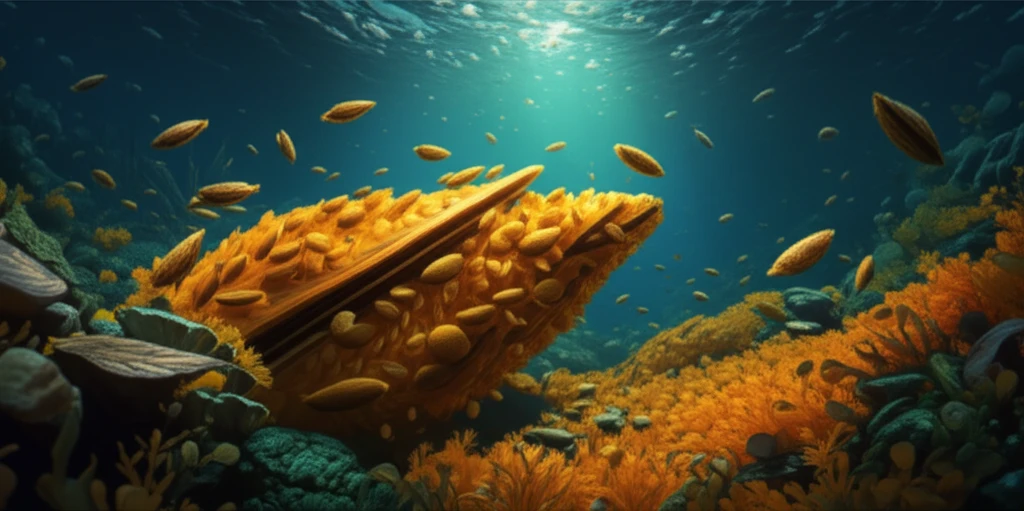
Golden mussels invading a freshwater ecosystem.

Golden Mussel Invasion: How Worried Should We Be?

"Unpacking the spread of Limnoperna fortunei in South American waterways and what it means for the ecosystem."


The golden mussel, scientifically known as Limnoperna fortunei, is an invasive species causing significant changes in South American freshwater ecosystems. Originally from Southeast Asia, this small bivalve has rapidly spread since its first detection in the Americas in 1991. Understanding its distribution and impact is crucial for managing its effects.

First identified in the River Plate estuary, Argentina, the golden mussel quickly colonized major rivers in the Uruguay River basin. By 1999, it had reached the northern end of Patos Lagoon in Brazil, marking the beginning of its expansion into estuarine environments. Its journey highlights its adaptability and the potential for invasive species to disrupt native ecosystems.

This article delves into a study conducted in the São Gonçalo Channel, Brazil, examining the spatial and temporal variations in the golden mussel population. By analyzing the abundance and size distribution of these mussels, the research provides valuable insights into their colonization patterns and the potential ecological consequences. This information is vital for predicting future dispersion and developing effective management strategies.

Tracking the Golden Mussel in São Gonçalo Channel

Golden mussels invading a freshwater ecosystem.

Researchers conducted a study in the São Gonçalo Channel, which connects the Mirim and Patos lagoons in southern Brazil, to understand the distribution and size of Limnoperna fortunei populations. Using bottom trawls to collect samples at depths between 3 and 6 meters, they analyzed the mussel populations over a year. This area is particularly interesting because the channel's water flow can change directions depending on water levels and wind, potentially aiding the mussel's spread.

The study revealed significant seasonal variations in the mussel population. The mean relative abundance, measured as catch per unit effort (CPUE), ranged from 2,425.3 individuals per trawl in the spring to a staggering 21,715.0 individuals per trawl in the fall. Throughout the year, the average was 9,515.3 individuals per trawl. The estimated mean density in the deeper regions of the channel varied from 1.2 to 10.3 individuals per square meter, with a peak density of 84.9 individuals per square meter recorded in the fall of 2008.

  • Bottom trawling proved effective for capturing mussels in the channel's soft, muddy bottom.
  • Mussels of various sizes, ranging from 0.4 to 3.2 cm, were captured.
  • The adult population mainly comprised small individuals (under 1.4 cm), making up as much as 74% of the collected population.
The dominance of smaller mussels suggests greater mobility among these individuals, allowing them to explore and colonize new areas more effectively. As they grow larger, they tend to settle in protected spots, forming clusters. This behavior influences their distribution and ecological impact within the channel. Understanding these dynamics is crucial for predicting how the golden mussel will continue to affect the ecosystem.

The Future of São Gonçalo Channel

The study highlights the golden mussel's successful establishment in the São Gonçalo Channel, demonstrating its capacity to colonize and thrive in this environment. The environmental parameters in the channel fall within the species' tolerance range, ensuring its continued presence and influence.

The golden mussel's abundance also implies its role as a potential food source, especially for fish. Research indicates that smaller mussels are a significant part of the diet of some fish species in the channel. This interaction further integrates the invasive species into the local food web, with complex consequences for the ecosystem.

Further research, combining bottom trawling with advanced technologies like Side Scan Sonar, is essential to fully understand the golden mussel's behavior and its impact on the ecosystem. This will aid in developing effective strategies to manage its spread and mitigate its effects on native species and habitats. Collaborative efforts and continued monitoring are key to preserving the health of South American waterways.

About this Article -

This article was crafted using a human-AI hybrid and collaborative approach. AI assisted our team with initial drafting, research insights, identifying key questions, and image generation. Our human editors guided topic selection, defined the angle, structured the content, ensured factual accuracy and relevance, refined the tone, and conducted thorough editing to deliver helpful, high-quality information.See our About page for more information.

This article is based on research published under:

DOI-LINK: 10.1590/s0073-47212012005000006, Alternate LINK

Title: Space-Time Variation Of The Relative Abundance Of Limnoperna Fortunei In Deep Zones Of São Gonçalo Channel, Rio Grande Do Sul, Brazil

Subject: Animal Science and Zoology

Journal: Iheringia. Série Zoologia

Publisher: FapUNIFESP (SciELO)

Authors: Michelle Lopes, João Vieira

Published: 2012-12-04

Everything You Need To Know

1

What exactly is a golden mussel?

The golden mussel, or Limnoperna fortunei, is a small bivalve originally from Southeast Asia. It has become an invasive species in South American freshwater ecosystems. Its rapid spread since 1991, starting in the River Plate estuary, Argentina, and then expanding into the Uruguay River basin and reaching the northern end of Patos Lagoon in Brazil by 1999, highlights its adaptability and the potential for invasive species to disrupt native ecosystems.

2

Where in South America does this study take place, and why is that location significant?

The study focuses on the São Gonçalo Channel, which connects the Mirim and Patos lagoons in southern Brazil. This location is critical because the channel's dynamic water flow, influenced by water levels and wind, affects the distribution and spread of the golden mussel. The research in the channel offers a specific example of how the species adapts and thrives in a particular environment, demonstrating the implications of its invasion on a smaller scale.

3

How did scientists in this research study the golden mussel?

Scientists used bottom trawls to collect golden mussel samples in the São Gonçalo Channel at depths of 3 to 6 meters. This method was effective for capturing the mussels in the channel's soft, muddy bottom. By analyzing the abundance and size distribution of the Limnoperna fortunei populations, researchers gain insights into their colonization patterns and potential ecological consequences. This includes tracking the mussels' population over time, understanding their densities, and observing their size variations to understand how they establish and influence the ecosystem.

4

What were some of the key findings about the golden mussel population in this study?

The study showed significant seasonal variations in the golden mussel population. The mean relative abundance, measured as catch per unit effort (CPUE), ranged from 2,425.3 individuals per trawl in the spring to 21,715.0 individuals per trawl in the fall. The estimated mean density in the deeper regions of the channel varied from 1.2 to 10.3 individuals per square meter, with a peak density of 84.9 individuals per square meter recorded in the fall of 2008. These findings underscore the mussel's adaptability to environmental changes and its potential for significant ecological impact due to its varying population densities.

5

What does the size distribution of the golden mussel tell us about its behavior and impact?

The dominance of smaller golden mussels in the São Gonçalo Channel suggests they are more mobile and able to colonize new areas. As the mussels grow larger, they tend to settle and form clusters. The study demonstrates the golden mussel's successful establishment, indicating its ability to thrive in the channel's environment. Understanding these dynamics is critical for predicting how the golden mussel will continue to affect the ecosystem and for developing effective management strategies.

Newsletter Subscribe

Subscribe to get the latest articles and insights directly in your inbox.