
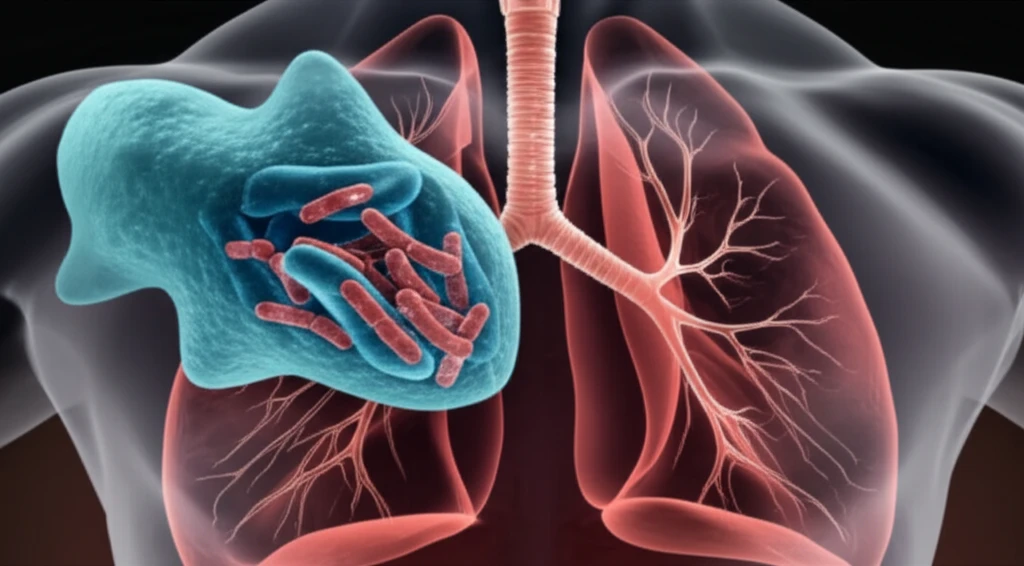
Amoeba harboring Streptococcus bacteria inside a human lung.

Germ Warfare: How Amoebas Could Be Making Infections Worse

"Scientists uncover the hidden role of amoebas in harboring and spreading dangerous bacteria, potentially impacting public health."


For years, we've battled bacteria with antibiotics, but what if the enemy had a secret ally? Scientists are now discovering that amoebas, those single-celled organisms lurking in our soil and water, might be acting as safe havens for dangerous bacteria, helping them to spread and evolve in unexpected ways. This could have major implications for how we understand and fight infections.

Streptococcus pneumoniae and Streptococcus pyogenes are familiar names, infamous for causing everything from sore throats and skin infections to life-threatening pneumonia and meningitis. But what happens when these bacteria encounter Acanthamoeba castellanii, a common amoeba found in various environments? A new study dives into this microscopic battlefield, revealing how these interactions could be making bacterial infections even more challenging to overcome.

This article explores the groundbreaking research into the hidden relationships between amoebas and bacteria, shedding light on how these interactions might be influencing the spread of infectious diseases and the rise of antibiotic resistance. Understanding these complex dynamics is crucial for developing more effective strategies to protect public health and combat emerging threats.

Amoebas: Unsuspecting Allies of Deadly Bacteria?

Amoeba harboring Streptococcus bacteria inside a human lung.

Acanthamoeba castellanii isn't just another amoeba; it's a widespread organism known for its ability to survive in diverse conditions. Found in soil, water, and even our homes, these amoebas have a knack for engulfing bacteria as a source of food. However, some bacteria have evolved to not only resist being digested but to thrive inside these single-celled hosts. This new research highlights how Streptococcus pneumoniae and Streptococcus pyogenes can exploit amoebas as a survival strategy.

The study reveals that both Streptococcus pneumoniae and Streptococcus pyogenes can interact with A. castellanii in several critical ways:

  • Association: The bacteria attach to the outside of the amoeba.
  • Invasion: They manage to get inside the amoeba.
  • Survival: Once inside, they can survive the amoeba's defenses.
  • Multiplication: In some cases, they even multiply within the amoeba.
What's particularly alarming is that the bacteria can survive the process of encystation, where the amoeba forms a protective cyst to withstand harsh conditions. The bacteria hunker down inside these cysts, emerging later, potentially more resistant and ready to infect. This means that amoebas can act as a Trojan horse, sheltering bacteria from antibiotics and disinfectants and then releasing them into the environment.

Implications and Future Directions

The discovery of amoebas acting as reservoirs for pathogenic bacteria opens up new avenues for understanding and combating infectious diseases. It suggests that current disinfection and sterilization methods might not be enough to eliminate these threats, as bacteria can remain protected within amoebic cysts. Further research is needed to explore the full extent of these interactions and develop strategies to disrupt them.

About this Article -

This article was crafted using a human-AI hybrid and collaborative approach. AI assisted our team with initial drafting, research insights, identifying key questions, and image generation. Our human editors guided topic selection, defined the angle, structured the content, ensured factual accuracy and relevance, refined the tone, and conducted thorough editing to deliver helpful, high-quality information.See our About page for more information.

Everything You Need To Know

1

What exactly is Acanthamoeba castellanii?

Acanthamoeba castellanii are single-celled organisms, commonly found in soil, water, and even indoor environments. They consume bacteria as a food source. However, certain bacteria, like Streptococcus pneumoniae and Streptococcus pyogenes, have adapted to survive inside these amoebas, using them as protective hosts.

2

Why is the interaction between amoebas and bacteria important?

This is significant because it changes our understanding of how bacteria survive and spread. Bacteria like Streptococcus pneumoniae and Streptococcus pyogenes can use Acanthamoeba castellanii as a refuge, protecting themselves from antibiotics and disinfectants. This can lead to more persistent infections and the spread of antibiotic-resistant bacteria.

3

How do Streptococcus pneumoniae and Streptococcus pyogenes interact with Acanthamoeba castellanii?

The research indicates that Streptococcus pneumoniae and Streptococcus pyogenes can associate with, invade, survive within, and even multiply inside Acanthamoeba castellanii. Critically, the bacteria can endure encystation, where the amoeba forms a protective cyst. This allows the bacteria to survive harsh conditions and emerge later, potentially more resistant and ready to cause infection.

4

What are the implications of amoebas harboring pathogenic bacteria?

The discovery implies that standard disinfection methods might not be sufficient to eliminate dangerous bacteria, as they can be protected inside amoebic cysts. It also suggests that we need to reconsider our strategies for combating infections, taking into account the role of amoebas as reservoirs for bacteria. Future research will likely focus on developing methods to disrupt the interactions between bacteria and amoebas.

5

What are Streptococcus pneumoniae and Streptococcus pyogenes and why are they mentioned?

Streptococcus pneumoniae and Streptococcus pyogenes are bacteria known to cause a variety of infections. Streptococcus pneumoniae is a common cause of pneumonia, meningitis, and ear infections, while Streptococcus pyogenes is known for causing strep throat, skin infections (like impetigo), and more severe conditions like scarlet fever and rheumatic fever. Their ability to hide within Acanthamoeba castellanii makes these infections harder to treat.

Newsletter Subscribe

Subscribe to get the latest articles and insights directly in your inbox.