
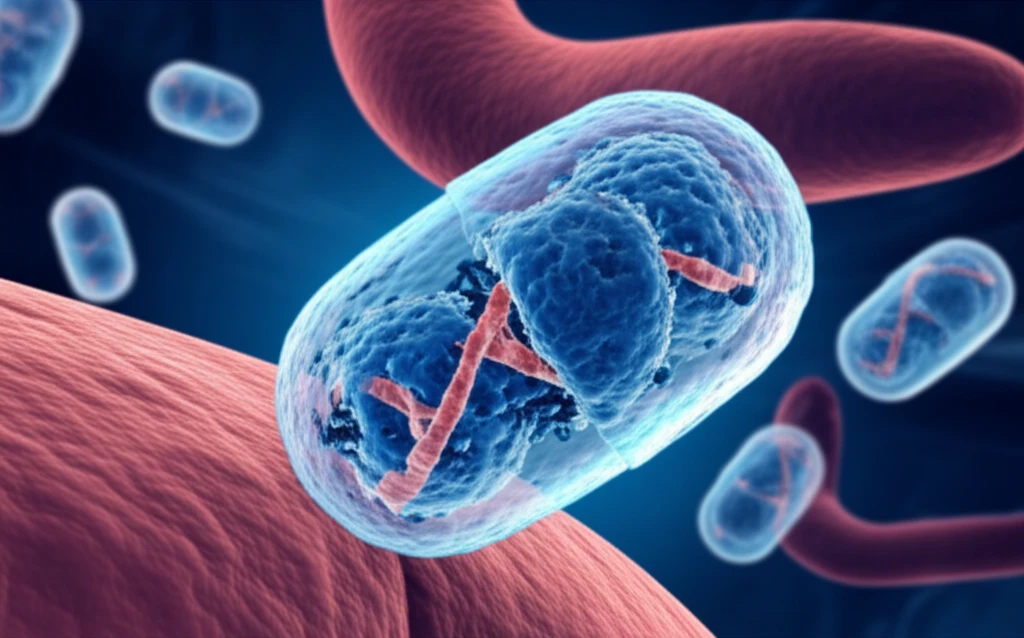
Chondroitin Sulfate Capsule Protecting DNA Strands in Spleen

Gene Delivery Breakthrough: Is Chondroitin Sulfate the Key to Safer, More Effective Gene Therapy?

"Researchers explore how encapsulating gene therapies with chondroitin sulfate could revolutionize treatment by improving safety and targeting."


Non-viral gene delivery has emerged as a promising avenue for therapeutic interventions, offering advantages such as reduced immunogenicity and simplified production compared to viral vectors. This approach involves using carriers like cationic polymers and lipids to transport genetic material into cells. However, these carriers often face challenges related to toxicity and non-specific interactions within the body, leading to adverse effects like rapid elimination and inflammation.

To address these limitations, researchers have explored the use of anionic polymers to encapsulate cationic vectors. Chondroitin sulfate (CS), a biocompatible polymer widely used in pharmaceuticals and cosmetics, has shown potential in this area. Previous studies have indicated that CS can effectively encapsulate gene complexes, reducing toxicity and enhancing gene expression.

A recent study investigated the universal applicability of CS encapsulation for improving gene delivery systems. The researchers developed various ternary complexes consisting of DNA encapsulated with polyplexes and lipoplexes, using CS as the encapsulating agent. They evaluated the effectiveness and safety of these complexes in vitro and in vivo, focusing on their ability to deliver genes efficiently while minimizing adverse effects.

How Does Chondroitin Sulfate Enhance Gene Delivery?

Chondroitin Sulfate Capsule Protecting DNA Strands in Spleen

The study involved creating complexes by mixing DNA with cationic vectors such as poly-L-arginine (PLA), poly-L-lysine (PLL), and liposomes composed of DOTMA-cholesterol or DOTMA-DOPE. CS was then added to encapsulate these complexes, forming ternary structures. The researchers examined several key properties of these complexes:

In vitro transfection efficiency: How well the complexes delivered genes into cells in a laboratory setting. Cytotoxicity: The degree to which the complexes harmed cells. Hematotoxicity: The complexes' impact on blood cells. In vivo transfection efficiency: How effectively the complexes delivered genes in living organisms (mice).

  • Cationic polymers and liposomes effectively bound to DNA, forming stable polyplexes and lipoplexes.
  • These cationic complexes showed high gene transfer efficiency in B16-F10 cells, but also exhibited high cytotoxicity and caused red blood cells to clump together (agglutination).
  • CS encapsulation created stable, negatively charged particles without disrupting the core structures of the polyplexes and lipoplexes.
The resulting CS-encapsulated complexes demonstrated high gene transfer efficiency in B16-F10 cells while significantly reducing cytotoxicity and agglutination. Animal experiments revealed that CS encapsulation improved gene transfer specifically to the spleen, whereas non-encapsulated polyplexes showed little efficiency. However, CS encapsulation reduced the gene transfer efficiency of lipoplexes.

The Future of Gene Therapy: What Does This Mean for You?

This research highlights the potential of chondroitin sulfate as a valuable component in gene delivery systems. By reducing toxicity and improving targeting, CS encapsulation could pave the way for safer and more effective gene therapies. The ability to target specific organs like the spleen opens up new possibilities for treating diseases localized in these areas.

While the study shows promise, further research is needed to fully understand the mechanisms by which CS enhances gene delivery and to optimize its use with different types of gene carriers. Future studies should focus on detailed analyses of intracellular trafficking and endosomal escape to maximize the therapeutic potential of CS-encapsulated gene complexes.

The findings suggest that CS encapsulation could contribute to polyplex-mediated gene delivery systems for effective and safe gene therapy. As gene therapy continues to evolve, innovations like CS encapsulation will play a crucial role in overcoming current limitations and expanding the clinical applications of this transformative approach.

About this Article -

This article was crafted using a human-AI hybrid and collaborative approach. AI assisted our team with initial drafting, research insights, identifying key questions, and image generation. Our human editors guided topic selection, defined the angle, structured the content, ensured factual accuracy and relevance, refined the tone, and conducted thorough editing to deliver helpful, high-quality information.See our About page for more information.

This article is based on research published under:

DOI-LINK: 10.18433/j3gk52, Alternate LINK

Title: Chondroitin Sulfate Capsule System For Efficient And Secure Gene Delivery

Subject: Pharmaceutical Science

Journal: Journal of Pharmacy & Pharmaceutical Sciences

Publisher: University of Alberta Libraries

Authors: Tomoaki Kurosaki, Takashi Kitahara, Shintaro Fumoto, Koyo Nishida, Kayo Yamamoto, Hiroo Nakagawa, Yukinobu Kodama, Norihide Higuchi, Tadahiro Nakamura, Hitoshi Sasaki

Published: 2010-09-06

Everything You Need To Know

1

How does chondroitin sulfate improve the delivery of genes in gene therapy?

Chondroitin sulfate (CS) enhances gene delivery by acting as an encapsulating agent for gene complexes. When DNA is mixed with cationic vectors like poly-L-arginine (PLA), poly-L-lysine (PLL), or liposomes (DOTMA-cholesterol or DOTMA-DOPE), it forms polyplexes and lipoplexes. Encapsulating these complexes with CS creates stable, negatively charged particles. This encapsulation reduces the toxicity and non-specific interactions of the complexes within the body, minimizing adverse effects such as inflammation and rapid elimination.

2

How did researchers create Chondroitin sulfate complexes for gene delivery?

The study created ternary complexes by mixing DNA with cationic vectors such as poly-L-arginine (PLA), poly-L-lysine (PLL), and liposomes composed of DOTMA-cholesterol or DOTMA-DOPE. Then Chondroitin sulfate (CS) was added to encapsulate these complexes, forming ternary structures. The effectiveness of these complexes was evaluated by measuring in vitro transfection efficiency, cytotoxicity, hematotoxicity and in vivo transfection efficiency.

3

What are the implications of using chondroitin sulfate in gene therapy for patients?

This breakthrough means that gene therapies could become safer and more effective. Chondroitin sulfate (CS) helps in targeting specific organs like the spleen, opening new possibilities for treating localized diseases. Future gene therapies using CS could potentially reduce side effects and improve treatment outcomes for various genetic and acquired diseases.

4

What is non-viral gene delivery, and how does chondroitin sulfate enhance this process?

Non-viral gene delivery uses carriers like cationic polymers and lipids to transport genetic material into cells, offering advantages like reduced immunogenicity and easier production compared to viral vectors. Chondroitin sulfate (CS) addresses the limitations of these carriers, such as toxicity and non-specific interactions. By encapsulating the gene complexes, CS enhances gene expression and reduces adverse effects, thus improving the overall safety and effectiveness of non-viral gene delivery systems. However, the effectiveness of CS can vary, as it reduced gene transfer efficiency in lipoplexes in the study.

5

What did the study reveal about the impact of chondroitin sulfate on gene transfer efficiency and toxicity?

The study found that while cationic polymers and liposomes effectively bind to DNA, forming polyplexes and lipoplexes with high gene transfer efficiency in B16-F10 cells, they also exhibit high cytotoxicity and cause red blood cells to clump together (agglutination). Chondroitin sulfate (CS) encapsulation was shown to reduce both the cytotoxicity and agglutination while maintaining high gene transfer efficiency. In animal experiments, CS encapsulation improved gene transfer specifically to the spleen for polyplexes, but reduced the gene transfer efficiency of lipoplexes.

Newsletter Subscribe

Subscribe to get the latest articles and insights directly in your inbox.