
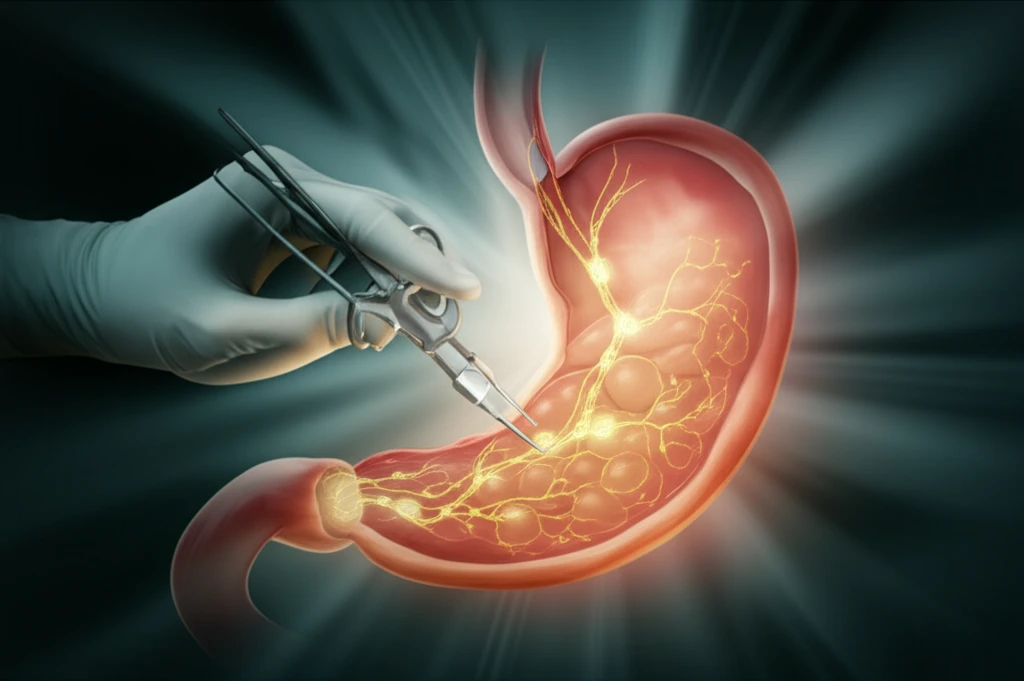
Surreal illustration of a surgeon removing lymph nodes from a stomach

Gastric Cancer Treatment: How Precision Surgery Boosts Survival Rates

"A groundbreaking study reveals how meticulous surgical practices and quality control can significantly improve outcomes for gastric cancer patients."


Gastric cancer remains a significant health challenge worldwide, but advancements in surgical techniques and treatment protocols are offering new hope. One of the most critical factors in improving patient outcomes is the quality of surgery, particularly the precision and thoroughness of lymphadenectomy—the surgical removal of lymph nodes.

A recent study published in the Annals of Surgery sheds light on how rigorous surgical quality control and adherence to specific protocols can dramatically enhance the effectiveness of gastric cancer treatment. The study, which focuses on the CRITICS (ChemoRadiotherapy after Induction chemotherapy In Cancer of the Stomach) trial, reveals the importance of meticulous surgical practices in achieving better survival rates.

The CRITICS trial, a multicenter study, randomized patients with resectable gastric cancer to receive preoperative chemotherapy followed by gastrectomy with a D1+ lymphadenectomy. This procedure involves removing lymph node stations 1 to 9 and 11. Following surgery, patients were further randomized to receive either additional chemotherapy or chemoradiotherapy. The primary goal of the study was to evaluate the impact of these treatment strategies, but a key component was also assessing and ensuring the quality of the surgical procedures.

Why Surgical Precision Matters in Gastric Cancer Treatment?

Surreal illustration of a surgeon removing lymph nodes from a stomach

The cornerstone of effective gastric cancer treatment lies in high-quality surgery. Over the years, patient outcomes have improved due to advancements in surgical techniques, reduced post-operative complications, and enhanced survival rates. In Asian countries, an extended lymph node dissection (D2) has long been the standard, while Western countries traditionally practiced a more limited dissection (D1).

The Dutch Gastric Cancer Trial (DGCT) initially sparked debate regarding the extent of lymphadenectomy needed. While initial results didn't show a significant difference between D1 and D2 dissections, long-term follow-up revealed that a more extended lymph node dissection could indeed be beneficial, especially when post-operative morbidity and mortality are minimized. This highlights the critical importance of adhering to surgical protocols and ensuring high-quality surgical execution.

  • Comprehensive Lymph Node Removal: Ensuring all specified lymph nodes are removed.
  • Minimizing Surgical Contamination: Avoiding damage to surrounding tissues.
  • Adherence to Guidelines: Following established protocols for the extent of resection.
One of the most reliable indicators of surgical quality in gastric cancer is the “Maruyama Index of Unresected Disease” (MI). This index estimates the amount of residual nodal disease after surgery. Studies, including the DGCT and the Intergroup 0116 trial, have demonstrated that a lower MI is associated with better survival rates. A MI of less than 5 indicates more thorough cancer removal and is linked to significantly improved outcomes.

The Future of Gastric Cancer Surgery

The CRITICS trial underscores the importance of surgical quality control and adherence to lymphadenectomy protocols in gastric cancer treatment. The study's findings highlight that meticulous surgical practices, combined with a comprehensive quality assurance program, can significantly improve patient outcomes. As research continues, standardizing surgical techniques and assessing surgical performance will be essential for enhancing treatment strategies and ensuring the best possible results for individuals battling gastric cancer.

About this Article -

This article was crafted using a human-AI hybrid and collaborative approach. AI assisted our team with initial drafting, research insights, identifying key questions, and image generation. Our human editors guided topic selection, defined the angle, structured the content, ensured factual accuracy and relevance, refined the tone, and conducted thorough editing to deliver helpful, high-quality information.See our About page for more information.

This article is based on research published under:

DOI-LINK: 10.1097/sla.0000000000002444, Alternate LINK

Title: Surgicopathological Quality Control And Protocol Adherence To Lymphadenectomy In The Critics Gastric Cancer Trial

Subject: Surgery

Journal: Annals of Surgery

Publisher: Ovid Technologies (Wolters Kluwer Health)

Authors: Yvette H. M. Claassen, Wobbe O. De Steur, Henk H. Hartgrink, Johan L. Dikken, Johanna W. Van Sandick, Nicole C. T. Van Grieken, Annemiek Cats, Anouk K. Trip, Edwin P. M. Jansen, Willemina M. Meershoek-Klein Kranenbarg, Jeffrey P. B. M. Braak, Hein Putter, Mark I. Van Berge Henegouwen, Marcel Verheij, Cornelis J. H. Van De Velde

Published: 2018-12-01

Everything You Need To Know

1

What is the main goal of surgery for gastric cancer?

The primary goal of gastric cancer surgery is to remove the cancerous tumor and any affected lymph nodes. The procedure, known as lymphadenectomy, involves the surgical removal of lymph nodes to prevent cancer from spreading. The study highlights that the precision and thoroughness of lymphadenectomy are critical for improving patient outcomes. The CRITICS trial used a D1+ lymphadenectomy, which includes removing lymph node stations 1 to 9 and 11.

2

Why is surgical quality control so important in gastric cancer treatment?

Surgical quality control is vital because it directly impacts patient survival rates. The “Maruyama Index of Unresected Disease” (MI) is a key indicator of surgical quality. A lower MI, indicating more thorough cancer removal, is associated with better survival rates. Studies have shown that meticulous surgical practices, along with adhering to established protocols like lymphadenectomy, lead to improved patient outcomes. The CRITICS trial demonstrates the importance of a comprehensive quality assurance program.

3

What is lymphadenectomy, and why is it important in the context of gastric cancer?

Lymphadenectomy is the surgical removal of lymph nodes to prevent cancer from spreading and is a cornerstone of effective gastric cancer treatment. In the context of gastric cancer, it involves removing lymph nodes near the stomach. The study emphasizes the importance of adhering to specific protocols in lymphadenectomy for improving survival rates. Different levels of lymph node dissection are used, with D2 (extended) and D1 (more limited) approaches. The CRITICS trial used D1+ lymphadenectomy.

4

What is the significance of the “Maruyama Index of Unresected Disease” (MI)?

The “Maruyama Index of Unresected Disease” (MI) estimates the amount of residual nodal disease after surgery. A lower MI, indicating a more thorough removal of cancer, is associated with better survival rates. Studies like the Dutch Gastric Cancer Trial (DGCT) and the Intergroup 0116 trial have shown that MI is a reliable indicator of surgical quality. The implication is that surgeons need to aim for complete cancer removal during surgery.

5

What surgical practices are crucial for improving outcomes in gastric cancer treatment?

Meticulous surgical practices, including comprehensive lymph node removal, minimizing surgical contamination, and adhering to guidelines, are essential. Comprehensive lymph node removal ensures all specified lymph nodes are removed. Minimizing surgical contamination prevents damage to surrounding tissues. Adherence to guidelines means following established protocols for the extent of resection. These practices, along with quality control programs, are critical for enhancing treatment strategies and ensuring the best possible outcomes for patients with gastric cancer. The CRITICS trial highlights the significance of these practices.

Newsletter Subscribe

Subscribe to get the latest articles and insights directly in your inbox.