
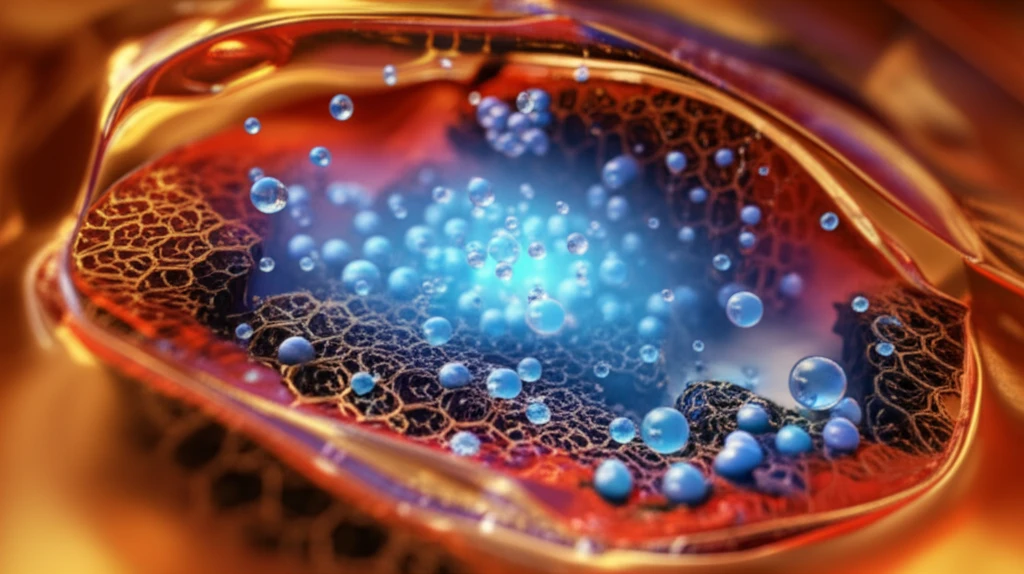
Nano-zeolites adsorbing water molecules from liquid fuel.

Fueling the Future: How Nano-Zeolites are Revolutionizing Liquid Fuel Dehydration

"Unlock the potential of high-performance liquid fuels with innovative nano-zeolite technology for efficient and eco-friendly dehydration."


In the quest for high-performance, low-toxicity liquid fuels, Dimethyl amino ethyl azide (DMAZ) has emerged as a promising candidate. However, like many fuels, DMAZ needs to meet stringent quality standards, particularly regarding water content. Excess water can hinder engine performance and compromise fuel stability. This is where innovative dehydration methods become crucial.

Traditional dehydration techniques often involve high temperatures, which can be problematic for sensitive fuels like DMAZ. Adsorption, a process where water molecules adhere to a solid material, offers a safer and more effective alternative. Zeolites, with their porous structure and high affinity for water, are excellent candidates for this task. Now, nano-zeolites are pushing the boundaries of what's possible.

This article delves into the groundbreaking research exploring the use of nano-zeolites for DMAZ dehydration. We'll uncover how scientists are optimizing these materials to achieve maximum water removal, the thermodynamic principles governing the process, and the potential for this technology to revolutionize liquid fuel production. Get ready to explore the future of fuel… one nano-zeolite at a time.

Nano-Zeolites: Tiny Particles, Huge Impact on Fuel Quality

Nano-zeolites adsorbing water molecules from liquid fuel.

Zeolites are aluminosilicate minerals with a unique, cage-like structure. These "cages" have an exceptional ability to trap water molecules, making zeolites ideal for dehydration. Nano-zeolites take this concept to the next level by significantly increasing the surface area available for water adsorption. Think of it like this: a sponge made of countless microscopic compartments will absorb far more water than a single, solid block of the same material.

Researchers have successfully synthesized 3A molecular sieve nano-zeolites using a hydrothermal method, a process involving high temperature and pressure in an aqueous solution. The resulting nano-zeolites were then meticulously tested for their ability to dehydrate DMAZ. An L16 orthogonal array, a powerful statistical tool, was used to design experiments and optimize key parameters. These parameters included:

  • Initial Water Concentration (Co): The amount of water present in the DMAZ fuel.
  • Shaking Rate (SR): The speed at which the mixture is agitated, influencing the contact between the nano-zeolites and water molecules.
  • Temperature (T): The temperature at which the dehydration process occurs.
  • Adsorbent Dosage (AD): The amount of nano-zeolite used in the process.
The results were impressive. Adsorbent dosage and initial water concentration emerged as the most influential factors, contributing nearly 40% each to the overall water removal capacity. This highlights the importance of using the right amount of nano-zeolite and carefully controlling the initial water content of the fuel.

The Future is Dry: Nano-Zeolites Pave the Way for Better Fuels

This research confirms that nano-zeolites offer a promising avenue for achieving efficient and effective dehydration of liquid fuels like DMAZ. The optimized nano-zeolite material, synthesized through a hydrothermal method and carefully tested, demonstrated a remarkable ability to remove water, enhancing fuel quality and stability.

Furthermore, thermodynamic analysis revealed that the dehydration process is exothermic, physical, and spontaneous, making it an environmentally friendly and energy-efficient approach. The insights gained from this study can be applied to optimize dehydration processes for a wide range of liquid fuels, contributing to cleaner combustion and improved engine performance.

As the demand for high-performance, low-emission fuels continues to grow, nano-zeolite dehydration technology is poised to play a vital role in shaping the future of the energy landscape. This groundbreaking research brings us one step closer to a future where fuels are not only powerful but also sustainable.

About this Article -

This article was crafted using a human-AI hybrid and collaborative approach. AI assisted our team with initial drafting, research insights, identifying key questions, and image generation. Our human editors guided topic selection, defined the angle, structured the content, ensured factual accuracy and relevance, refined the tone, and conducted thorough editing to deliver helpful, high-quality information.See our About page for more information.

This article is based on research published under:

DOI-LINK: 10.1007/s13369-017-2891-6, Alternate LINK

Title: Thermodynamic Study And Optimization A Nano-Zeolite For Dehydration Liquid Fuel (Dmaz) Using Taguchi $$\Hbox {L}_{16}$$ L 16 Orthogonal Array

Subject: Multidisciplinary

Journal: Arabian Journal for Science and Engineering

Publisher: Springer Science and Business Media LLC

Authors: Hamid Reza Azizi, Shahram Ghanbari Pakdehi, Saeed Babaee

Published: 2017-10-24

Everything You Need To Know

1

What are nano-zeolites, and how do they work in liquid fuel dehydration?

Nano-zeolites are aluminosilicate minerals characterized by a cage-like structure. This unique structure enables them to trap water molecules effectively, making them highly suitable for dehydration processes. Their nano size significantly increases the surface area available for water adsorption, enhancing their water removal capacity compared to traditional zeolites.

2

What are the most important factors to consider when using nano-zeolites to remove water from Dimethyl amino ethyl azide (DMAZ)?

In the dehydration of Dimethyl amino ethyl azide (DMAZ) using nano-zeolites, adsorbent dosage and initial water concentration are the most critical parameters. Adsorbent dosage refers to the amount of nano-zeolite used, while initial water concentration is the amount of water present in the DMAZ fuel. These factors significantly impact the overall water removal capacity, with each contributing nearly 40% to the process.

3

How are nano-zeolites created and tested for dehydrating Dimethyl amino ethyl azide (DMAZ)?

Researchers successfully synthesized 3A molecular sieve nano-zeolites using a hydrothermal method, which involves high temperature and pressure in an aqueous solution. The effectiveness of these nano-zeolites in dehydrating DMAZ was rigorously tested. Key parameters, including initial water concentration, shaking rate, temperature, and adsorbent dosage, were optimized using an L16 orthogonal array, a statistical tool for efficient experimental design.

4

Why are nano-zeolites a better option for dehydrating fuels like Dimethyl amino ethyl azide (DMAZ) compared to traditional methods?

Traditional dehydration techniques for liquid fuels often involve high temperatures, which can be detrimental to sensitive fuels such as Dimethyl amino ethyl azide (DMAZ). High temperatures can cause fuel degradation or unwanted chemical reactions. Adsorption using nano-zeolites offers a safer alternative by removing water at lower temperatures, preserving the integrity and stability of the fuel.

5

What are the broader benefits of using nano-zeolites to dehydrate Dimethyl amino ethyl azide (DMAZ) in terms of fuel quality and environmental impact?

The use of nano-zeolites for Dimethyl amino ethyl azide (DMAZ) dehydration has significant implications for fuel quality and environmental impact. By efficiently removing water, nano-zeolites enhance fuel stability and performance, leading to improved engine efficiency and reduced emissions. The optimized dehydration process contributes to the production of high-performance, low-toxicity liquid fuels, aligning with environmental sustainability goals. The study utilized L16 orthogonal array method, a statistical method, to optimize the key dehydration parameters to enable these outcomes.

Newsletter Subscribe

Subscribe to get the latest articles and insights directly in your inbox.