
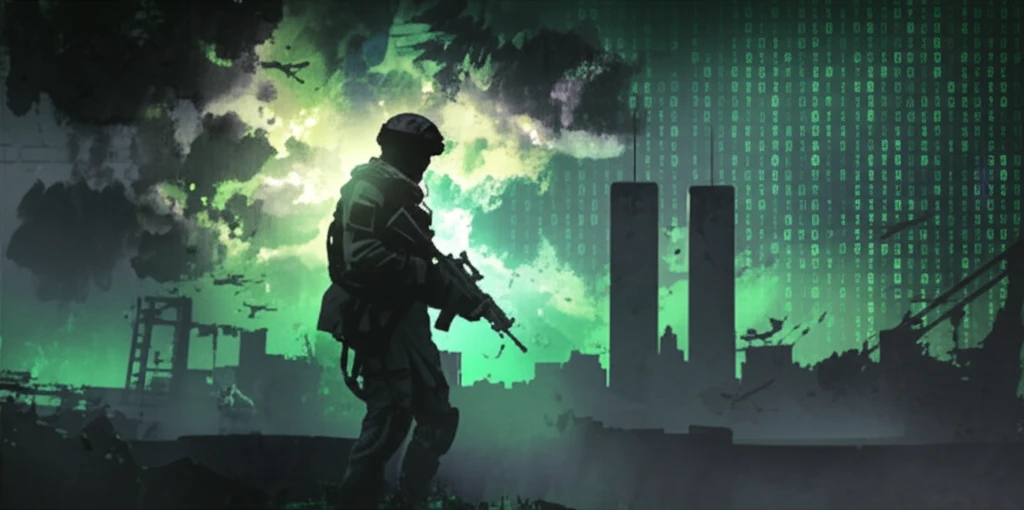
From Pixels to Policy: How Military Video Games Shape Our Worldview After 9/11

"Explore the surprising ways military-themed video games influence perceptions of war, national identity, and real-world conflicts."
The line between entertainment and reality has blurred, especially when it comes to military video games. These aren't just simple shoot-'em-ups; they're sophisticated simulations that put players in the boots of soldiers, offering a visceral experience of modern warfare. After the September 11 attacks, these games took on new significance, reflecting and shaping our understanding of conflict, patriotism, and national identity.
Matthew Thomas Payne's "Playing War: Military Video Games After 9/11," explores this phenomenon in depth. Payne argues that military-themed video games do more than just entertain; they actively cultivate a specific worldview, influencing how we perceive war and its impact. This article will explore the key themes of Payne's work and expand on how military video games contribute to a broader cultural narrative.
We will discuss how games influence our understanding of war and conflict, covering from the nuanced ways these games cultivate our perceptions of national identity and global politics to how games contribute to a potentially problematic glorification of combat. Join us as we explore the complex and evolving relationship between pixels, policy, and public perception.
The Influence of Military Video Games on Public Perception
Military-themed video games have become one of the most consumed forms of entertainment media globally, generating billions in annual revenue and reaching audiences far larger than any formal military recruitment effort. The post-9/11 era saw a surge in titles that depicted contemporary conflicts, embedding military narratives into mainstream popular culture. While precise figures on how these games shape individual worldviews remain difficult to quantify, scholars broadly agree that the cultural footprint of military video games has expanded substantially over the past two decades. Their role in framing public understanding of war, geopolitics, and military service continues to attract growing academic and policy attention.
Military Wargaming as a Planning and Decision-Making Tool
Wargaming has long served as a structured method for military planners to test courses of action before real-world deployment. The U.S. Army emphasizes integrating modular, resource-light wargaming into the military decision-making process (MDMP) at battalion and brigade levels to improve analysis and leader development. Advocates argue that wargaming functions as a laboratory for scientific examination of operational plans, enabling more rigorous and evidence-based thinking. However, wargaming carries real limitations: if misapplied, it can reinforce bad assumptions and be used to justify unrealistic or faulty battle plans, underscoring the need for standardized practices and critical evaluation of outcomes.
The Origins of Wargaming and Military Entertainment
Pre-digital tabletop wargames have functioned as war-planning tools for centuries, with Prussian Kriegsspiel in the 19th century often cited as a foundational milestone. The connection between electronic games and the military tightened after computers were first employed during World War II for code-breaking and ballistics calculations. During the Cold War, multiple nations developed both analog and digital simulation tools for strategic and tactical training. These historical developments laid the groundwork for the modern military-entertainment complex, blurring lines between training, planning, and commercial entertainment in ways that continue to evolve.
The Rise of Ludic War: Blurring the Lines Between Play and Reality
Payne introduces the concept of "ludic war" to describe the intersection of military-themed video games, game marketing, and the post-9/11 War on Terror. "Ludic war" suggests that players become "ludic soldiers," immersed in a world of simulated combat that reflects real-world geopolitical tensions. This immersion isn't accidental; it's carefully crafted through game design, marketing strategies, and the pervasive influence of the military-industrial complex.
- Simplified Narratives: Complex geopolitical conflicts are often reduced to simplistic narratives of good versus evil.
- Heroic Individualism: Players are typically cast as heroic individuals who can single-handedly turn the tide of battle, reinforcing a sense of American exceptionalism.
- Technological Determinism: Modern warfare is often presented as a technological showcase, emphasizing the power and precision of military hardware while downplaying the human cost of conflict.
Evolving Scholarship on Games and Conflict
Academic interest in the intersection of video games and real-world conflict has grown considerably in recent years, reflecting the expanding cultural significance of interactive media. Scholars are increasingly examining how games depict historical and contemporary wars, and what influence these portrayals exert on public understanding. Research methodologies are diversifying, incorporating ethnographic fieldwork, textual analysis, and large-scale audience surveys. While no single consensus has emerged on the net effect of military video games, the field is moving toward more nuanced, empirical investigations that account for the complexity of player engagement and interpretation.
Limitations and Critiques of Military Game Narratives
Critics argue that military video games frequently sanitize and trivialize real-world conflicts, presenting war as a thrilling spectacle while obscuring its human costs. Some researchers caution that framing effects within games can reinforce nationalistic or militaristic ideologies without players' conscious awareness. Others point out that the interactive nature of games may amplify persuasive messaging compared to passive media such as film. However, it remains contested whether these effects translate into measurable shifts in political attitudes or behavior, and some scholars note that players often engage with games critically rather than absorbing content uncritically.
Variety and Scope of Modern Military War Games
The contemporary war game landscape spans a wide spectrum, from hyper-realistic tactical shooters to deep grand-strategy titles. Games such as Wargame Red Dragon, Steel Division 2, and Hearts of Iron IV cater to players seeking complex strategic decision-making, while tactical shooters emphasize squad-based realism and immersion. The distinction between action-driven titles and simulation-focused games shapes how military concepts are presented and consumed by players. This diversity means that the experience of engaging with military themes varies enormously depending on a player's genre preferences, complicating any blanket assessment of games' cultural influence.
A Call for Critical Engagement
Military video games are not mere entertainment; they are cultural artifacts that reflect and shape our understanding of war, national identity, and global politics. By critically examining the narratives, mechanics, and marketing strategies of these games, we can gain a deeper understanding of their influence and promote more informed discussions about the realities of conflict in the 21st century. It is also important to recognize that games are made for entertainment, so they are most likely to appeal to the masses if they are simple and fun, but in doing so the messages they preach may be diluted.
The Militarization of Video Game Culture
Researchers have documented a deep historical entanglement between military institutions and the video game industry, tracing connections from Cold War-era simulations through to today's commercial titles. The military's embrace of video games is understood by some scholars as a deliberate effort to shape players' views, using games that may misrepresent the realities of war and military service. At the same time, research suggests that war video games can activate argumentative and critical thinking dimensions when they engage with the ideological discourses inherent in conflict. University students surveyed in one study indicated that such games may encourage critical engagement with war if they are perceived as more than mere entertainment.
The Growing Military Game Market
Market analysts project robust growth in the military simulation and war game sector, driven by advances in realistic combat simulation and expanding applications across entertainment, education, and professional training. New and upcoming titles continue to draw on both historical conflicts and speculative near-future scenarios, reflecting enduring audience demand. The military game market ecosystem is increasingly recognized as spanning commercial gaming, defense simulation, and educational platforms. As technology advances, the boundaries between training tools and entertainment products are expected to blur further, raising new questions about how these games are designed and consumed.
Structural Issues in the Military-Entertainment Complex
The entanglement of military institutions and the entertainment industry raises systemic concerns about whose narratives are amplified and whose are suppressed. Commercial incentives in the gaming industry may privilege spectacle and marketability over nuanced depictions of conflict, creating structural pressures that shape the content players encounter. Governments and defense organizations have historically collaborated with game developers to ensure favorable portrayals of military operations, though the degree and transparency of this influence vary. Addressing these structural dynamics requires scrutiny not only of individual games but of the industry pipelines, funding relationships, and cultural assumptions that underpin the production of military entertainment.
How Games Shape Perceptions of Conflict
Scholars increasingly focus on how military video games frame wars and contribute to militaristic ideologies, with historical representation in games often sanitizing and trivializing real-world conflicts and their consequences. Ethnographic research, including fieldwork with both game developers and military personnel, has illuminated the close operational ties between entertainment production and defense institutions. Studies examining games inspired by contemporary conflicts, such as the war in Ukraine, reveal how interactive media can shape public awareness and empathy in complex ways. A case study on the Call of Duty: Modern Warfare franchise highlights how post-9/11 military entertainment reduced certain narrative complexities while intensifying others, influencing how players engage with ideas of heroism and warfare.