
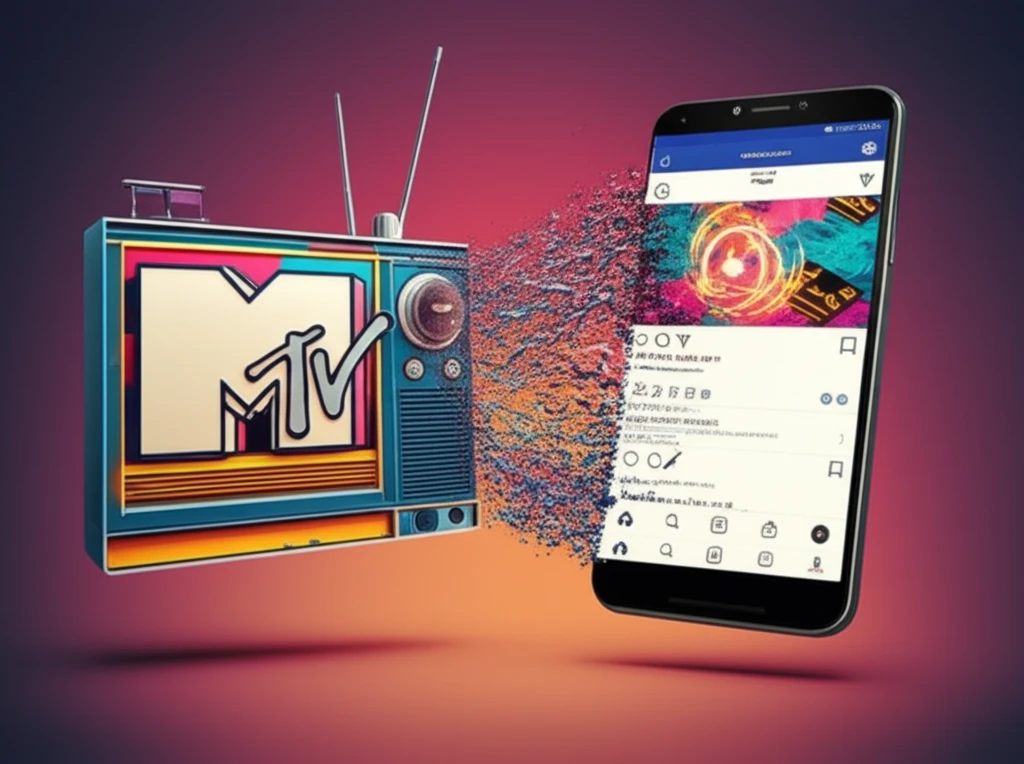
From MTV to IGTV: How Music Consumption Has Evolved

"Exploring the shift from traditional music television to Instagram and social media, and what it means for artists and fans."
On June 24, 2018, Taylor Swift uploaded a short, seven-part story to her Instagram profile. Her fans immediately recognized that the recordings were from her concert at London's Wembley Stadium. Swift was sitting at the piano, her blonde hair gently blowing in the wind, and the melody began. Instantly recognizable: 'I sit and wait.' It's 'Angels' by Robbie Williams. The crowd roars, and Swift grins—the effect is electric.
In the second clip of the story, Robbie Williams, the original artist, suddenly appears in front of the piano, elevated through a trapdoor in the stage floor. Now the third clip starts: Swift plays the piano, her laughter grows wider, and Williams sings. He’s wearing a T-shirt promoting Swift's Reputation tour, where he is currently a guest performer. Swift is shown briefly, and she can hardly contain her happiness.
Earlier, such recordings would only have been shown on (music) television. Those times are gone. (Music) television—like print media—has been predicted to decline for about a decade now. For the German music channel VIVA, which has been around since 1993, the prediction is indeed coming true. It ceased broadcasting on December 31, 2018. The reason is obvious: the success of social media, especially YouTube and Instagram, where fans can access the videos or pictures of their stars independently, mobile, and at any time.
The Recycling of Content on Instagram
In 2003, before the breakthrough of social media, film scholar Michaela Krützen described music television, using MTV as an example, in a way that could characterize Instagram today. More than any other channel, MTV was 'a medium of repetition, anticipation, distraction, entertainment, lack of history, fragmentation, and flow.'
- Countless perspectives of the same concert performance or photo shoot.
- Various snippets of music videos are sometimes published directly one after the other.
- Sometimes they're released at appropriate intervals, over and over again.
The Future of Music Consumption
Instagram, like MTV or VIVA before it, is primarily for entertainment. Although one might argue that Instagram has a seemingly immeasurable repertoire, while a TV channel always follows a program put together by a few people, even if there are many Instagram profiles that set traditional educational goals, this does not apply to the popular accounts. Popular are those who have many followers and what gets many likes and comments—which almost always applies to entertaining content.
Regarding the characteristic of lack of history, Instagram seems to be a descendant of music television. 'MTV is the triumph of pure presence,' wrote David J. Tetzlaff in the 'Journal of Communication Inquiry' in 1986. Krützen confirmed this: Each report leads to 'present triumphs' – and thus brings together two things that Instagram also unites in a virtuoso way: the suggestion of the present – mostly through everyday representations – and the staging of success.
What will happen with the music? It has to be added by the users. Although short sequences appear again and again in the feed (images and video excerpts with music) or in a story – so it is an integral part of the feed – but to listen to it, if you are honest, is not a great pleasure. Yet it remains to be seen how the music industry will make IGTV usable for itself. A lot is conceivable, from outtakes to backstage stories to specially adapted music clips. Above all, there will probably be a lot of 'reality TV,' as is already emerging: The star and lifestyle profiles also follow in the footsteps of music television.