
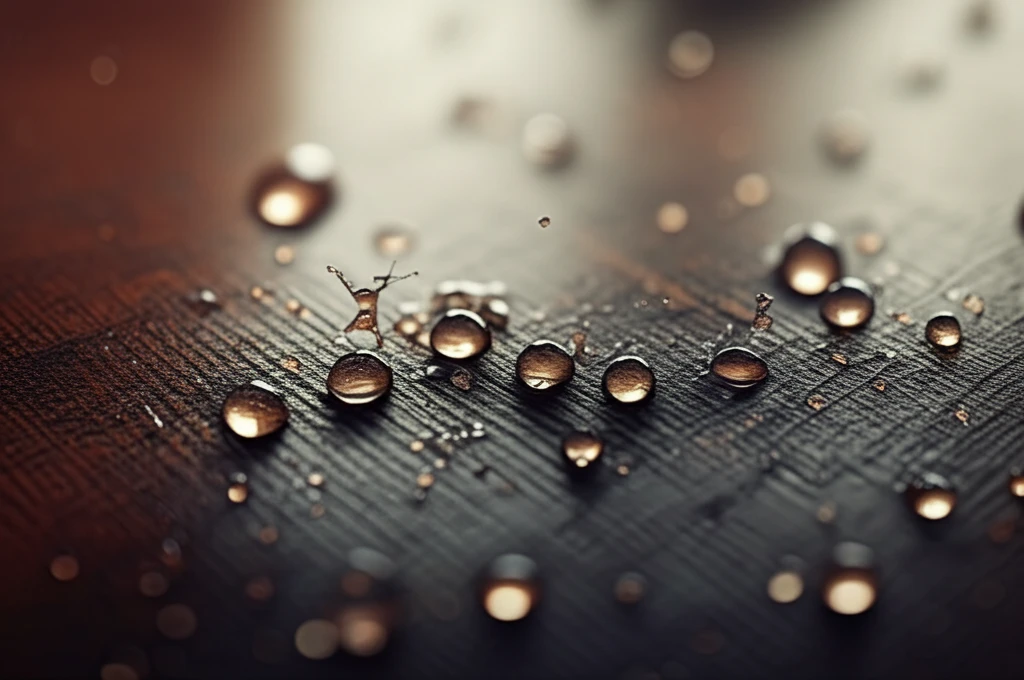
From Lab to Life: How Understanding Water Droplet Movement Can Revolutionize Everyday Surfaces

"Uncover the fascinating science of water droplet mobility on hydrophobic surfaces and its potential to transform everything from self-cleaning windows to advanced cooling systems."
We often take for granted the behavior of water, especially its interaction with different surfaces. But what if we could control how water droplets move? Recent research is unlocking the secrets of droplet mobility on hydrophobic (water-repelling) surfaces, paving the way for a new generation of technologies. This article delves into the innovative work being done in this field, exploring its potential to impact numerous aspects of our lives.
Imagine a world where windows self-clean in the rain, industrial cooling systems operate with unprecedented efficiency, and medical diagnostics are more precise than ever before. These advancements are not science fiction, but rather potential realities driven by our growing understanding of water droplet behavior. Controlling droplet movement on surfaces offers unique advantages across diverse sectors.
Scientists are meticulously studying the forces that govern droplet motion, including surface tension, thermal gradients, and the properties of the surface itself. This research is not just about pure science; it's about engineering solutions to real-world problems. By understanding how to manipulate these forces, we can design surfaces and systems with tailored properties, leading to groundbreaking innovations.
Defining Hydrophobic Interactions
Hydrophobic molecules are nonpolar substances that repel water due to water's polar nature, causing them to aggregate in aqueous solutions to minimize contact with water molecules. This hydrophobic effect maximizes water entropy while reducing the interface area between water and nonpolar substances. Common hydrophobic materials include oils, fats, alkanes, and waxes, which share electrons evenly and lack significant positive or negative poles. These substances are prevalent in both domestic and industrial applications where water repellency is desired.
Conventional Surface Treatments
Traditional approaches to creating water-repellent surfaces typically rely on chemical coatings or surface texturing that increase contact angles, though these methods often face durability challenges under mechanical wear, UV exposure, and thermal cycling. Many conventional hydrophobic treatments degrade over time, losing effectiveness as surface chemistry changes or microstructures wear down. The limitations of these standard methods have driven research toward more robust, self-healing, or structurally intrinsic solutions.
Early Observations of Water Repellency
The available source material for this section returned results unrelated to the historical development of hydrophobic surface science, referencing a pain management clinic in Orem, Utah rather than foundational research on water droplet behavior. Historical milestones in understanding surface wetting phenomena—from Young's equation (1805) to Wenzel and Cassie-Baxter models (1930s-1940s)—are not covered by the provided sources. A proper historical account would require access to the primary literature on interfacial science and biomimetic surface research.
What Makes Water Droplets Move? Unveiling the Key Forces
At the heart of this research lies the concept of hydrophobic surfaces, materials engineered to repel water. When a water droplet lands on such a surface, it doesn't spread out; instead, it forms a bead-like shape. What happens next is determined by a delicate balance of forces:
- Surface Tension: The cohesive forces between water molecules create surface tension, which minimizes the surface area of the droplet.
- Adhesion: The attraction between water molecules and the surface. Hydrophobic surfaces minimize this adhesion.
- Gravity: Pulls the droplet downwards.
- External Forces: Thermal gradients (temperature differences), electrical fields, or mechanical vibrations can also influence droplet motion.
Contemporary Understanding of Hydrophobic Materials
Recent references define hydrophobic substances as those lacking affinity for water, being insoluble in water, and actively repelling water. Examples cited include alkanes, oils, fats, and greasy substances broadly categorized as hydrophobic molecules. These materials find applications across both domestic and industrial sectors, though the source does not detail specific recent advances in droplet dynamics or surface engineering. The definition aligns with long-established chemical principles rather than reporting new discoveries.
Challenges in Superhydrophobic Implementation
Despite promising laboratory results, superhydrophobic surfaces often fail in real-world deployment due to mechanical fragility of micro/nano structures, contamination-induced wetting transitions, and limited scalability of fabrication methods. Many surfaces that achieve high contact angles in controlled conditions lose performance under abrasion, condensation, or exposure to surfactants and oils. The gap between idealized test conditions and practical service environments remains a significant barrier to widespread adoption.
Hydrophobic vs. Superhydrophobic Performance
Superhydrophobic surfaces achieve water contact angles around 153° with easy roll-off behavior, significantly outperforming standard hydrophobic surfaces. Electrodeposition time affects performance, with longer durations (0.5 to 3 hours) altering surface morphology and wetting properties. Innovative methods now use sessile water droplets on hydrophobic surfaces for environmental dust mitigation, leveraging droplet-surface interactions for cleaning. Natural examples like water boatman insects demonstrate how scale structures enable movement through water surfaces without entrapment, inspiring biomimetic designs.
The Future is Fluid: Innovations on the Horizon
The study of water droplet movement on surfaces is rapidly evolving, holding the potential to reshape industries and improve our daily lives. From energy-efficient cooling to advanced medical diagnostics, the ability to control droplet behavior offers a powerful toolkit for innovation. As research continues, we can expect even more exciting applications to emerge, transforming the way we interact with the world around us.
Integrating Lab Findings into Practice
Translating laboratory breakthroughs in droplet dynamics into commercial surfaces requires reconciling high-performance metrics with manufacturing constraints, cost targets, and regulatory requirements. Experts emphasize that successful deployment depends not just on peak contact angles but on robustness metrics—abrasion resistance, chemical stability, and longevity under thermal cycling. The field increasingly focuses on scalable fabrication techniques that preserve hierarchical micro/nano structures essential for superhydrophobicity.
Emerging Directions in Surface Engineering
Next-generation research targets adaptive surfaces that switch wettability on demand, self-healing coatings that recover hydrophobicity after damage, and computational design of optimal surface textures using machine learning. Integration with functional materials—photocatalytic, antimicrobial, or energy-harvesting layers—could yield multifunctional surfaces. Scalable roll-to-roll manufacturing and environmentally benign chemistries are critical enablers for mass adoption.
Environmental and Economic Considerations
Widespread deployment of advanced hydrophobic surfaces faces systemic hurdles including fluorinated compound regulations, lifecycle environmental impact of nano-structured coatings, and economic viability for high-volume applications. Standards for measuring and certifying hydrophobic performance across industries remain fragmented. Supply chain constraints for specialty precursors and the need for application-specific optimization limit rapid technology transfer from academia to industry.
Everyday Applications and User Experience
Effective water-shedding surfaces translate to tangible benefits: self-cleaning windows reducing maintenance, anti-fogging mirrors and eyewear improving visibility, corrosion-resistant infrastructure extending service life, and medical devices resisting biofouling. Consumer products from textiles to electronics gain durability and functionality. The human impact spans reduced cleaning chemical use, improved safety in transportation, and lower resource consumption—outcomes that depend on moving beyond lab demonstrations to reliable, affordable solutions.