
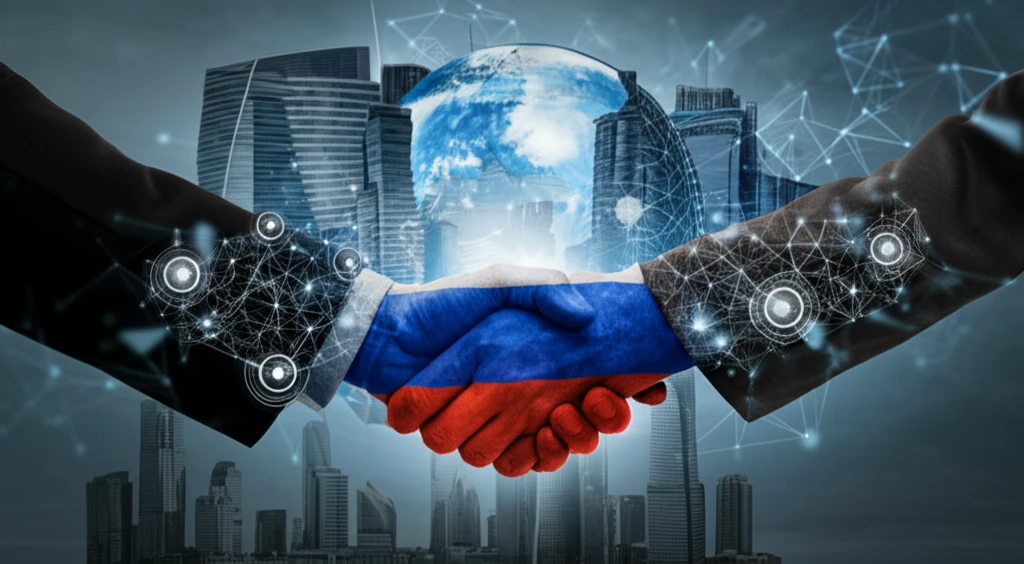
From Cronyism to Cooperation: How Russia's Business Climate is Evolving

"Discover how the changing dynamics between the state and businesses in Russia could lead to more transparent and mutually beneficial relationships."
The relationship between businesses and government in Russia has long been a subject of intense scrutiny. The financial crisis of 2008-2009 threw these dynamics into sharp relief, highlighting the critical nature of state support and how it's allocated. This sparked renewed interest in understanding not just the mechanics of these interactions, but also the priorities that guide governmental assistance at the federal, regional, and local levels.
Historically, Russia's business-government interactions have been viewed through various lenses. Early analyses often pointed to "state capture," where larger firms, particularly at the regional level, were seen as manipulating government support to their advantage. This model, popularized by J. Stigler in 1971, suggested that government assistance disproportionately favored established, often underperforming, enterprises with strong ties to local authorities.
However, a contrasting view emerged with the "grabbing hand" model, which described a more predatory relationship, especially impacting small and medium-sized new businesses (SMEs). In this scenario, government officials were seen as extracting resources from these firms, creating a challenging environment for growth and innovation. More recently, economist Timothy Frye proposed a more nuanced perspective, suggesting a "system of exchange" where enterprises and regional authorities engage in reciprocal relationships, trading support for obligations.
Business Climate Gauge Nears Stagnation
Russia's economy showed further signs of slowing in February, with a key business sentiment gauge hovering just above contraction territory, according to data from the Central Bank as reported by The Moscow Times. The business climate index is calculated monthly by the Central Bank from a survey of around 15,000 enterprises. The indicator slipping to near-stagnation points to persistent headwinds for the country's business climate. Because the gauge rests on a large monthly survey, it offers one of the most direct statistical readings of how Russian firms view current conditions.
Standardized Reporting and Its Limits
Standardized climate tools are universal methods and frameworks used to measure, report, and address climate risks and emissions, ensuring that data and results are comparable across organizations and regions. Mandatory climate-related reporting is now on the way for many businesses, with standards being developed in line with the Task Force on Climate-related Financial Disclosures (TCFD) recommendations and requiring organizations to assess climate risks and opportunities across four themes. Alongside these rules, global standards bodies have moved to take aim at company 'greenwashing' claims, tightening scrutiny of corporate climate statements. The combination gives regulators and investors a common basis for comparison, even as the enforcement and comparability limits of such frameworks remain subject to debate.
A Legacy of Geopolitical Milestones
Any assessment of Russia's business climate sits against a long backdrop of geopolitical milestones, including the Cuban Missile Crisis of October 1962, when the United States and the Soviet Union faced off at the height of the Cold War. That standoff shaped decades of mutual suspicion that conditioned trade and investment between Washington and Moscow. Contemporary reporting shows the pattern of confrontation persisting, with the BBC documenting waves of Russian strikes on Ukrainian cities alongside drone attacks reaching toward Moscow. These recurring tensions form the risk environment in which Russian businesses operate and foreign partners weigh engagement.
The Rise of the "Model of Exchange"
Recent research indicates a significant shift in these dynamics. A 2009 survey of 957 manufacturing enterprises reveals that the "model of exchange" is now the predominant pattern in Russia's business-government relations. This suggests a move away from the more exploitative models of the 1990s, where either state capture or the grabbing hand held sway. Instead, businesses and the government are increasingly engaging in mutually beneficial collaborations.
From Post-9/11 Hopes to Sanctions
Research on US-Russia business ties in the aftermath of the September 11th attacks asked whether new alliances against global terrorism would extend to the business sphere, with Presidents Putin and Bush scheduling a summit in mid-November. Two decades later, the commercial climate has taken a very different course. TASS, the Russian state news agency, now frames the business landscape through the military operation in Ukraine and the sanctions that followed, with Russian diplomats arguing that anti-Russian sanctions are hitting back on Europe. The contrast illustrates how quickly geopolitical goodwill has given way to economic confrontation in the Russia-Western relationship.
Counter-Narratives on Climate and Science
Russian climate scepticism is an understudied case, shaped, as in the United States, by scientists, the media, public opinion, the government and business, according to research published in Climatic Change. One account of the country's climate science notes the role of Kyril Kondratyev (1920–2006), described as a dominant figure who blocked progress in a whole field, with concerns that nationalism and propaganda have affected the discipline. At the official level, Moscow has published an action plan that also outlines 'positive' effects of climate change and how Russia might use the 'advantages' of a warming climate. These currents run against the wider scientific consensus, which NASA describes as unequivocal evidence that Earth is warming at an unprecedented rate.
Benchmarking Russia Against Peers
Dedicated comparison platforms such as versus.com and worlddata.info allow countries to be assessed side by side on population, economy, energy, technology and other key figures. Applied to environmental performance, Russia, the world's fourth-largest carbon emitter, released 2.12 billion tons of CO2 in 2019, compared with 3.8 billion tons by the European Union, according to a draft strategy cited by Kommersant and reported by The Moscow Times. The same projections show Russian emissions rising 8.2% to 2.29 billion tons by 2050. Such comparative data provide a starting point for benchmarking Russia's business and environmental trajectory against its main trading partners.
Implications for the Future
These trends suggest that Russia may be on the cusp of a significant shift in its approach to economic development. As regional authorities increasingly focus on supporting modernization, the country could move toward a more innovation-driven economy. The federal government's focus on employment stability, while conservative, provides a crucial safety net during economic transitions. The blend of these approaches could pave the way for sustainable and inclusive growth.
War, Energy and the Climate Trade-off
Expert commentary on the Russia-Ukraine war emphasises the energy interdependence at the heart of the conflict. Georg Zachmann, a climate analyst at the Brussels-based think tank Bruegel, warned that if an embargo is coming or Russia cuts off gas, Europe would burn more coal and see higher emissions in the short term. In other words, geopolitical confrontation risks short-term environmental backsliding even as it accelerates longer-term efforts to diversify away from Russian energy. The stakes of these choices are underscored by the scientific consensus, with one peer-reviewed analysis putting expert agreement on human-caused warming at likely exceeding 99%.
Tracking the Economic Path Ahead
Forward-looking assessments of the world economy rest on projections such as the IMF's World Economic Outlook, a survey of prospects and policies published twice a year with updates in between. Market activity is meanwhile picking up, with Reuters reporting that the two biggest U.S. futures marts posted record volume. For Russia, the near- and medium-term trajectory depends heavily on sanctions policy, energy prices and the course of the war, the very variables the IMF's regular outlook updates track across the global economy. Real-time business and markets coverage such as newsfilter.io complements these reports by flagging the day-to-day events that shift the picture.
Strategic Rivalries and Shared Pressures
The broader context for Russia's business climate is one of strategic rivalry. The UK's integrated review identifies Russia as an 'active threat' and China as a 'systemic challenge' in the biggest foreign, security and defence policy review since the Cold War. In the Arctic, Russia's military activities are worrying Norway, the only NATO member that borders Russia north of the Arctic Circle, even as climate change reshapes the region's economics and shipping routes, according to the Atlantic Council. These security dynamics interact with other systemic pressures, including the push for climate-neutral tourism across Baltic cities and financial providers' efforts to tackle financial exclusion and climate impacts.
From Targets to Real-World Consequences
At the level of individual companies, the human stakes of climate and business decisions are becoming tangible. More than 7,000 businesses across regions and industries have set emissions reduction targets grounded in climate science through the Science Based Targets initiative, with companies such as Patagonia frequently cited as examples of serious commitment to sustainability. Climate data tools show the world's temperature averages running warmer than normal, lending urgency to these pledges. For workers, communities and consumers, the real impact is felt in how credibly and consistently firms translate such targets into everyday practice.