
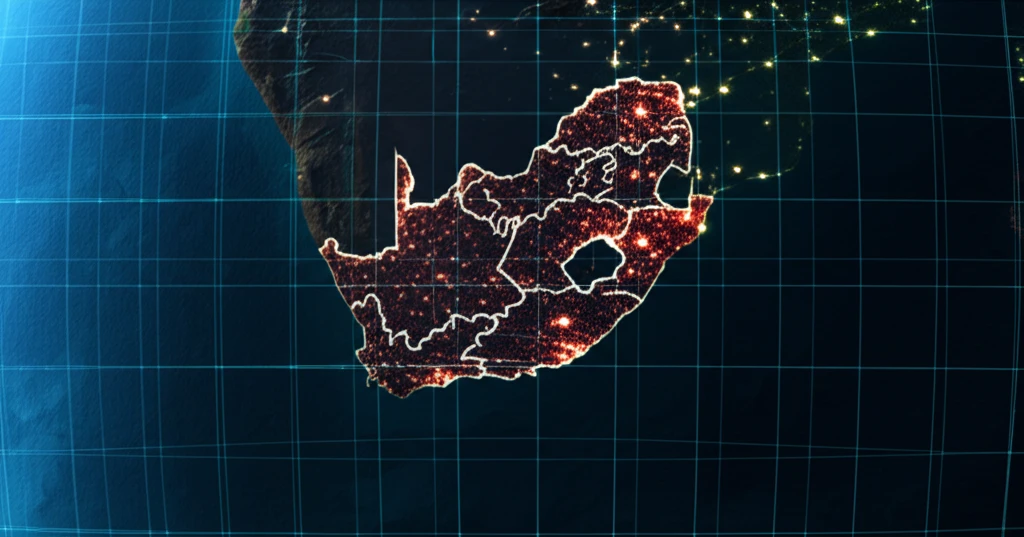
Decoding Economic Growth: Is Night Light Data the New GDP?

"Explore how innovative uses of nighttime light data are challenging traditional economic measures and offering fresh insights into South Africa's growth dynamics."
For decades, Gross Domestic Product (GDP) has been the gold standard for measuring a nation's economic health. It's the number everyone watches, the metric that guides policy, and the benchmark for progress. But what if there was a better way? A method that cuts through the noise of traditional data and offers a clearer, more real-time view of economic activity? Enter nighttime light data—a revolutionary approach that's turning heads and challenging the status quo.
Imagine peering down at Earth from space, not during the day, but at night. What you'd see is a patchwork of glowing lights, each point representing human activity, energy consumption, and economic vibrancy. This isn't science fiction; it's a rapidly developing field that uses satellite imagery to measure economic growth. The core idea? Where there's light, there's economic activity. And increasingly, researchers are finding that this light offers a more accurate and nuanced picture than GDP alone, especially in emerging economies.
This article delves into the fascinating world of nighttime light data and its potential to revolutionize how we understand economic growth. We'll focus on a compelling case study: South Africa, where researchers are using light data to challenge traditional GDP measurements and uncover new insights into the nation's economic dynamics. Get ready to question everything you thought you knew about measuring progress.
Measuring What Matters
Gross Domestic Product has long served as the primary yardstick for national economic performance, yet it is widely acknowledged to capture an incomplete picture of prosperity. GDP measures the market value of goods and services produced but struggles to account for informal economies, unpaid labor, environmental degradation, and income distribution. The search for supplementary or alternative indicators has grown more urgent as policymakers seek richer, real-time data to guide development decisions.
The GDP Framework and Its Blind Spots
Conventional national accounts rely on household surveys, tax records, and business registries to estimate output, but these instruments are costly to maintain and slow to produce results. Many developing nations lack the statistical infrastructure to generate timely GDP figures, and revisions can take years to finalize. As a result, economists and international organizations have increasingly looked to alternative data sources—including satellite imagery—to fill informational gaps.
From Sputnik to Smartphones
The idea of using nighttime satellite imagery to gauge economic activity dates back to the early 1990s, when researchers first paired Defense Meteorological Satellite Program (DMSP) data with national income statistics. Early studies demonstrated that the intensity of artificial light visible from space correlated meaningfully with electricity consumption and output. Over subsequent decades, the advent of the VIIRS sensor aboard the Suomi NPP satellite dramatically improved resolution and data availability, making nighttime lights a mainstream tool in development economics.
The Limitations of GDP: Why We Need a New Perspective
GDP, despite its widespread use, has some critical limitations, especially when applied to emerging economies. Traditional GDP calculations often rely on data that can be outdated, incomplete, or even intentionally skewed. This can lead to inaccurate assessments of economic health and misinformed policy decisions. The study emphasizes that in regions where data collection is inconsistent or unreliable, GDP figures may not fully reflect the ground reality.
- Data Reliability: GDP relies on accurate and timely data, which can be a challenge in some regions.
- Informal Economy: GDP often misses the economic activity in the informal sector.
- Distributional Issues: GDP doesn't reflect how wealth is distributed within a country.
- Non-Economic Factors: GDP doesn't account for social progress, environmental impacts, or overall well-being.
The Evolving Economic Landscape
Contemporary economics examines how societies allocate scarce resources to produce, distribute, and consume goods and services, with growing attention to how non-traditional data streams inform that analysis. Britannica notes that economists are increasingly concerned with the extent to which factors affecting economic development can be shaped by public policy, a question that benefits from timely, granular data. Meanwhile, economists and analysts at major financial outlets track real-time economic indicators as they emerge, reflecting demand for faster and more adaptive measurement frameworks.
When Proxies Fall Short
While alternative data sources like night light imagery offer promising supplements to traditional measures, scholars caution that they are not substitutes for rigorous national accounting. Economics, as a discipline rooted in understanding resource allocation, demands indicators that capture not just output but also distribution, welfare, and opportunity costs—dimensions a light-intensity proxy cannot directly reveal. Overreliance on any single proxy risks misleading policy if the relationship between the proxy and the underlying economic reality weakens or breaks down under structural change.
Night Lights vs. Traditional Metrics
Multiple studies have now established that long-term growth in nighttime light intensity is positively associated with long-term economic growth, including evidence specific to small island developing states (SIDS). The World Bank has catalogued findings of positive correlations between nighttime lights and several economic variables, reinforcing the case for satellite-derived proxies in contexts where conventional data are sparse. Gibson and colleagues describe nighttime lights as a widely adopted data source for evaluating regional economic performance, and their county-level U.S. study has been cited over 100 times. Researchers at VoxDev have contributed a new adjusted and harmonized satellite nighttime-lights series spanning 1992–2023, designed to track local development in the Global South more accurately than previous datasets.
The Future of Economic Measurement: Shining a Light on Progress
The shift towards using nighttime light data represents a significant step forward in how we measure and understand economic growth. While traditional GDP measurements will likely remain a key indicator, incorporating alternative data sources like satellite imagery offers a more nuanced and accurate perspective. This is particularly crucial for emerging economies, where reliable data is often scarce. By embracing these innovative approaches, policymakers and researchers can gain deeper insights, make more informed decisions, and ultimately drive more sustainable and equitable economic development. The future of economic measurement is bright—literally.
Weighing the Evidence
The convergence of remote sensing technology and economic research has produced a genuinely useful, if imperfect, complement to traditional measurement. Night light data cannot replace the depth and breadth of national accounts, but in data-scarce environments they offer a credible and timely signal. As measurement frameworks mature, the most productive path likely involves integrating satellite-derived indicators alongside conventional statistics rather than treating them as rivals.
What Comes Next
Ongoing improvements in satellite sensor resolution and data processing algorithms are expected to sharpen the precision of nighttime-lights analysis at increasingly local scales. The development of harmonized, long-run datasets spanning several decades will allow researchers to study structural economic transitions with greater confidence. Future work may also explore combining night light data with other non-traditional sources—such as mobile phone activity, social media geolocation, and agricultural remote sensing—to build multidimensional economic dashboards.
Systemic Barriers to Better Measurement
Despite methodological advances, significant challenges remain in translating satellite observations into reliable economic inference. Cloud cover, sensor degradation, and differences across satellite platforms introduce noise that must be carefully calibrated and corrected. Perhaps more fundamentally, no single indicator—traditional or alternative—can capture the full complexity of economic life, and policymakers must resist the temptation to reduce multidimensional welfare to a lone metric.
Data Behind the Darkness
Behind every pixel of nighttime satellite imagery is a community whose economic reality it purports to reflect. When measurement tools improve, they do more than sharpen academic models; they can redirect development aid, influence infrastructure investment, and shape how governments prioritize resources. Ensuring that these tools are accessible, transparent, and grounded in local realities is essential if they are to serve—not distort—the populations they are meant to help.