
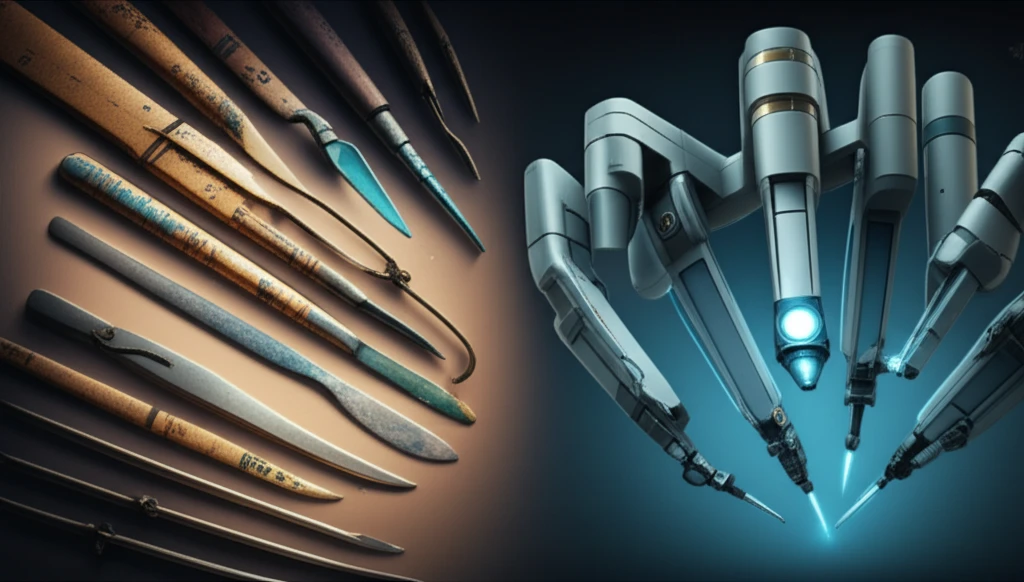
A surreal image representing the evolution of surgery, blending ancient and modern tools.

From Ancient Practices to Robotic Surgery: How Far Has Surgery Evolved?

"Explore the milestones in surgical history, from early wound care to cutting-edge robotic techniques, and how these innovations have shaped modern medicine."


Surgery, as we know it today, is a culmination of centuries of innovation, adaptation, and relentless pursuit of better patient outcomes. What began as rudimentary wound care has transformed into a highly specialized field, incorporating advanced technologies like robotics and minimally invasive techniques.

This journey through surgical history highlights the pivotal moments and influential figures who dared to challenge existing norms, often in the face of skepticism and resistance. From the early understanding of anatomy to the development of anesthesia and antisepsis, each breakthrough has paved the way for the next, expanding the boundaries of what is surgically possible.

This article explores the evolution of surgery, examining key milestones in anatomy, surgical techniques, and medical thinking that have shaped our current practices. It offers insights into how historical challenges were overcome, setting the stage for future advancements in this dynamic field.

Early Days: Wound Care and the Dawn of Surgical Thought

A surreal image representing the evolution of surgery, blending ancient and modern tools.

The earliest evidence of surgical intervention dates back to ancient Egypt, with documents like the Edwin Smith Papyrus detailing wound approximation and stitching techniques. These early practices focused on basic repair and differed little from mending clothes or fixing tents.

Humoral theory, popularized by Hippocrates and Galen, significantly influenced surgical approaches for centuries. This theory posited that the body's health depended on a balance of four humors: blood, phlegm, black bile, and yellow bile. Treatment often involved bloodletting, cupping, and inducing sweating or pus formation to restore balance.

  • Ancient Egypt: The Edwin Smith Papyrus provides the earliest surgical documentation, detailing wound closure with sutures and linen strips.
  • Hippocrates and Galen: Their humoral theory dominated medical thinking for over 1500 years, influencing surgical practices and treatment methods.
  • Roman Era: Autopsies were prohibited, limiting anatomical knowledge and forcing Galen to base his understanding on animal dissections.
Despite its limitations, the humoral theory offered a logical framework for understanding and treating diseases, guiding medical practice well into the Middle Ages. This system was only replaced with new insights.

Looking Ahead: What Does the Future Hold?

As we reflect on the journey of surgery, from ancient wound care to modern robotic interventions, one thing becomes clear: the pursuit of better patient outcomes will continue to drive innovation.

While predicting the future is always a challenge, especially given surgeons'

Despite the unpredictability of technological advancements, the core mission of surgery remains constant: to alleviate suffering and improve the quality of life for patients. This commitment will continue to guide surgeons as they embrace new tools and techniques in the years to come.

About this Article -

This article was crafted using a human-AI hybrid and collaborative approach. AI assisted our team with initial drafting, research insights, identifying key questions, and image generation. Our human editors guided topic selection, defined the angle, structured the content, ensured factual accuracy and relevance, refined the tone, and conducted thorough editing to deliver helpful, high-quality information.See our About page for more information.

This article is based on research published under:

DOI-LINK: 10.1080/00015458.2013.11680968, Alternate LINK

Title: History Of Surgery: A Global View (1)

Subject: General Medicine

Journal: Acta Chirurgica Belgica

Publisher: Informa UK Limited

Authors: R. Van Hee

Published: 2013-01-01

Everything You Need To Know

1

What specific surgical techniques were employed in ancient Egypt based on the Edwin Smith Papyrus?

Early surgical practices, as documented in the Edwin Smith Papyrus of ancient Egypt, primarily focused on basic wound care, such as approximating wound edges and using sutures and linen strips to close them. These methods were rudimentary compared to modern surgical techniques, resembling the simple repair of clothing or tents. There was a limited understanding of anatomy and physiology, which restricted the scope and effectiveness of surgical interventions. There was no mention of specific tools used in the document.

2

How did the humoral theory of Hippocrates and Galen impact surgical treatments, and what were its limitations?

Hippocrates and Galen's humoral theory, which posited that health depended on the balance of four humors (blood, phlegm, black bile, and yellow bile), significantly influenced surgical practices for over 1500 years. Treatments based on this theory often involved bloodletting, cupping, and inducing sweating or pus formation to restore humoral balance. Although limited by today's standards, the humoral theory provided a structured framework for understanding and treating diseases, guiding medical practice well into the Middle Ages. However, it lacked a precise understanding of human anatomy and physiology.

3

What impact did the prohibition of autopsies during the Roman era have on anatomical knowledge and surgical advancements?

The prohibition of autopsies during the Roman era severely limited the understanding of human anatomy. Galen, a prominent physician of the time, was forced to rely on animal dissections to understand anatomy. This led to inaccuracies in his anatomical descriptions, which persisted for centuries due to the lack of direct observation of the human body. The limitation of anatomical knowledge hindered advancements in surgical techniques and understanding disease processes. The texts also didn't specify what animals he used.

4

What is the primary driving force behind the continuous evolution of surgical practices?

The evolution of surgery has been driven by the relentless pursuit of better patient outcomes, leading to continuous innovation and adaptation. From the earliest wound care techniques in ancient Egypt to the modern robotic surgery, each advancement has built upon previous knowledge and challenged existing norms. Key milestones such as the understanding of anatomy, development of anesthesia and antisepsis, and the integration of advanced technologies have expanded the boundaries of what is surgically possible. The article shows that robotic surgeries didn't just appear. They are the result of centuries of work and dedication of many people.

5

How do modern surgical technologies, such as robotics and minimally invasive techniques, enhance patient outcomes compared to historical methods?

Modern surgery leverages advanced technologies like robotics and minimally invasive techniques to improve patient outcomes. These technologies enable surgeons to perform complex procedures with greater precision, reduce invasiveness, and shorten recovery times. While the text highlights the use of robotics, other advancements like imaging technologies (MRI, CT scans) and sophisticated monitoring systems also play crucial roles in modern surgical practices. The article focuses on the progression of ideas and the next article would likely talk about tools.

Newsletter Subscribe

Subscribe to get the latest articles and insights directly in your inbox.