
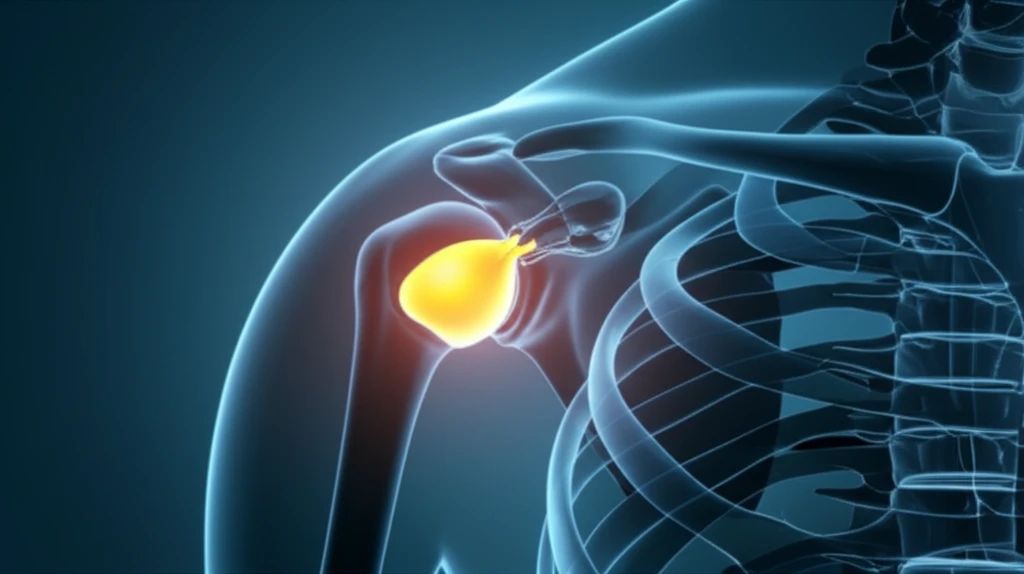
Illustration of a shoulder joint with a subacromial spacer supporting a fractured greater tuberosity.

Fracture Breakthrough: How a New Spacer Technique Gets You Moving Sooner

"Comminuted greater tuberosity fractures can be tough, but a novel surgical method using a subacromial spacer is changing recovery times and outcomes."


Greater tuberosity (GT) fractures, common in younger, active individuals, often require surgical intervention when displacement occurs. Traditionally, these fractures, which account for a significant portion of proximal humeral fractures, are addressed with techniques aimed at restoring rotator cuff biomechanics and preventing subacromial impingement.

Arthroscopic techniques have emerged as a valuable tool, allowing surgeons to address GT fractures while simultaneously identifying and treating coexisting injuries like rotator cuff and labral tears. However, comminuted fractures, where the bone is broken into multiple fragments, present a challenge for traditional rigid fixation methods.

Now, a novel approach is offering new hope for these complex cases: the use of a subacromial spacer in conjunction with double-row suture anchor fixation. This article explores this innovative technique, detailing its benefits for comminuted GT fractures and how it facilitates earlier, more active rehabilitation.

The Subacromial Spacer Solution: Compression and Early Mobility

Illustration of a shoulder joint with a subacromial spacer supporting a fractured greater tuberosity.

The core concept behind this technique leverages the unique properties of a subacromial spacer, typically used in cases of massive, irreparable rotator cuff tears. The InSpace device, a biodegradable balloon-shaped implant, is inserted between the acromion and the humeral head.

Here's how it works:

  • Compression Effect: The inflated spacer provides a consistent compression force on the GT fracture fragments, promoting stability and preventing further displacement.
  • Early Active Rehabilitation: This stability allows for earlier initiation of active shoulder rehabilitation, crucial for preventing stiffness and restoring function.
  • Biodegradable: The spacer degrades naturally within 12 months, leaving no permanent implant.
The surgical technique involves a detailed arthroscopic assessment to identify any concomitant injuries. The GT fracture is visualized, and the spacer is carefully positioned through an anterolateral portal. Proper sizing of the spacer is essential to ensure adequate compression without overstuffing the joint. Suture anchor fixation is then performed to secure the fracture fragments. The entire procedure aims to restore shoulder biomechanics, reduce pain, and facilitate a faster return to activity.

A New Era in Fracture Management

The addition of a subacromial spacer represents a significant advancement in the surgical treatment of comminuted GT fractures. By providing compression and stability, this technique enables earlier rehabilitation and potentially improves long-term outcomes.

While the cost of the spacer and the additional operative time are factors to consider, the benefits of reduced pain, shorter hospital stays, and faster return to work may outweigh these concerns. Furthermore, the simplicity of the technique makes it accessible to a wider range of surgeons.

This innovative approach offers a promising solution for patients with challenging GT fractures, paving the way for quicker recovery and a return to an active lifestyle. The 'double tension-band' effect created by the suture bridge and balloon implant is designed to prevent displacement.

About this Article -

This article was crafted using a human-AI hybrid and collaborative approach. AI assisted our team with initial drafting, research insights, identifying key questions, and image generation. Our human editors guided topic selection, defined the angle, structured the content, ensured factual accuracy and relevance, refined the tone, and conducted thorough editing to deliver helpful, high-quality information.See our About page for more information.

This article is based on research published under:

DOI-LINK: 10.1055/s-0038-1675162, Alternate LINK

Title: Surgical Management Of Comminuted, Displaced Greater Tuberosity Fractures: A New Technique Of Subacromial Spacer On Top Of Double-Row Suture Anchor Fixation

Subject: Rehabilitation

Journal: Joints

Publisher: Georg Thieme Verlag KG

Authors: Leslie Naggar

Published: 2018-09-01

Everything You Need To Know

1

What exactly is a comminuted greater tuberosity fracture, and why is it challenging to treat?

A comminuted greater tuberosity fracture refers to a break of the greater tuberosity into multiple fragments. This type of fracture is more challenging to treat with traditional rigid fixation methods because the multiple fragments make it difficult to achieve stable fixation. The subacromial spacer provides a solution by offering compression and stability to these fragments, promoting better healing.

2

How does the subacromial spacer technique specifically aid in the recovery process for greater tuberosity fractures?

The subacromial spacer technique aids in recovery from greater tuberosity fractures by providing a consistent compression force on the fracture fragments, enhancing stability, and preventing further displacement. This stability allows for earlier initiation of active shoulder rehabilitation, which is crucial for preventing stiffness and restoring function. The InSpace device, a biodegradable balloon-shaped implant, is inserted between the acromion and the humeral head to achieve this compression.

3

Can you explain the role of the InSpace device in this novel fracture treatment and what happens to it over time?

The InSpace device, used in this technique, is a biodegradable balloon-shaped implant typically used in cases of massive, irreparable rotator cuff tears. In the context of comminuted greater tuberosity fractures, it is inserted between the acromion and the humeral head to provide compression and stability to the fracture fragments. The spacer degrades naturally within 12 months, leaving no permanent implant.

4

Why is double-row suture anchor fixation used in conjunction with the subacromial spacer, and what does it achieve?

Double-row suture anchor fixation is used in conjunction with the subacromial spacer to secure the fracture fragments of the greater tuberosity. While the subacromial spacer provides compression and stability, the suture anchors ensure that the fragments are held together securely, promoting optimal healing. This combination aims to restore shoulder biomechanics, reduce pain, and facilitate a faster return to activity.

5

What are the primary benefits of using a subacromial spacer with double-row suture anchor fixation, especially concerning rehabilitation and long-term outcomes, compared to traditional methods?

The primary benefit of using a subacromial spacer with double-row suture anchor fixation is that it enables earlier active rehabilitation for comminuted greater tuberosity fractures. By providing compression and stability, this technique reduces the risk of stiffness and promotes a faster return to function. While rigid fixation aims to hold the fragments together, the spacer actively supports the healing process by allowing controlled movement and reducing stress on the healing bone, potentially leading to improved long-term outcomes compared to traditional methods.

Newsletter Subscribe

Subscribe to get the latest articles and insights directly in your inbox.