
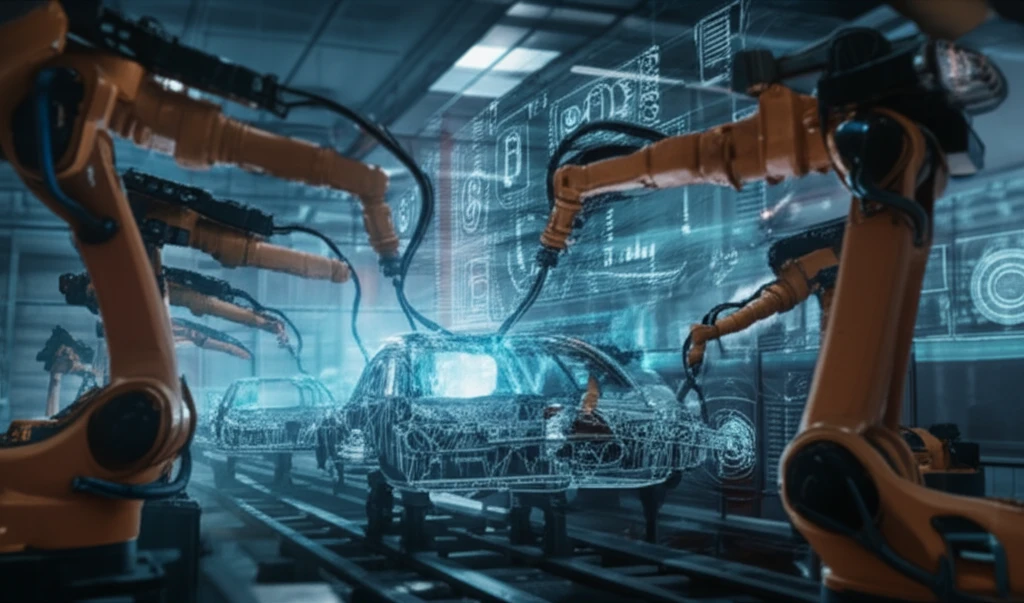
Futuristic automobile assembly line featuring injection forging.

Forging Ahead: Is Injection Forging the Future of Auto Manufacturing?

"Explore the potential of injection forging versus traditional methods in automobile manufacturing, and how this innovative approach could revolutionize production efficiency and component quality."


In the relentless pursuit of efficiency and innovation, the automotive industry is constantly exploring new manufacturing techniques. Among these, injection forging has emerged as a promising alternative to traditional multistep forging for producing automobile fasteners. This approach aims to streamline production, reduce material waste, and enhance the overall quality of components.

Traditional cold forging has long been a mainstay in the manufacturing of metal components, particularly in the automotive sector. Renowned for its ability to deliver precise dimensions, superior surface finishes, and enhanced material properties, cold forging has been the go-to method for producing symmetrical auto parts. However, as global competition intensifies and demands for greater efficiency grow, conventional forging methods face increasing challenges.

This article delves into a detailed comparison between traditional multistep forging and the innovative injection forging technique, leveraging finite element analysis to assess critical factors such as forging force, energy consumption, component accuracy, and die stress distribution. By understanding these elements, manufacturers can better evaluate the potential and challenges of adopting injection forging in their operations.

Injection Forging vs. Multistep Forging: What's the Difference?

Futuristic automobile assembly line featuring injection forging.

Traditional multistep forging involves several stages to transform raw material into a finished product. Each step progressively shapes the metal, often requiring multiple dies and significant energy input. This method, while reliable, can be time-consuming and generate considerable material waste.

Injection forging, on the other hand, offers a more streamlined approach. By combining multiple forming operations into a single step, injection forging reduces the process chain, minimizes post-processing requirements, and improves material utilization. This innovative technique involves injecting metal into a die cavity under high pressure, creating complex shapes with greater precision and efficiency.

Here’s a quick breakdown of the key differences:
  • Process Chain: Injection forging shortens the process by combining steps.
  • Material Use: Injection forging improves material use, reducing waste.
  • Energy Consumption: Multistep forging typically requires more energy due to the multiple stages involved.
  • Component Accuracy: Both methods can achieve high accuracy, but injection forging offers potential for even greater precision in complex shapes.
Researchers have been actively exploring and refining injection forging techniques. Studies have focused on defining formability limits, optimizing die designs, and understanding material flow to enhance the process. These efforts aim to overcome challenges such as instability in the workpiece and surface folding, paving the way for wider adoption of injection forging in mass production.

The Road Ahead: Embracing Innovation in Auto Manufacturing

Injection forging represents a significant step forward in automobile manufacturing, offering potential benefits in terms of efficiency, material utilization, and component quality. While challenges remain, ongoing research and development efforts are paving the way for wider adoption of this innovative technique. As the automotive industry continues to evolve, embracing such advancements will be crucial for staying competitive and meeting the demands of the future.

About this Article -

This article was crafted using a human-AI hybrid and collaborative approach. AI assisted our team with initial drafting, research insights, identifying key questions, and image generation. Our human editors guided topic selection, defined the angle, structured the content, ensured factual accuracy and relevance, refined the tone, and conducted thorough editing to deliver helpful, high-quality information.See our About page for more information.

This article is based on research published under:

DOI-LINK: 10.1051/matecconf/20152102007, Alternate LINK

Title: Comparison Study Of Multistep Forging And Injection Forging Of Automobile Fasteners

Subject: General Medicine

Journal: MATEC Web of Conferences

Publisher: EDP Sciences

Authors: Senyong Chen, Yi Qin

Published: 2015-01-01

Everything You Need To Know

1

What exactly is injection forging and how does it work?

Injection forging combines multiple forming operations into a single step, creating complex shapes with greater precision and efficiency. This method involves injecting metal into a die cavity under high pressure. This contrasts with multistep forging, which uses several stages to transform raw material into a finished product, often needing multiple dies and significant energy.

2

Why is injection forging considered significant in auto manufacturing?

Injection forging is important in auto manufacturing because it offers several advantages over traditional multistep forging. It streamlines production by reducing the process chain, minimizes post-processing requirements, and improves material utilization. This leads to greater efficiency, reduced waste, and potentially higher-quality components, which are crucial for staying competitive in the automotive industry.

3

What are the main differences between injection forging and multistep forging?

The primary difference lies in the process. Multistep forging uses multiple stages, each shaping the metal progressively, making it time-consuming and energy-intensive. Injection forging combines multiple forming operations into a single step, making it more efficient and reducing waste. Injection forging involves injecting metal into a die cavity under high pressure. While both methods aim for component accuracy, injection forging has the potential to achieve greater precision, especially in complex shapes.

4

What are the potential implications of using injection forging in automobile manufacturing?

The implications of adopting injection forging are significant for the automotive industry. By improving material utilization, injection forging reduces waste and lowers production costs. The streamlined process also speeds up production times. Greater precision and higher-quality components resulting from injection forging contribute to more reliable and durable vehicles. This can give automakers a competitive edge in the market. The industry will embrace these advancements to meet future demands.

5

What is the future of injection forging in auto manufacturing?

The automotive industry is constantly exploring new manufacturing techniques to improve efficiency, reduce waste, and enhance component quality. Injection forging has emerged as a promising alternative to traditional multistep forging. Ongoing research focuses on optimizing die designs and understanding material flow, which is critical for mass production adoption. Embracing such advancements will be crucial for staying competitive and meeting the demands of the future.

Newsletter Subscribe

Subscribe to get the latest articles and insights directly in your inbox.