
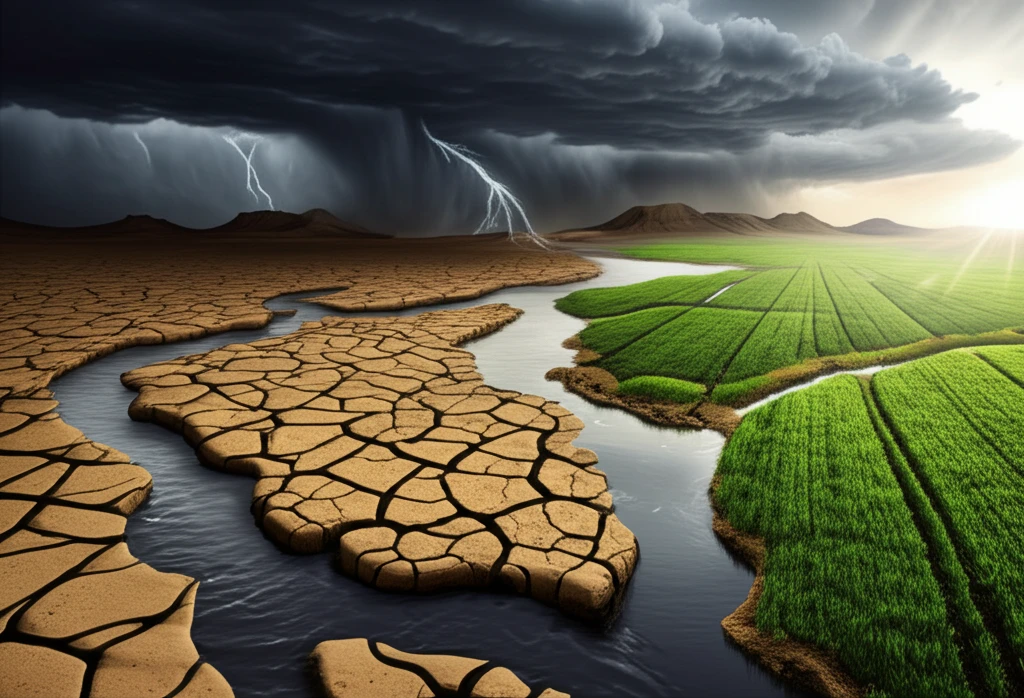
Surreal landscape symbolizing the food security challenges in Egypt and Ethiopia.

Food Security Under Threat: Can Egypt and Ethiopia Withstand Future Climate Shocks?

"New research reveals how climate change and socioeconomic factors could drastically impact food security in Egypt and Ethiopia by 2050."


In an era defined by rapid environmental and socioeconomic shifts, the stability of national food supplies is under increasing pressure. A recent study casts a spotlight on Egypt and Ethiopia, two nations in the Nile region facing distinct yet interconnected challenges to their food security. As global populations surge and climate patterns become more unpredictable, understanding and mitigating these risks is more critical than ever.

The study, employing a probabilistic scenario-based framework, integrates Shared Socioeconomic Pathways (SSP) and Representative Concentration Pathways (RCP) to model potential futures. This innovative approach allows researchers to treat each scenario—defined by socio-economic and climate factors—as a dynamic model, generating a range of possible trajectories. By focusing on population dynamics, economic forecasts, and climate variables, the research paints a detailed picture of potential food security outcomes.

This article unpacks the study’s methodologies, findings, and implications, emphasizing the importance of proactive strategies and international cooperation in safeguarding food security for vulnerable nations. As we delve into the specifics of the challenges facing Egypt and Ethiopia, we'll consider what these insights might mean for global food security strategies.

Egypt's Looming Water Crisis: A Threat to Food Security?

Surreal landscape symbolizing the food security challenges in Egypt and Ethiopia.

Egypt, a nation heavily reliant on the Nile, faces an 'extremely high' water stress situation. The study underscores that Egypt's food security is intricately linked to its water resources, with levels fluctuating precariously over the past two decades. This dependence makes Egypt particularly vulnerable to climate change impacts, which could further strain water availability and, consequently, agricultural output.

Despite these challenges, the research suggests a nuanced outlook. While Egypt's food security risk is projected to increase in the coming years, the study also indicates a potential stabilization, or even slight improvement, in the long term under certain SSP-RCP scenarios. However, this outcome hinges on proactive measures and sustainable water management strategies.

  • Infrastructure Investments: Upgrading irrigation systems and water management technologies to minimize waste.
  • Policy Interventions: Implementing policies that promote water conservation in agriculture.
  • International Cooperation: Strengthening collaborations with neighboring countries to ensure equitable water distribution from the Nile.
Without these measures, Egypt risks exacerbating its already strained food security situation. The study’s findings serve as a call to action, urging policymakers to prioritize water conservation and sustainable agricultural practices to safeguard the nation’s food supply.

Charting a Course Towards Food Security

The challenges facing Egypt and Ethiopia offer valuable lessons for countries worldwide. By adopting integrated approaches, investing in sustainable practices, and fostering international cooperation, nations can proactively address the threats to their food security. Only through concerted effort and forward-thinking policies can we hope to ensure stable and secure food supplies for future generations, even in the face of an uncertain climate.

About this Article -

This article was crafted using a human-AI hybrid and collaborative approach. AI assisted our team with initial drafting, research insights, identifying key questions, and image generation. Our human editors guided topic selection, defined the angle, structured the content, ensured factual accuracy and relevance, refined the tone, and conducted thorough editing to deliver helpful, high-quality information.See our About page for more information.

This article is based on research published under:

DOI-LINK: 10.1093/jrsssa/qnae046,

Title: Probabilistic Scenario-Based Assessment Of National Food Security Risks With Application To Egypt And Ethiopia

Subject: econ.em stat.ap

Authors: Phoebe Koundouri, Georgios I. Papayiannis, Achilleas Vassilopoulos, Athanasios N. Yannacopoulos

Published: 07-12-2023

Everything You Need To Know

1

How does the study assess future food security in Egypt and Ethiopia?

The study employs a probabilistic scenario-based framework, integrating Shared Socioeconomic Pathways (SSP) and Representative Concentration Pathways (RCP) to model potential futures in Egypt and Ethiopia. This innovative approach treats each scenario—defined by socio-economic and climate factors—as a dynamic model, generating a range of possible trajectories. The research focuses on population dynamics, economic forecasts, and climate variables to project potential food security outcomes. By considering various factors, the research paints a detailed picture of potential food security outcomes in Egypt and Ethiopia under different conditions.

2

What specific challenges does Egypt face regarding its food security?

Egypt faces an 'extremely high' water stress situation, making its food security intricately linked to its water resources. This dependence makes Egypt particularly vulnerable to climate change impacts, which could further strain water availability and, consequently, agricultural output. The country's reliance on the Nile River makes it susceptible to fluctuations in water levels and any disruptions to the river's flow. Egypt's food security risk is projected to increase, however sustainable water management strategies, which would require infrastructure investments, policy interventions, and international cooperation, could stabilize the situation.

3

What proactive measures are crucial for Egypt to safeguard its food supply, according to the research?

The research emphasizes that proactive measures, specifically, Infrastructure Investments which would entail upgrading irrigation systems and water management technologies to minimize waste, Policy Interventions by implementing policies that promote water conservation in agriculture, and International Cooperation by strengthening collaborations with neighboring countries to ensure equitable water distribution from the Nile are crucial for Egypt to safeguard its food supply. Without these measures, Egypt risks exacerbating its already strained food security situation, potentially leading to severe consequences for its population and economy.

4

In what ways do Shared Socioeconomic Pathways (SSP) and Representative Concentration Pathways (RCP) contribute to understanding food security challenges?

Shared Socioeconomic Pathways (SSP) and Representative Concentration Pathways (RCP) are used to create different scenarios to model potential futures. SSPs define possible socio-economic developments, such as population growth, economic development, and technological changes, while RCPs outline different climate change scenarios based on greenhouse gas concentration levels. By integrating these pathways, the study assesses how various combinations of socio-economic and climate conditions could impact food security in Egypt and Ethiopia. This approach allows for a comprehensive understanding of the multiple factors influencing food security and helps identify effective strategies for mitigating potential risks. They allow for a more detailed picture of what the future may hold.

5

Beyond Egypt and Ethiopia, what broader implications does this research have for global food security strategies?

The challenges facing Egypt and Ethiopia offer valuable lessons for countries worldwide. By adopting integrated approaches, investing in sustainable practices, and fostering international cooperation, nations can proactively address the threats to their food security. The study underscores the importance of forward-thinking policies that consider both climate change and socioeconomic factors in ensuring stable and secure food supplies for future generations, even in the face of an uncertain climate. Furthermore, it highlights the need for proactive strategies and international cooperation in safeguarding food security for vulnerable nations, which can be applied globally.

Newsletter Subscribe

Subscribe to get the latest articles and insights directly in your inbox.