
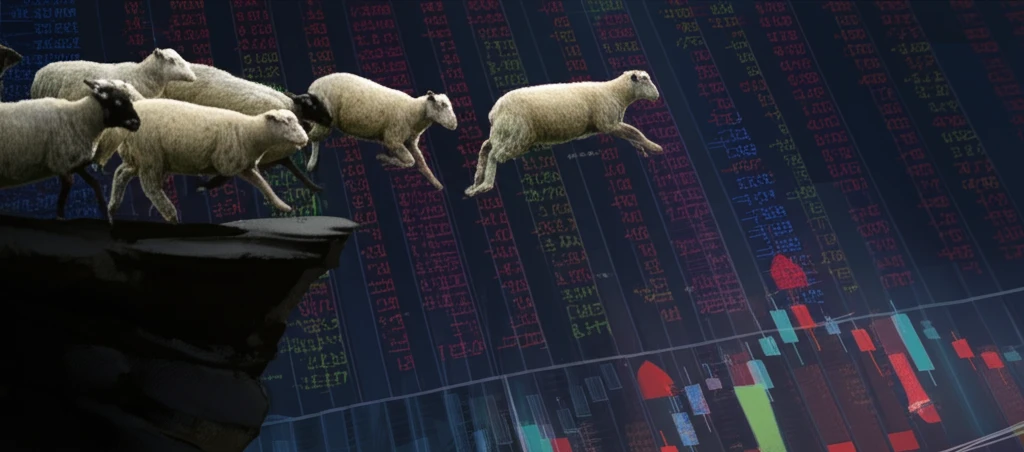
Herd of sheep jumping off a cliff, symbolizing the dangers of herd behavior in financial markets.

Following the Crowd? How Herd Behavior Impacts Your Investments

"Unlock the secrets of herd behavior in investing and learn how to make smarter, more independent financial decisions. Is following the crowd the right strategy, or is it a path to missed opportunities and potential losses?"


In the bustling world of finance, where fortunes are made and lost, it's tempting to follow the advice of leading experts. Financial analysts, fund managers, and other professionals share their insights through various channels, becoming de facto guides for many investors. However, the tendency to mimic these experts, a phenomenon known as herd behavior, can have profound implications on investment outcomes.

Herd behavior isn't just about heeding expert advice; it's also rooted in a basic human preference for conformity. People often lean towards decisions that align with the consensus, fostering a sense of trust and validation. While this approach can feel safe, it's crucial to understand how it affects individual investment strategies and overall market dynamics.

Optimal investment theory provides a framework for understanding how investors can dynamically adjust their decisions to maximize returns and minimize risks. But how does herd behavior fit into this picture? Can mathematical models help us quantify its influence and guide us towards more rational choices?

What is Herd Behavior and Why Does it Matter?

Herd of sheep jumping off a cliff, symbolizing the dangers of herd behavior in financial markets.

Herd behavior, at its core, is the inclination to follow the actions of a larger group, irrespective of one's own analysis or information. In financial markets, this means investors tend to mimic the decisions of leading experts or the general market trend, potentially overlooking individual financial goals and risk tolerance.

The implications of herd behavior are far-reaching. While it can drive short-term gains and market stability, it also poses significant risks. Overreliance on collective wisdom can lead to:

  • Missed Opportunities: Overlooking undervalued assets or innovative investment options.
  • Increased Volatility: Amplifying market swings as everyone buys or sells simultaneously.
  • Suboptimal Returns: Sacrificing personalized investment strategies for generic approaches.
  • Financial Bubbles and Crashes: Contributing to unsustainable market booms and subsequent collapses.
Therefore, it's essential to understand the dynamics of herd behavior and develop strategies to balance expert insights with independent analysis.

Navigating the Investment Landscape with Confidence

Understanding herd behavior is crucial for making informed and independent investment decisions. By recognizing its influence, balancing expert insights with personal analysis, and embracing rational decision-making, investors can navigate the financial landscape with greater confidence and achieve their long-term financial goals.

About this Article -

This article was crafted using a human-AI hybrid and collaborative approach. AI assisted our team with initial drafting, research insights, identifying key questions, and image generation. Our human editors guided topic selection, defined the angle, structured the content, ensured factual accuracy and relevance, refined the tone, and conducted thorough editing to deliver helpful, high-quality information.See our About page for more information.

This article is based on research published under:

DOI-LINK: https://doi.org/10.48550/arXiv.2401.07183,

Title: Optimal Investment With Herd Behaviour Using Rational Decision Decomposition

Subject: eess.sy cs.sy math.oc q-fin.mf q-fin.pm

Authors: Huisheng Wang, H. Vicky Zhao

Published: 13-01-2024

Everything You Need To Know

1

What is Herd Behavior in investing?

In the realm of investments, "Herd Behavior" represents the tendency of investors to emulate the actions of a larger group, often disregarding their own analysis or individual information. This behavior can manifest in various ways, such as mimicking decisions of "leading experts" or following general market trends. The core implication is that investors might overlook their personal financial goals and risk tolerance by blindly following the crowd.

2

Why should investors be wary of following Herd Behavior?

Investors should be cautious of "Herd Behavior" due to several significant risks. It can lead to "missed opportunities", where investors overlook potentially profitable undervalued assets or innovative investment options because the herd isn't focused on them. Also, it can inflate market "volatility", amplifying market swings as everyone buys or sells simultaneously, creating instability and unpredictability. Moreover, "Herd Behavior" often leads to "suboptimal returns", sacrificing personalized investment strategies for generic approaches that don't align with individual needs. Finally, in extreme cases, "Herd Behavior" can contribute to the formation of "financial bubbles and crashes", as the collective enthusiasm drives unsustainable market booms that eventually collapse.

3

How does "Optimal investment theory" relate to "Herd Behavior"?

"Optimal investment theory" offers a framework for investors to make decisions to maximize returns and minimize risks. The influence of "Herd Behavior" can disrupt this framework. When investors succumb to "Herd Behavior", they deviate from the principles of "Optimal investment theory" by making decisions based on group consensus rather than independent analysis and risk assessment. Therefore, understanding "Herd Behavior" is essential for investors aiming to apply "Optimal investment theory" effectively. The aim should be to make rational choices.

4

What are some practical strategies to avoid the negative impacts of "Herd Behavior"?

To mitigate the negative impacts of "Herd Behavior", investors can adopt several strategies. Firstly, it's crucial to balance expert insights with independent analysis. This means seeking advice from financial analysts or fund managers, but critically evaluating their recommendations based on personal research and understanding of individual financial goals. Secondly, develop a well-defined investment strategy. This involves setting clear financial objectives, understanding risk tolerance, and creating a diversified portfolio that aligns with these factors. Finally, embrace rational decision-making by avoiding emotional reactions to market fluctuations. Make investment choices based on facts and long-term goals rather than succumbing to the fear or greed that often drives "Herd Behavior".

5

How can one make investment decisions with greater confidence despite the influence of "Herd Behavior"?

Investors can navigate the financial landscape with greater confidence despite the influence of "Herd Behavior" by focusing on a few key elements. Firstly, understanding the dynamics of "Herd Behavior" is crucial; recognizing its potential impact on investment decisions allows investors to approach the market with a critical eye. Secondly, balancing expert insights with independent analysis is paramount; consider expert advice but always conduct your own research and align decisions with your specific financial goals. Finally, embrace rational decision-making over emotional responses. By sticking to a well-thought-out investment strategy and making choices based on factual analysis, investors can achieve their long-term financial goals and avoid the pitfalls of "Herd Behavior".

Newsletter Subscribe

Subscribe to get the latest articles and insights directly in your inbox.