
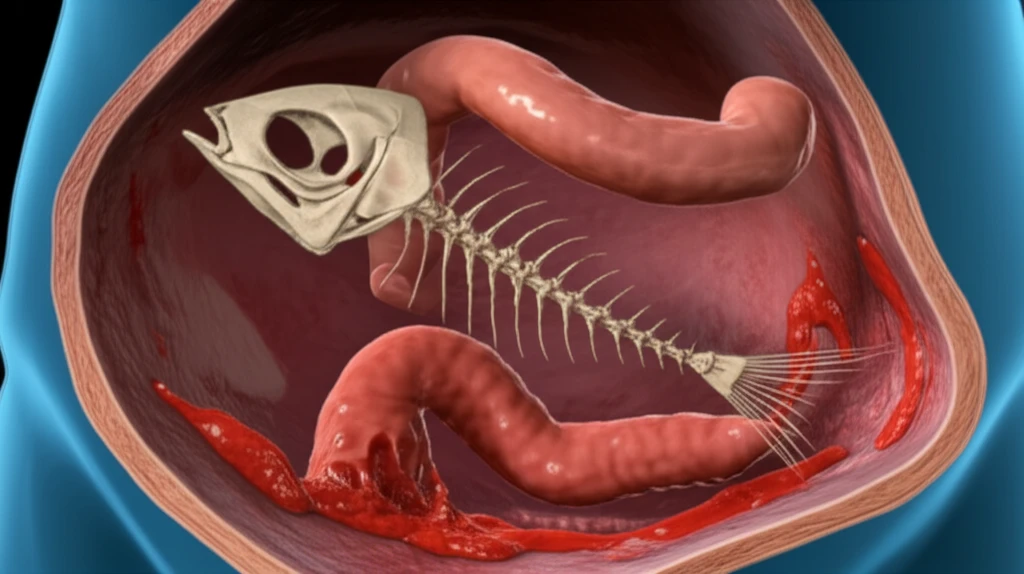
Fish Bone Perforation: A Rare Cause of Peritonitis

"When dinner fights back: A case study exploring how a seemingly harmless fish bone led to a serious abdominal infection and the surgical steps taken to resolve it."
Diagnosing a small bowel perforation caused by a foreign object before surgery is incredibly difficult. These perforations often occur near the ileocecal region, presenting symptoms similar to appendicitis or even generalized peritonitis. In rare instances, these perforations can heal on their own.
This case report details a 70-year-old patient with no significant medical history who was admitted to the emergency department with diffuse abdominal pain that had been worsening for two days. She also experienced some vomiting, but no other accompanying symptoms.
Upon examination, the patient had a fever of 38.6°C but was hemodynamically stable. Her abdomen showed generalized guarding, indicating peritonitis. The rest of her physical examination was unremarkable. Lab results revealed a high white blood cell count of 12,300/mm3 and a C-reactive protein (CRP) level of 94. An initial abdominal X-ray showed no abnormalities.
Unraveling the Diagnosis: How Imaging Revealed the Culprit
Due to the inconclusive X-ray results, an abdominal CT scan was performed. The scan revealed localized thickening of the small bowel, with regular and symmetrical circumferential involvement. There was also enhancement of the mucosa and edema in the submucosa. Within this area, a foreign body, suspected to be a fish bone, appeared to be piercing the intestinal wall, accompanied by a moderate amount of fluid in the peritoneal cavity.
- Preoperative Diagnosis Challenges: Highlighting the difficulties in diagnosing small bowel perforations caused by foreign objects, emphasizing the similarity to other abdominal conditions.
- Importance of Advanced Imaging: Illustrating how a CT scan was crucial in identifying the fish bone and the resulting perforation, leading to a definitive diagnosis.
- Surgical Intervention: Describing the surgical procedure, including the extraction of the fish bone and the subsequent repair of the perforation.
Key Takeaways: Learning from a Rare Case
This case underscores the importance of considering foreign body ingestion in patients presenting with unexplained abdominal pain and peritonitis, even in the absence of a clear history. Advanced imaging techniques like CT scans are invaluable in diagnosing such cases, allowing for prompt surgical intervention and favorable outcomes.