
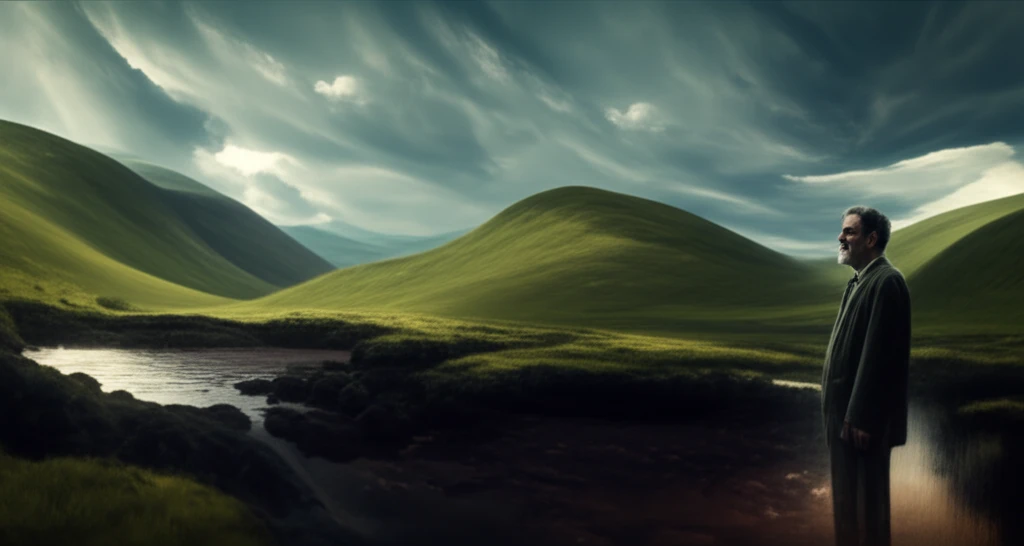
Seamus Heaney standing on the edge of a bog in the Irish landscape.

Finding Home in the Heartland: How Seamus Heaney's Poetry Explores Belonging and Alienation

"Discover how the Irish poet Seamus Heaney uses vivid landscapes to navigate his complex relationship with his homeland, tradition, and artistic freedom."


Poetry and landscape have a long and intertwined history. Just as painters use landscapes to convey emotions and ideas, poets use vivid descriptions of nature to explore complex themes. Seamus Heaney, one of Ireland's most celebrated poets, masterfully employs landscape in his early works to delve into his relationship with his homeland, Irish culture, and his own artistic identity.

Growing up on a farm in County Derry, Northern Ireland, Heaney was immersed in the natural world. This connection profoundly shaped his poetry, where landscapes become more than just backdrops; they are active participants in his exploration of belonging, alienation, and the search for personal and artistic freedom. His early work can be divided into 3 stages. The first stage, the typical Irish landscape as well as ancient tradition is presented.

This article will explore how Heaney uses the landscapes of his childhood—natural settings, farm practices, and place names—in his collections Death of a Naturalist (1966), Door into the Dark (1969), and Wintering Out (1972). We'll examine how these landscapes reflect his complex feelings of being both allied with and alienated from his native culture, and how he uses them to reconcile his artistic aspirations with his social responsibilities.

The Landscapes of the Mind: Natural Ecology in Heaney's Poetry

Seamus Heaney standing on the edge of a bog in the Irish landscape.

Seamus Heaney actively involves in ecological nature and presents it as vivid landscape description. Heaney's relationship with the natural world is a central theme in his poetry. Heaney masterfully uses landscape to express his feelings and artistic vision. His childhood home of Mossbawn becomes a recurring motif, representing both a source of comfort and a place of complex cultural tensions.

Heaney's descriptions of Mossbawn evoke a sense of nostalgia and belonging. Recalling his childhood, he writes of getting lost in a field, finding solace in the "green web, a caul of veined light...full of assuaging earth and leaf smell, a sunlit lair." This peaceful imagery offers a retreat from the external world, suggesting that nature provides a sanctuary for the poet. If he goes astray or gets lost in the way of artistic career, it is natural landscape that he turns to for help, consolation as well as shelter. In addition, natural landscape can give Heaney varied life experiences.

  • Lough Neagh: In poems like "A Lough Neagh Sequence," Heaney captures the essence of the Irish landscape. He presents not just a peaceful lake, but a microcosm of society. It's full of natural forces, mystery, and instinct.
  • Darkness and Mystery: "The Plantation," "The Peninsula," and "Night Drive" reveal a different side of Heaney's landscape. Darkness, mystery, and a sense of uncertainty emerge, reflecting feelings of alienation.
  • The Bog as Memory: Bogs serve as a powerful symbol of Irish history and collective memory. For Heaney, the bog is "the memory of the landscape, or as a landscape that remembered everything that happened in and to it." Poems like "Bogland" connect the present with the past, revealing layers of history preserved within the land itself.
However, even in Mossbawn, Heaney recognizes a sense of division and historical antagonism. The name itself, with its mix of Scots, English, and Gaelic etymologies, reflects the split culture of Ulster. The paradise is seized and translated by the alien Planters. This duality—the sense of belonging intertwined with a consciousness of historical conflict—pervades Heaney's landscape descriptions.

Finding Freedom in the Fields: Heaney's Enduring Connection to the Land

Heaney's landscape descriptions offer more than just scenic beauty; they provide a space for reflection and reconciliation. The rural Irish countryside becomes a refuge. It offers a chance to grapple with complex emotions and find a balance between artistic freedom and social responsibility.

Ultimately, Heaney's poetry suggests that true freedom lies in understanding and engaging with one's heritage, even when that heritage is fraught with conflict and division. By exploring the landscapes of his past, Heaney forges a path toward artistic and personal authenticity.

Through his evocative use of landscape, Seamus Heaney invites us to contemplate our own relationships with the places we call home. He shows us that even in the most familiar landscapes, we can discover new depths of meaning and a deeper understanding of ourselves.

About this Article -

This article was crafted using a human-AI hybrid and collaborative approach. AI assisted our team with initial drafting, research insights, identifying key questions, and image generation. Our human editors guided topic selection, defined the angle, structured the content, ensured factual accuracy and relevance, refined the tone, and conducted thorough editing to deliver helpful, high-quality information.See our About page for more information.

This article is based on research published under:

DOI-LINK: 10.5539/ells.v4n4p79, Alternate LINK

Title: Allied And Alienated: Landscape In Seamus Heaney’S Early Poetry

Subject: General Medicine

Journal: English Language and Literature Studies

Publisher: Canadian Center of Science and Education

Authors: Yaorong He

Published: 2014-11-25

Everything You Need To Know

1

How does Seamus Heaney use landscape in his poetry?

Seamus Heaney uses the Irish landscape as a central element in his poetry, particularly in his early collections such as *Death of a Naturalist*, *Door into the Dark*, and *Wintering Out*. Heaney doesn't just describe landscapes; he uses them to explore complex themes such as belonging, alienation, and the search for artistic freedom. Heaney's descriptions of the natural world, like the farm in County Derry and specific locations like Lough Neagh and the bogs, serve as powerful symbols to examine his relationship with his homeland and artistic identity. The landscape provides a place for reflection and reconciliation, a refuge to grapple with emotions and find a balance between artistic freedom and social responsibility.

2

What does the concept of 'belonging' mean in Seamus Heaney's poetry?

The concept of 'belonging' is central to Heaney's poetry. He uses the Irish landscape, especially places like Mossbawn, to express his feelings of connection to his cultural roots. Heaney's connection to the land is not simple; it involves a complex interplay of nostalgia, comfort, and the consciousness of historical conflict. The landscape becomes a place where he can find solace and a sense of identity, represented by descriptions of Mossbawn and other natural settings. The presence of both belonging and alienation is a recurring theme.

3

Why is landscape so important in Seamus Heaney's poems?

The significance of landscape in Heaney's work lies in its ability to serve as a metaphor for his internal and external conflicts. Heaney's use of landscape is not only about describing nature. It is about exploring his identity, his relationship with Irish culture, and his aspirations as an artist. Heaney's poetry moves beyond simple description to offer insight into the human experience, making the landscape a powerful medium for conveying emotions and ideas. For instance, the darkness and mystery found in poems such as "The Plantation" and "Night Drive", help express feelings of alienation and uncertainty.

4

What is the significance of the 'bog' in Seamus Heaney's poetry?

The 'bog' is a particularly significant symbol in Seamus Heaney's poetry. The bog is a representation of Irish history and collective memory. Poems such as "Bogland" connect the present with the past. Heaney describes the bog as the memory of the landscape, emphasizing its role in preserving layers of history. Through the bog, Heaney explores themes of time, memory, and the enduring impact of the past on the present. By using the bog, Heaney provides a layered understanding of identity and heritage.

5

What role does Mossbawn play in Heaney's work?

Seamus Heaney's childhood home, Mossbawn, is a recurring motif in his poetry. It represents both a source of comfort and a place of complex cultural tensions. Heaney recalls his childhood, finding solace in the natural settings. However, the name Mossbawn reflects the mixed culture of Ulster. This duality—the sense of belonging intertwined with historical conflict—pervades Heaney's landscape descriptions. Heaney uses the natural landscape to help him deal with artistic conflicts and provide a space for reflection and reconciliation, enabling him to find a balance between artistic freedom and social responsibility.

Newsletter Subscribe

Subscribe to get the latest articles and insights directly in your inbox.