
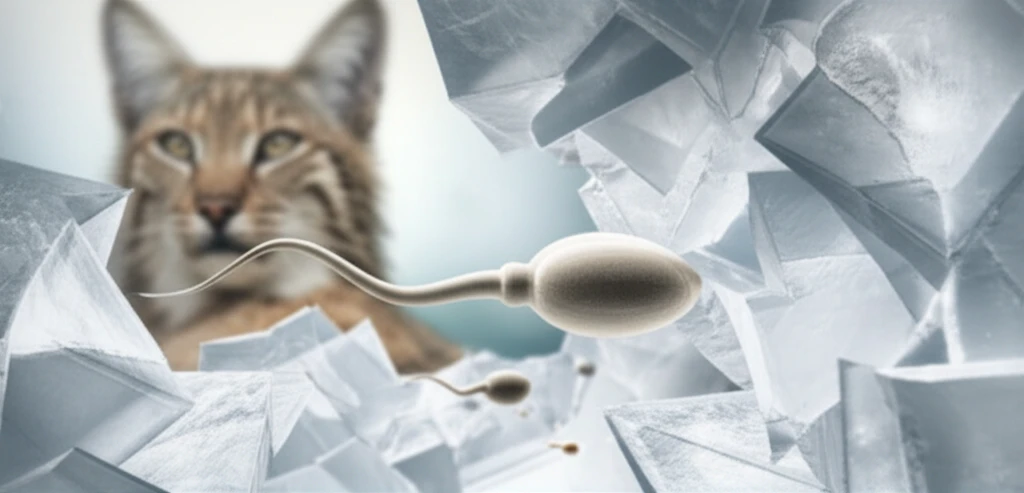
Feline Fertility: How Osmotic Stress Impacts Sperm Health

"Understanding osmotic tolerance can improve cryopreservation techniques for preserving feline epididymal sperm."
For endangered wild cat species, preserving genetic material is critical. Often, this involves freezing sperm collected from the epididymis, a duct behind the testicles where sperm mature. Like human sperm, feline epididymal sperm can be used in assisted reproductive technologies to increase chances of conception.
However, freezing sperm—a process called cryopreservation—isn't always successful. A significant portion of sperm can be damaged during the process. One key factor is osmotic stress, which happens when sperm are exposed to changing salt concentrations during cryopreservation. This can damage the sperm's membranes and internal structures.
New research investigates how well feline epididymal sperm tolerate these osmotic changes. By understanding these tolerance limits, scientists hope to refine cryopreservation techniques and improve the success rates of preserving feline sperm for future use.
Osmotic Stress: A Deep Dive into Sperm Damage
The study exposed feline epididymal sperm to different osmolalities, measuring sperm motility, membrane integrity, and mitochondrial membrane potential (MMP). Osmolality refers to the concentration of dissolved particles (like salts) in a solution. Sperm were taken from three regions of the epididymis: caput, corpus, and cauda, representing different stages of sperm maturation.
- Motility: Best at 300 mOsm, significantly reduced at 75 and 600 mOsm.
- Membrane Integrity: Damaged at 900 and 1200 mOsm.
- Mitochondrial Membrane Potential: Reduced at 900 and 1200 mOsm.
- Regional Differences: Cauda sperm more sensitive to osmotic stress.
Implications for Fertility Preservation
The study highlights the importance of carefully controlling osmolality during feline sperm cryopreservation. The researchers suggest that rapid changes in osmolality, like those that occur during the addition and removal of cryoprotectants, can be particularly damaging.
They propose further research into methods that minimize osmotic stress, such as slow-step dilution techniques or avoiding returning sperm to isotonic conditions after exposure to hypertonic solutions.
By refining these protocols, scientists can improve the success of preserving feline sperm and contribute to the conservation of endangered wild cat species.