
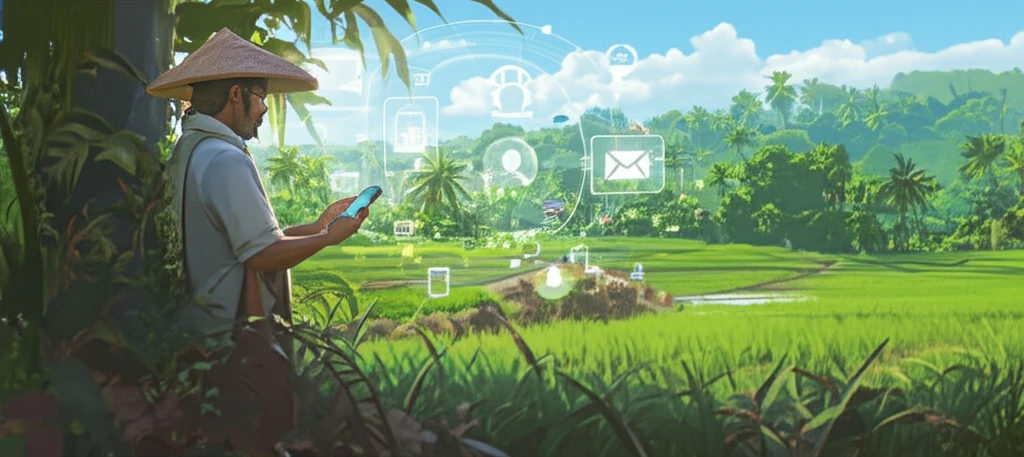
Farming Smarter: How Sri Lankan Farmers Can Master Modern Agriculture

"Unlock the secrets to thriving in today's agriculture: A practical guide for Sri Lankan cucurbit farmers to access knowledge, overcome challenges, and boost yields."
In the heart of Sri Lanka, a quiet revolution is taking place. Farmers, the backbone of the nation, are adapting to the demands of modern agriculture, seeking new ways to boost their yields and access global markets. This transformation isn't just about planting seeds; it's about cultivating knowledge and embracing innovation.
For Sri Lankan cucurbit farmers, the journey to success hinges on accessing the right agricultural knowledge at the right time. This knowledge is the compass that guides them through the complexities of export markets, Good Agricultural Practices (GAP) standards, and the ever-evolving demands of the industry.
This article explores how these farmers interact with agricultural knowledge resources, the barriers they face, and the strategies they employ to thrive in a competitive landscape. Drawing from recent research, we'll uncover practical insights that empower farmers to make informed decisions and cultivate a brighter future.
Agriculture as the Economic Mainstay
Agriculture is the mainstay of the Sri Lankan economy, accounting for 22% of GDP and employing 42% of the labour force. The sector plays a vital role in the national economy, and successive governments have provided - and continue to provide - strong support to strengthen it. Yet historical land use has taken a toll: unsustainable practices such as chena cultivation and logging have resulted in land degradation and a reduction in forest reserves. To counter these pressures, international partners have stepped in, with the World Bank's Agriculture Sector Modernization Project providing comprehensive agricultural development support in targeted areas.
Market-Led Growth and Digital Platforms
Market-led approaches are increasingly seen as the standard path forward for Sri Lankan agriculture, emphasising private investment, technological adoption and export-oriented high-value crops to address longstanding productivity stagnation. Complementing this, the expansion of digital platforms such as e-farmer.lk has been presented as a transformative solution to the challenges that hinder the sector's growth and sustainability. Even so, a long-recognised limitation persists: the prosperity of a village, especially in Rajarata where paddy cultivation is the livelihood of the people, depends on the availability of water for cultivation.
A 2,500-Year Agricultural Heritage
Sri Lanka has a rich agricultural history dating back more than 2,500 years, and for centuries paddy cultivation was not just an economic activity but a way of life that shaped the society, culture, religion and economy of the island nation. Rice production remains the primary form of agriculture, cultivated during the Maha and Yala seasons, while tea is grown in the central highlands and is a major source of foreign exchange. Vegetables, fruits and oilseed crops are also cultivated across the country, and commentators note that the nation's still-living agricultural heritage points the way to further benefits ahead.
Decoding the Knowledge Landscape: Where Farmers Turn for Answers
Sri Lankan farmers tap into a diverse network of information sources, each offering unique benefits. These sources can be broadly categorized as formal (government extension workers) and informal (family members, fellow farmers), with a further distinction between digital and non-digital channels.
- Formal Channels: CAB officers and Agricultural Instructors (Als) offer structured, government-backed advice.
- Informal Networks: Family traditions and knowledge sharing with other farmers play a significant role.
- Digital Resources: Online platforms and social media are increasingly used for information gathering.
- Blending Approaches: Successful farmers often combine traditional knowledge with modern techniques learned from various sources.
From Vegetable Sub-Sectors to Organic Policy
The Sri Lankan agriculture sector consists of several subsectors, and the vegetable subsector directly influences the entire population since it is mainly grown for domestic consumption. At the policy-research frontier, President Gotabaya Rajapaksa promised in his 2019 election campaign to transition the country's farmers to organic agriculture over a period of ten years, a pledge that subsequently reshaped national debate. Research attention is therefore split between the day-to-day dynamics of domestic food subsectors and the large-scale policy experiments that determine the environment in which farmers operate.
When Rapid Policy Change Backfired
Attempts to force rapid change in Sri Lankan agriculture have produced severe setbacks. Tea production fell by over 40% following the ban on chemical fertilizer use, dealing a heavy blow to Sri Lanka's most important export earner and its foreign-exchange income. The policy aimed to transform the sector into a 100% organic system within ten years, but critics point out that Sri Lankan farmers had long depended on large quantities of external inputs, including inorganic fertilizer, synthetic pesticides and fossil fuel, making an abrupt transition especially disruptive. In this context, some observers argue that integrating AI and technology into the sector is not just an opportunity but a necessity for the country's food security and economic development.
From Food-as-Medicine to Pesticide Dependence
Any international comparison of Sri Lankan agriculture must reckon with the fact that the choice of comparators is arbitrary and selective, depending on country size, geography, resource endowments or colonial heritage. Historically, Sri Lanka deeply embodied the concept of 'food as medicine,' pairing spices with heirloom grains; today, however, it is one of the highest chemical pesticide-using countries, with over 2,500 tons used on this small island. That pesticide dependence made the government's April 2021 overnight adoption of an exclusively organic agriculture policy especially jarring, sending shockwaves across a sector that relied heavily on imported agrochemicals to achieve economically viable crop yields.
Cultivating a Knowledge-Rich Future: Recommendations for Success
To empower Sri Lankan farmers and foster a thriving agricultural sector, it's crucial to strengthen the flow of information and bridge the gap between knowledge and practice. Encouraging two-way communication channels between government extension services and farmers is paramount. While extension workers are highly respected, farmers need a platform to voice their challenges and provide feedback on the practicality of recommended practices. By incorporating farmer feedback and acknowledging the diversity of information sources, policymakers can create more effective policies and support the growth of agricultural exports. Embracing digital tools and online platforms is also essential. Putting more government agricultural information online in easily accessible formats and popularizing these sites will empower farmers to access the knowledge they need to thrive.
Heritage Meets Modernisation
Expert commentary increasingly positions agriculture at the centre of Sri Lanka's economic revival, a theme captured by a pivotal conference titled 'Transforming Agriculture for Economic Revival in Sri Lanka.' While the country has a rich history of agriculture dating back thousands of years, analysts note that in a modern world governed by artificial intelligence, the sector has yet to scratch the surface of its vast potential. The synthesis emerging from such discussions is that Sri Lanka's deep agricultural heritage, combined with modern tools and diversified strategies, holds the key to lasting prosperity.
Smart Irrigation and Modest Market Growth
Looking ahead, smart irrigation systems are expected to reduce agricultural water usage in Sri Lanka by up to 30% by 2025, according to sector forecasts. Market projections put the agricultural products sector on track to grow from $4.85 billion in 2021 to $5.08 billion by 2026, an average annual increase of 0.8%. Equipment markets are likewise being closely monitored for emerging trends, growth drivers, revenue analysis and forecast outlook as the sector modernises.
Globalisation, Climate and Land Policy Pressures
Globalization exerts significant political, economic and cultural influence on Sri Lankan agriculture, shaping the sector in ways that extend far beyond farm-level decisions. At the same time, cropping systems in all climatic zones of Sri Lanka at elevations below 600 metres are highly vulnerable to increasing temperatures and rainfall variability, two of the key features of climate change. Land policy adds a further layer of complexity, with studies documenting the distributional impacts of land policies across the country.
Farmers, Disease and the Fight for Food Security
Agriculture remains the backbone of Sri Lanka's economy, yet crop yields are frequently compromised by fungal and bacterial diseases such as Tea Blister Blight and Paddy Blast, and traditional manual diagnosis is labor-intensive, slow and prone to human error. This is where new tools meet real-world need: deep-learning-based mobile frameworks are being developed for real-time plant disease detection in tea and paddy crops. Alongside such technology, institutional efforts such as the Sri Lankan Army's agricultural and livestock assistance are being studied for their contribution to achieving food security, showing how the human element of farming is evolving beyond the individual farmer.