
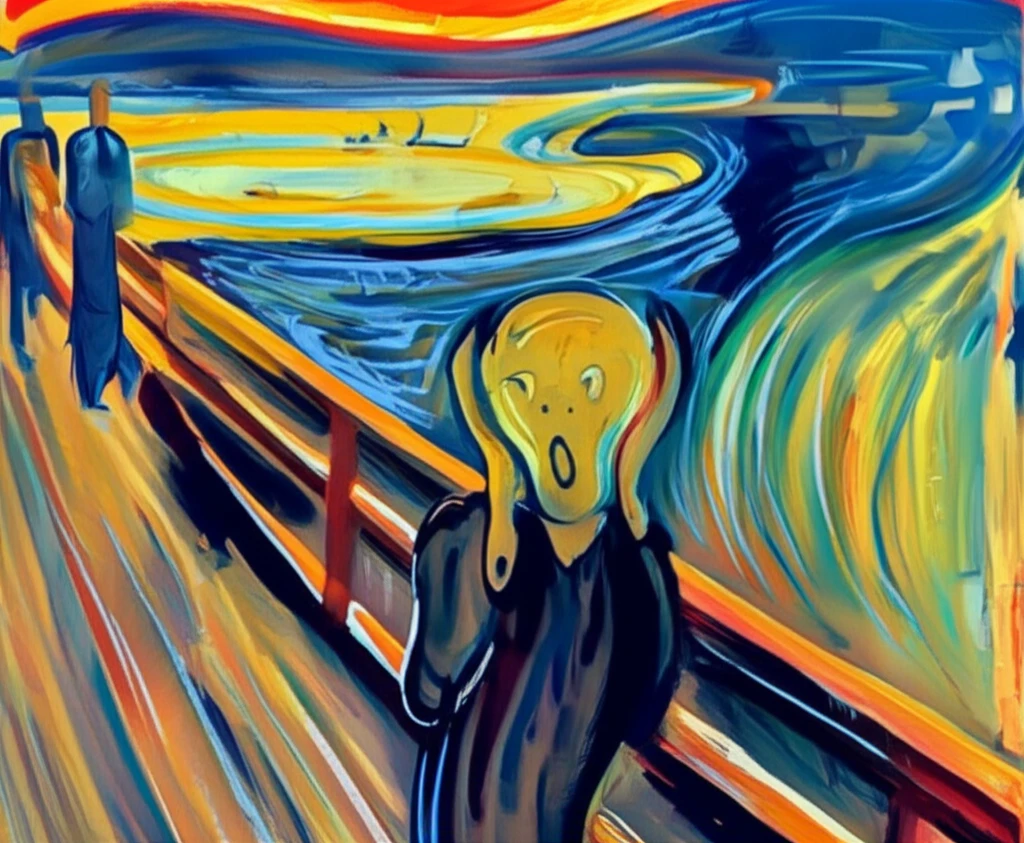
Fading Masterpieces: Unlocking the Secrets of Deteriorating Art

"Scientists investigate why cadmium yellow pigment breaks down in iconic paintings like Edvard Munch's 'The Scream' and Matisse's 'Flower Piece'."
The early 20th century was a period of artistic revolution, with artists embracing newly available synthetic pigments to create vibrant and expressive works. However, the long-term stability of these novel materials was often uncertain, leading to degradation and discoloration in many iconic paintings.
Cadmium yellow, a popular pigment prized for its bright hues, has proven particularly susceptible to deterioration. This poses a significant challenge for art conservators and historians, who are working to understand and mitigate the damage to important cultural artifacts.
A recent study delves into the degradation mechanisms of cadmium yellow in two celebrated paintings: Edvard Munch's 'The Scream' (c. 1910) and Henri Matisse's 'Flower Piece' (1906-1907). By employing advanced scientific techniques, researchers are uncovering the chemical processes that cause the pigment to fade, flake, and develop unsightly crusts.
A Measured Problem
Soiling of cultural heritage due to air pollution remains a major challenge for the conservation community, motivating scientists to quantify how paintings degrade and to test potential preventative measures. Over the last three decades, the analytical investigation of pigments has grown into a core research topic in heritage science, archaeometry, conservation science, and technical art history. Recent laboratory work shows why this matters: some pigments, such as azurite, demonstrate stability, with pigment-binder interactions actively inhibiting the degradation of adhesives. Data analytics is also entering the field, with business-intelligence approaches being integrated into pigment and dye analysis to support preservation decisions.
Accepted Methods and Their Limits
The accepted approach to caring for paintings centers on cleaning and conservation treatments driven by the preservation of both an artwork's aesthetic and readability and the physical and chemical stability of its constituent materials. Guiding such work, advanced X-ray techniques using conventional sources or synchrotron radiation have seen significantly increased application to pigment alteration over the last two decades, because they provide spatially resolved elemental, molecular, and structural information from the macroscopic to the nanoscopic level. Limitations persist nonetheless: even pigments classed as 'highly stable' still deteriorate, and characterizing their photosensitivity, degradation mechanisms, and resultant products—for instance through principal component analysis of reflectance spectra—remains necessary to inform preventive conservation. Accepted methods can thus diagnose and slow damage, but they cannot fully halt it.
Centuries of Colour, Decades of Conservation
Artists' pigments have shaped culture, science, and creative expression for millennia, tracing a line from prehistoric ochres to modern quinacridones. The conservation field has its own documented milestones, including the 1990 initiation of the CAA/Heritage Preservation Award for Distinction in Scholarship and Conservation, honoring contributions that enhance understanding of art through conservation and art history. Institutions such as the National Gallery of Art now examine pigment alteration and color change through the lens of the relationships scholars and society have had over time with cultural heritage objects. Educational resources similarly connect the techniques of historical watercolor masters with the chemistry of pigments and cutting-edge contemporary methods used to analyze and preserve them.
The Case Studies: 'The Scream' and 'Flower Piece'
Researchers focused on areas where cadmium yellow had visibly deteriorated. In 'The Scream,' the pigment has faded to an ivory white in the neck of the central figure and in a prominent brushstroke in the sky, with flaking observed in cadmium yellow brushstrokes in the water. In Matisse's 'Flower Piece,' the cadmium yellow paint has developed an ivory crust in one region (the center of a daisy) and darkened in another (to the right of the pitcher).
- X-ray fluorescence identified cadmium-containing regions in both paintings.
- Microscopy revealed the growth of crystalline degradation products, such as rod-shaped particles of cadmium chloride, on the surface of the paint.
- Further analysis identified cadmium carbonates, sulfates, chlorides, hydroxychlorides, and cadmium oxide within the altered pigment.
- Electron diffraction data and microscopy showed that the remaining cadmium sulfide particles were polycrystalline and very small (around 7 nm), leading to a high surface area that accelerates degradation.
An Evolving Evidence Base
Research into why artworks fade, discolor, and break down chemically remains an active and fast-moving field, with new analytical findings published regularly. Because much of this work is recent or still ongoing, individual conclusions should be treated as emerging rather than settled, and details may be revised as better evidence accumulates. The broad direction, however, is consistent: laboratories and museums continue to deepen the shared knowledge base on which conservators rely to protect vulnerable works.
When Damage Cannot Be Undone
A key counterpoint to confidence in restoration is that some degradation appears irreversible: as pigments age, complex chemical reactions can lead to changes that challenge even the most skilled art restorers. Failure is not always a matter of technique, either—the conservation literature notes that graphic media carry problems inherent to the materials themselves, arising in the media or their relationship to the support, whether at the time of application or as the object ages, and posing special difficulties during treatment. Together, these realities shift attention toward prevention and deeper material understanding rather than reliance on corrective repair.
Light Versus Matrix
Comparative research highlights how strongly fading depends on external conditions and material context. Light is a primary driver—its interaction with color pigments can fade and transform an object's appearance—which has prompted investigation into whether LEDs, compared across different illumination conditions, could help art conservation. On the chemistry side, comparisons between in-solution and on-substrate photodegradation of dyes and pigments show that matrix-specific parameters meaningfully affect breakdown pathways, and that photodegradation products require dedicated analytical methods to characterize. Neither light exposure nor the surrounding material environment, the two literatures jointly suggest, can be assessed in isolation.
Preserving Our Cultural Heritage
This research provides valuable insights into the complex degradation processes affecting cadmium yellow pigment. Understanding these mechanisms is crucial for developing effective conservation strategies to protect our artistic heritage.
What Reviews Conclude
Literature reviews offer the clearest synthesis of what governs pigment survival. A review of medieval inorganic pigments consolidates evidence on the effects of climate, material selection, biological activity, and the influence of analysis and conservation treatments on stability. Syntheses of this kind point to an expert consensus that deterioration is rarely caused by any single factor, but instead emerges from the interplay of environment, material choice, biology, and human intervention.
Machine Learning and Beyond
Machine learning stands out as a leading frontier: a state-of-the-art review identifies applications across the enhancement of scientific imagery, pigment analysis, damage detection, and virtual approaches to painting conservation. Scholarly publishing is organizing around the theme as well, with special issues devoted to the latest trends and challenges in studying pigments and dyes and their degradation in cultural heritage objects. Realizing this potential will also mean confronting persistent practical challenges—environmental factors such as temperature, humidity, light, and pollutants, alongside material deterioration and ethical considerations—that shape what preservation can achieve.
Pressures Beyond the Lab
At a systemic level, protecting deteriorating art depends on far more than laboratory breakthroughs. Heritage institutions generally face pressures around resources, expertise, environmental control, and the tension between public access and preservation, although how these play out varies widely by institution and region. Comprehensive comparative data remain limited, so sweeping claims deserve caution—yet the underlying strain between keeping heritage visible and keeping it stable is broadly acknowledged across the field.
Real Places, Real Practitioners
Behind the science stand real places and practitioners. A 2025 study reports the first real-world application of the SYSPECTRAL system at Müstair Monastery, a UNESCO World Heritage Site since 1983, where stratigraphic LIBS analysis of wall paintings revealed lead- and iron-based pigments in black and red hues—evidence suggesting pigment degradation and past restoration interventions. Conservators describe their work as a distinctive blend of technical expertise, artistic sensibility, and profound respect for cultural heritage, with real-life restoration stories underscoring what is at stake for the objects, and the communities, that treasure them.
By identifying the factors that contribute to pigment deterioration, conservators can tailor treatments to stabilize the paint, slow down the degradation process, and preserve the original colors of these important artworks. This might involve controlling environmental conditions, applying protective coatings, or even developing new methods for pigment stabilization.
Further research is needed to fully understand the long-term behavior of cadmium yellow and other problematic pigments. However, this study represents a significant step forward in our ability to safeguard the masterpieces of the early modern era for future generations.