
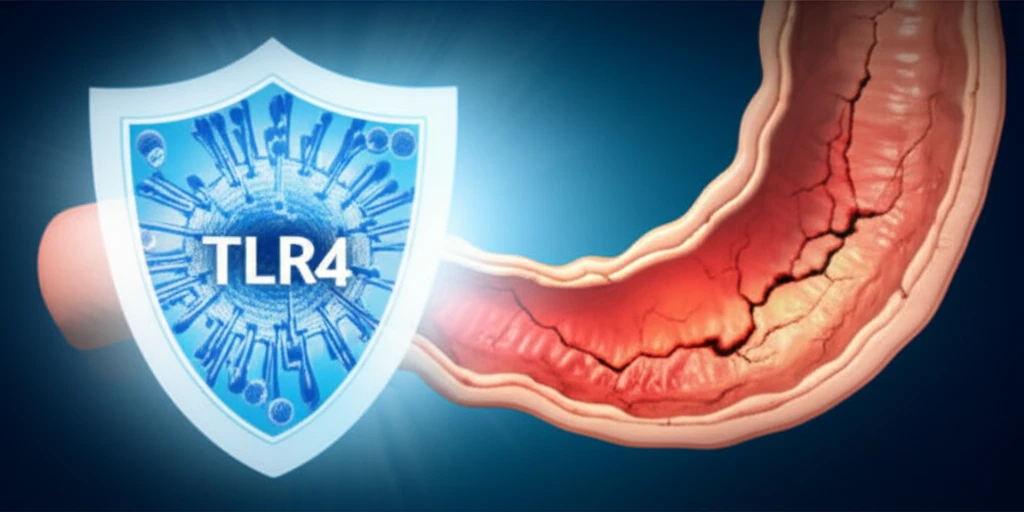
Esophageal Cancer Breakthrough: Targeting Inflammation for Prevention

"New research reveals how blocking a key inflammatory pathway could revolutionize esophageal adenocarcinoma treatment and prevention."
Esophageal cancer remains a formidable challenge, with a persistently low five-year survival rate. While advances in GERD and BE screening exist, the incidence of EAC continues to climb, underscoring the urgent need for innovative prevention and treatment strategies. New research is shedding light on the critical role of inflammation in this disease, specifically focusing on the Toll-like receptor-4 (TLR4) pathway.
Chronic inflammation, often triggered by conditions like gastroesophageal reflux disease (GERD) and Barrett's esophagus (BE), is increasingly recognized as a key driver in the development of EAC. Scientists have been investigating TLRs, components of the innate immune system, for their involvement in mediating the inflammatory response that promotes hyperplasia and metaplasia.
A study from the University of Colorado School of Medicine has delved into the role of TLR4 in promoting the proliferation of human esophageal adenocarcinoma cells. The findings suggest that TLR4 could be a crucial target for suppressing cancer growth, potentially revolutionizing how we approach EAC treatment and prevention.
How Does the TLR4 Pathway Fuel Esophageal Cancer?
The study, led by Patrick D. Kohtz, MD, and colleagues, explored the expression and function of TLR4 in both normal and cancerous esophageal cell lines. Researchers found that TLR4 is consistently present in esophageal cells, with significantly higher expression in adenocarcinoma cells. Furthermore, they discovered that simulated reflux conditions increase TLR4 expression in normal esophageal cells, suggesting a direct link between inflammation and TLR4 activity.
- Significant increases in cell proliferation.
- Activation of the TLR4–MyD88–TRAF6–NF-κB signaling pathway.
- Reduced growth rate when NF-κB, a key protein in the inflammatory pathway, was inhibited.
The Future of Esophageal Cancer Treatment: Targeting the Inflammatory Achilles' Heel
This research provides a compelling rationale for developing therapies that target the TLR4-NF-κB pathway. By specifically blocking this inflammatory cascade, scientists hope to create more effective treatments for EAC and potentially prevent its development in high-risk individuals. Future research will likely focus on identifying specific inhibitors of the TLR4-NF-κB pathway and evaluating their efficacy in preclinical and clinical studies, offering new hope in the fight against this deadly disease.