
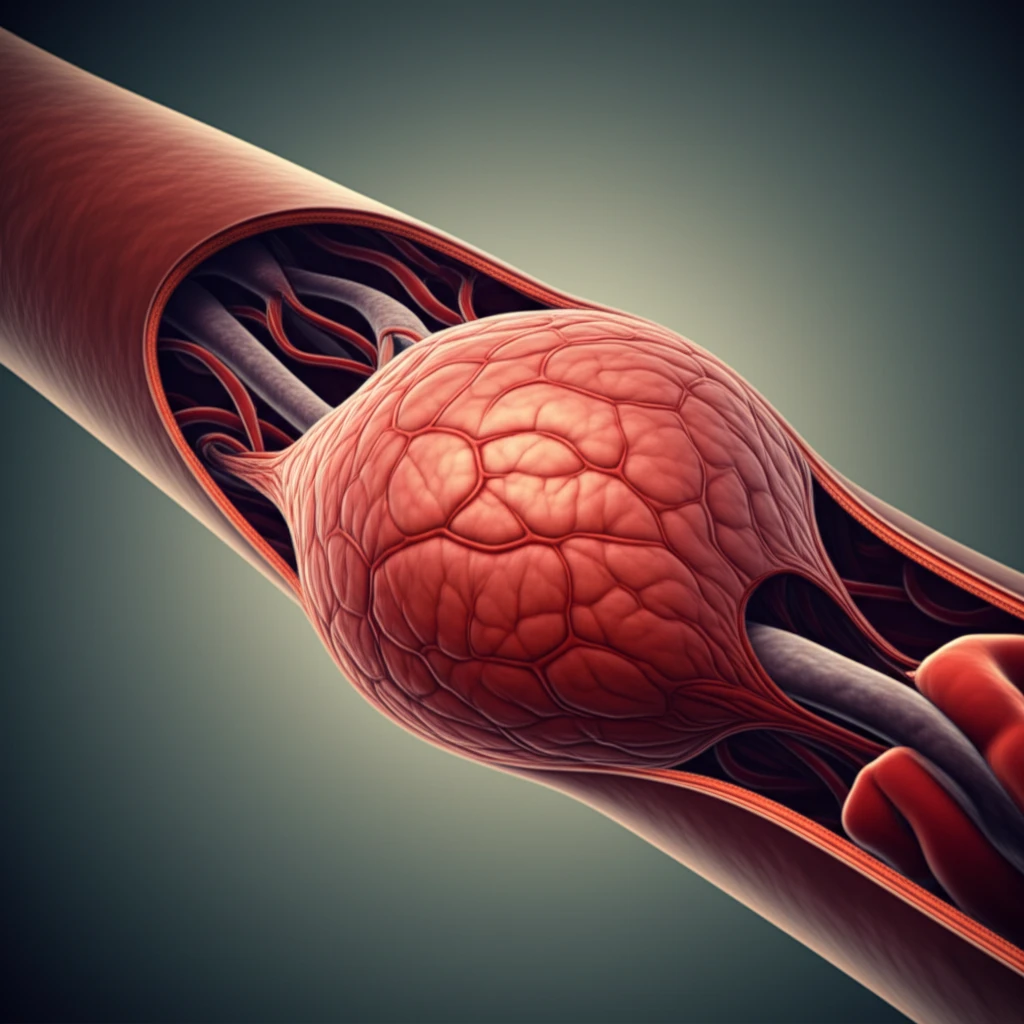
Illustration of endotension in an aortic aneurysm repair.

Endotension: The Silent Threat in Aortic Aneurysm Repair

"Unveiling the complexities of endotension after endovascular aneurysm repair (EVAR) and how it leads to rupture."


For patients with aortic aneurysms who are not candidates for conventional surgery or standard endovascular procedures, a new technique called 'chimney' is considered. This approach involves placing stents through the visceral and renal branches of the aorta during endovascular aneurysm repair (EVAR).

The 'chimney' technique is used when open surgery carries significant risks because the aneurysm affects the renal and visceral vessels. It involves deploying covered stents parallel to the main aortic stent-graft to maintain blood flow to vital side branches.

While EVAR has become a routine procedure, it isn't without potential complications. One of the most common of these is an endoleak, where blood flow persists within the excluded aneurysm sac, pressurizing it and increasing the risk of rupture. This article will guide you through understanding of endoleaks and endotension, and the best ways to protect yourself.

What is Endotension?

Illustration of endotension in an aortic aneurysm repair.

An endoleak is a complication of EVAR, maintaining flow and pressure within the excluded aneurysm sac. Endoleaks are classified into five types based on their mechanisms and locations.

Type V endoleak, also known as endotension, involves persistent or recurrent pressurization of the aneurysm sac through the parietal thrombi. Endotension differs from other endoleaks because pressure is transmitted without active blood flow within the aneurysm sac.

  • Type I: Occurs at the proximal or distal attachment sites of the endograft, indicating an incomplete seal.
  • Type II: Results from retrograde flow into the aneurysm sac via branch vessels like the lumbar or inferior mesenteric arteries.
  • Type III: Involves leaks due to graft defects, disconnection of graft components, or tears in the graft material.
  • Type IV: Characterized by graft porosity, where blood permeates through the graft fabric itself.
  • Type V (Endotension): Aneurysm sac expansion without a detectable leak, often due to increased pressure transmitted through the thrombus lining the sac.
The prevalence of endoleaks after EVAR varies widely, ranging from 2.4% to 45.5%. The presence of an endoleak significantly increases the risk of aneurysm rupture, although endotension-related ruptures are rare.

Navigating the Shadows of Endotension

The development of aneurysm sac expansion due to endotension remains a diagnostic challenge, even with advanced imaging techniques. Because endotension lacks visible leaks, it requires a high degree of clinical suspicion and often is diagnosed by exclusion. Continued research into new diagnostic methods, such as implantable pressure sensors, is essential to improving outcomes and reducing the risk of rupture in patients undergoing EVAR.

About this Article -

This article was crafted using a human-AI hybrid and collaborative approach. AI assisted our team with initial drafting, research insights, identifying key questions, and image generation. Our human editors guided topic selection, defined the angle, structured the content, ensured factual accuracy and relevance, refined the tone, and conducted thorough editing to deliver helpful, high-quality information.See our About page for more information.

This article is based on research published under:

DOI-LINK: 10.1590/s1677-54492012000200016, Alternate LINK

Title: Endotension: Rupture Of Abdominal Aortic Aneurysm

Subject: Cardiology and Cardiovascular Medicine

Journal: Jornal Vascular Brasileiro

Publisher: FapUNIFESP (SciELO)

Authors: Alexandre Campos Moraes Amato, Flávio Amim Abraham, Henrique Dini Kraide, Leandro Teixeira Rocha, Ricardo Virginio Dos Santos

Published: 2012-06-01

Everything You Need To Know

1

What exactly is endotension following an endovascular aneurysm repair (EVAR)?

Endotension, classified as a Type V endoleak, is a complication that can arise after EVAR. Unlike other types of endoleaks where there's active blood flow into the aneurysm sac, endotension involves the persistent or recurrent pressurization of the aneurysm sac through the parietal thrombi, without a visible leak. This means the pressure inside the sac increases, potentially leading to expansion and rupture, even though standard imaging might not detect any actual blood flowing into the sac. Differentiating it from other endoleaks is crucial for proper diagnosis and management.

2

Why is endotension so difficult to detect after aortic aneurysm repair?

Endotension poses a diagnostic challenge because it lacks the visible leakage characteristic of other endoleaks. Standard imaging techniques may not always reveal the pressure buildup within the aneurysm sac. Diagnosis often relies on a high degree of clinical suspicion and the exclusion of other types of endoleaks. Current research is exploring new diagnostic methods, such as implantable pressure sensors, to improve the early detection and management of endotension. This is because the pressure increase is transmitted through the thrombus lining, not direct blood flow.

3

What are the different types of endoleaks that can occur after EVAR, and how does endotension (Type V) fit in?

Following EVAR, endoleaks are classified into five types. Type I endoleaks occur at the attachment sites of the endograft, indicating an incomplete seal. Type II endoleaks result from retrograde flow into the aneurysm sac via branch vessels. Type III endoleaks involve leaks due to graft defects or disconnection of components. Type IV endoleaks are characterized by graft porosity. Endotension, or Type V endoleak, involves aneurysm sac expansion without a detectable leak, often due to increased pressure transmitted through the thrombus lining the sac. While Types I-IV involve actual blood leakage, Type V is more subtle, involving pressure transmission without active blood flow.

4

For patients who are not candidates for conventional surgery, what alternative methods exist for aortic aneurysm repair when the aneurysm affects the renal and visceral vessels?

When open surgery carries significant risks and standard endovascular procedures are not feasible, a 'chimney' technique can be considered. This involves placing stents through the visceral and renal branches of the aorta during EVAR. This technique involves deploying covered stents parallel to the main aortic stent-graft to maintain blood flow to vital side branches. The 'chimney' technique aims to preserve blood flow to the renal and visceral vessels while excluding the aneurysm from circulation.

5

If endotension doesn't involve a visible leak, how does it increase the risk of aneurysm rupture, and what are the implications for long-term monitoring after EVAR?

Even without a visible leak, endotension increases the risk of aneurysm rupture because the persistent pressurization of the aneurysm sac, transmitted through the thrombus, can weaken the sac walls over time, leading to expansion and eventual rupture. This highlights the importance of long-term monitoring after EVAR, even in the absence of detectable endoleaks. Regular imaging and vigilant clinical follow-up are essential to detect subtle signs of endotension, allowing for timely intervention to prevent rupture. The absence of visible leaks can give a false sense of security, making diligent monitoring even more crucial.

Newsletter Subscribe

Subscribe to get the latest articles and insights directly in your inbox.