
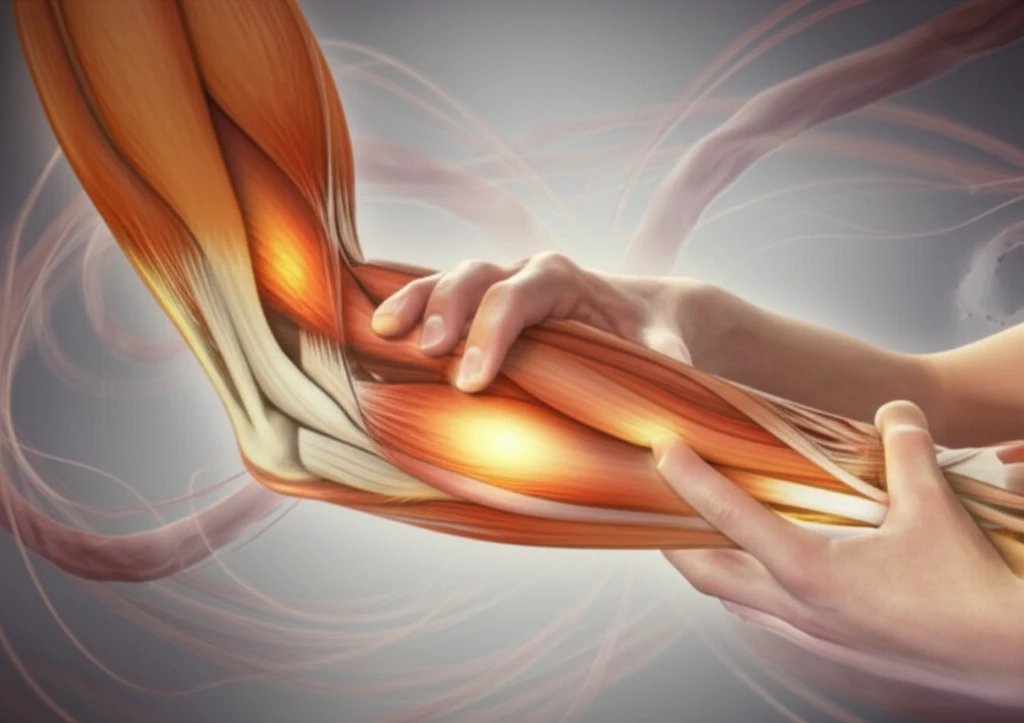
Illustration of fascial manipulation on an elbow.

Elbow Pain Relief: Can Fascial Manipulation & Exercise Help?

"Discover how combining fascial manipulation with eccentric exercises can offer a new approach to managing lateral elbow pain and improving your quality of life."


Lateral Elbow Pain (LEP), often a frustrating condition for active individuals, can significantly impact daily life and work. While various treatments exist, finding effective, long-term relief remains a challenge. Common approaches often target the wrist extensor tendons, where modifications are frequently observed.

However, recent research suggests that changes in the fascial layers surrounding the tendons may also play a crucial role in LEP. This has led to the exploration of new treatment methods, including Fascial Manipulation (FM), a manual technique designed to restore proper gliding of the deep fascia.

This article will delve into a study investigating the effectiveness of combining FM with eccentric exercises—a common LEP treatment—compared to eccentric exercise alone. We'll explore how this integrated approach can offer enhanced pain relief and functional improvement.

Fascial Manipulation and Eccentric Exercise: A Combined Approach

Illustration of fascial manipulation on an elbow.

The study, conducted by Iogna Prat, Cibrowski, Zuliani, and Stecco, aimed to determine whether adding FM to an eccentric exercise program could provide superior outcomes for individuals with LEP. Eccentric exercise involves lengthening a muscle under tension, a technique commonly used to strengthen tendons and reduce pain in tendinopathies.

Fascial Manipulation, on the other hand, focuses on releasing restrictions within the fascial system. By applying deep friction to specific points, practitioners aim to restore optimal gliding between fascial layers, improve tissue mechanics, and reduce pain.

  • Study Design: The researchers recruited 29 participants with LEP and randomly assigned them to two groups: an intervention group (n=17) and a control group (n=12).
  • Intervention: The intervention group received both eccentric exercise and FM, while the control group performed eccentric exercise only.
  • Eccentric Exercise Program: Both groups participated in a structured 27-day eccentric exercise program, with the intervention group also receiving three FM sessions.
  • Outcome Measures: Maximum Grip Strength, Pain-Free Grip, Pain Pressure Threshold (measured with a pressure algometer), and function (measured with the DASH scale) were assessed. A blinded examiner performed assessments before, immediately after, and at 1- and 3-month follow-ups.
The study revealed that both groups experienced significant improvements in all outcome measures at the 3-month follow-up. However, the intervention group, which received both FM and eccentric exercise, showed greater improvements in DASH scores at 1-month follow-up and Pain Pressure Threshold after the treatment and at the 3-month follow-up compared to the control group.

Key Takeaways and Future Directions

The findings suggest that eccentric exercise is an effective treatment for LEP, and adding FM may provide additional benefits, particularly in terms of pain relief and functional improvement. This combined approach could offer a more comprehensive solution for individuals struggling with chronic elbow pain.

It's important to note that the study had a small sample size, which limits the generalizability of the results. Further research with larger groups is needed to confirm these findings and explore the optimal parameters for FM and eccentric exercise in LEP treatment.

If you're experiencing lateral elbow pain, consider discussing FM and eccentric exercise with your healthcare provider. A tailored treatment plan incorporating both approaches may help you achieve significant pain relief and improve your overall function.

About this Article -

This article was crafted using a human-AI hybrid and collaborative approach. AI assisted our team with initial drafting, research insights, identifying key questions, and image generation. Our human editors guided topic selection, defined the angle, structured the content, ensured factual accuracy and relevance, refined the tone, and conducted thorough editing to deliver helpful, high-quality information.See our About page for more information.

This article is based on research published under:

DOI-LINK: 10.1016/j.jbmt.2018.09.028, Alternate LINK

Title: Efficacy Of Fascial Manipulation And Eccentric Exercise For Lateral Elbow Pain

Subject: Complementary and alternative medicine

Journal: Journal of Bodywork and Movement Therapies

Publisher: Elsevier BV

Authors: Pietro Iogna Prat, Dariusz Cibrowski, Andrea Zuliani, Antonio Stecco

Published: 2018-10-01

Everything You Need To Know

1

What is Lateral Elbow Pain (LEP), and why is it a concern?

Lateral Elbow Pain (LEP) is a condition that can significantly affect daily activities. The article highlights that finding effective, long-term solutions for LEP is challenging. Common treatments often focus on the wrist extensor tendons. However, the research suggests the fascial layers surrounding these tendons also play a crucial role, leading to the exploration of new treatment methods, including Fascial Manipulation (FM).

2

What is Fascial Manipulation, and how does it work?

Fascial Manipulation (FM) is a manual technique that focuses on restoring proper gliding of the deep fascia. In the context of the study, FM was combined with eccentric exercises to treat Lateral Elbow Pain (LEP). By applying deep friction to specific points, practitioners aim to improve tissue mechanics and reduce pain. The study suggests that combining FM with eccentric exercise may lead to better outcomes in pain relief and functional improvement compared to eccentric exercise alone.

3

What are eccentric exercises, and what is their purpose?

Eccentric exercise involves lengthening a muscle under tension, a technique commonly used to strengthen tendons and reduce pain in tendinopathies. The study used a 27-day eccentric exercise program. The benefits of eccentric exercises include strengthening the tendons, and, in the context of the study, served as the base treatment for both the intervention and control groups. The intervention group received both eccentric exercise and Fascial Manipulation (FM), demonstrating a combined approach for better outcomes.

4

What were the key findings of the study on Fascial Manipulation and eccentric exercise?

The study measured Maximum Grip Strength, Pain-Free Grip, Pain Pressure Threshold, and function (using the DASH scale) to evaluate the effectiveness of the treatments. The study compared an intervention group, which received both Fascial Manipulation (FM) and eccentric exercise, with a control group that received eccentric exercise only. The results showed that the intervention group had greater improvements in DASH scores at the 1-month follow-up and Pain Pressure Threshold after the treatment and at the 3-month follow-up.

5

What are the implications of the study's findings?

The findings suggest that combining Fascial Manipulation (FM) with eccentric exercise can offer enhanced pain relief and functional improvement for individuals with Lateral Elbow Pain (LEP). This combined approach addresses not only the tendons but also the fascial system, providing a more comprehensive solution. Further research may explore optimal FM techniques and exercise protocols to maximize the benefits.

Newsletter Subscribe

Subscribe to get the latest articles and insights directly in your inbox.