
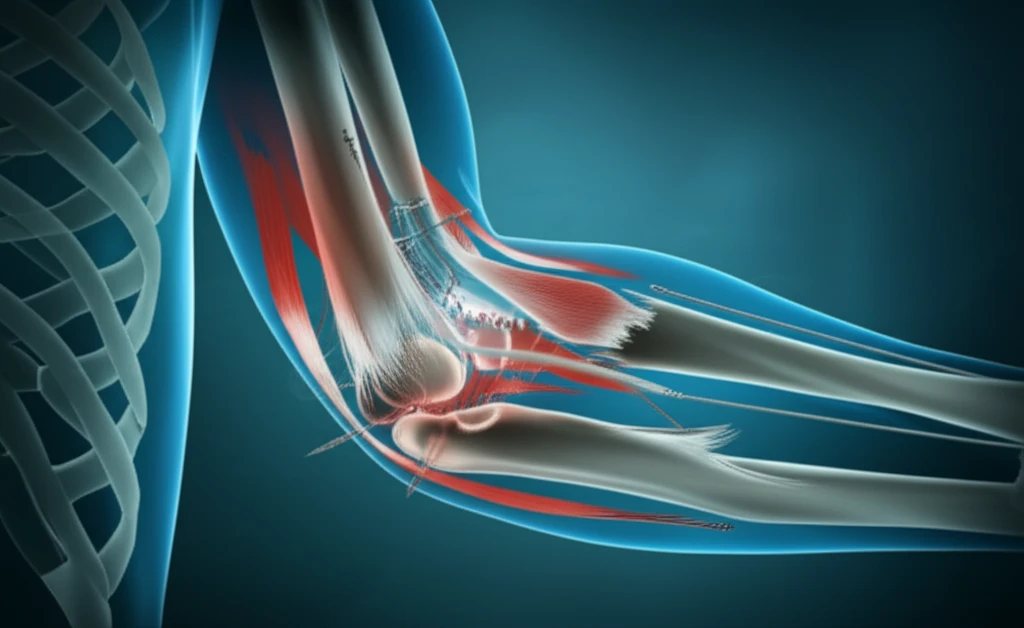
Elbow Instability? A New Surgical Fix Shows Promise

"Mini-open aMCL plication with suture anchor: A potential game-changer for post-traumatic elbow laxity."
Elbow injuries, especially those affecting the medial collateral ligament (MCL), can significantly impact daily life and athletic performance. The MCL, comprised of the anterior bundle (aMCL), posterior bundle (pMCL), and transverse ligament, is crucial for elbow stability, particularly against valgus stress—the force that pushes the elbow outward.
Traditional treatments range from conservative measures like rest and physical therapy to more invasive reconstructions using grafts. However, graft-based reconstructions are complex, time-consuming, and can present complications. Now, a new surgical technique offers a promising alternative: mini-open aMCL plication with suture anchors.
This article explores this innovative procedure, detailing its surgical process, benefits, and potential for restoring elbow stability and function after trauma. It provides insights into how this technique directly addresses aMCL laxity and enhances overall elbow mechanics.
How Does This New Elbow Surgery Work?
The mini-open aMCL plication is designed to restore stability to the elbow by addressing laxity in the anterior bundle of the medial collateral ligament. The procedure involves a few key steps, starting with a thorough arthroscopic evaluation.
- Ulnar Nerve Release: A limited release of the ulnar nerve is performed to prevent nerve damage or instability.
- aMCL Plication: The aMCL is plicated—folded and secured—using suture anchors inserted into the humerus at the ligament's original attachment point. This effectively tightens the ligament.
- Arthroscopic Reassessment: A final arthroscopic evaluation ensures proper tensioning of the plicated aMCL and restoration of the joint space.
Is This a Better Option for Elbow Instability?
The mini-open aMCL plication offers a potentially less invasive and more anatomic approach compared to traditional MCL reconstructions using grafts. By plicating the existing ligament rather than replacing it, the technique aims to restore natural elbow mechanics with potentially fewer complications.
While promising, this procedure is best suited for patients with partial ligament degeneration and may not be appropriate for cases of severe MCL damage. Preoperative MRI evaluation is crucial to assess the extent of ligament damage and determine the suitability of this technique.
Further research with larger patient groups and longer follow-up periods will help to solidify the role of mini-open aMCL plication in the treatment of medial elbow instability. However, the initial results suggest that it is a reliable and effective option for carefully selected patients seeking to regain elbow stability and function.