
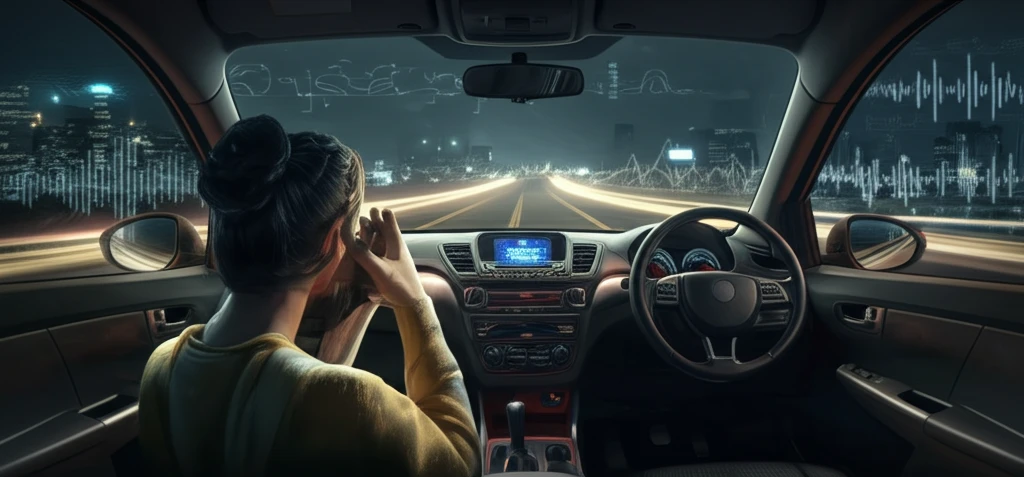
Driving Drowsy? How New Tech Can Spot Fatigue Before It's Too Late

"An automated EEG analysis algorithm offers a promising solution for detecting and mitigating driver fatigue, potentially preventing accidents related to obstructive sleep apnea and other sleep disorders."
Driving can be a risky task, and feeling sleepy makes it much worse. Driver fatigue is a big problem, causing up to 20% of serious car accidents. Conditions like obstructive sleep apnea (OSA), where people stop breathing during sleep, make this even more dangerous by causing severe fatigue and drowsiness. People with OSA are up to five times more likely to crash. Figuring out who is most at risk and predicting accidents is a big challenge.
Researchers are looking for ways to monitor how alert drivers are. Analyzing brain waves (EEG) can show how sleepy someone is, which affects their driving. When people are tired, their EEG shows more activity in certain frequency bands like alpha and theta. This method helps keep an eye on drivers' awareness and how well they're doing behind the wheel. However, getting reliable EEG data while someone is driving is tough because there can be a lot of interference.
One of the biggest problems in using EEG for this purpose is dealing with artifacts—things like movements, blinks, and electrical noise that mess up the brainwave signals. A technique called independent component analysis (ICA) helps to clean up these signals, but often it's not enough. Additional manual cleaning is needed, which takes a lot of time and can be subjective. To solve this, a team of researchers developed a new automated method to detect and remove these artifacts more efficiently.
Why Drowsy Driving Matters
Drowsy driving can reduce alertness, reaction time, and decision-making ability, creating serious risks on the road. The scale and effects of the problem vary across people, driving conditions, and available reporting methods. New fatigue-detection technologies may help identify warning signs earlier, but they should supplement, not replace, adequate sleep and responsible driving.
Software and Hardware Foundations
Many technology systems depend on software that connects an operating system with hardware such as cameras, sensors, and other devices. HP describes a driver as the software connection between Windows and hardware, while Intel provides drivers, firmware, utilities, BIOS updates, and patches for its products. NVIDIA reports that its drivers are tested from early access through downloadable content releases for performance, stability, and functionality, and that they receive Microsoft Windows Hardware Quality Labs certification. Intel's Driver & Support Assistant can detect available updates and provide customized software updates, but these maintenance systems address device compatibility and reliability rather than directly determining whether a driver is fatigued.
A Foundation of Tested Drivers
A foundational milestone in modern graphics and computing hardware has been the development of regularly updated device drivers. NVIDIA says its driver team tests games from early access through each downloadable-content release to improve performance, stability, and functionality. The company also reports that these drivers are certified by Microsoft's Windows Hardware Quality Labs, illustrating how formal testing and certification became part of the software-support process. This history provides context for the reliability expectations applied to newer vehicle-monitoring technologies.
How Does the Automated Algorithm Work?
The study, published in the International Journal of Psychophysiology, tested a new automated algorithm (AA) designed to detect and remove artifacts from EEG recordings taken during a driving simulation. The goal was to see if this method could accurately identify and eliminate noise, making it easier to analyze brainwave data and assess driver fatigue. Researchers compared the automated algorithm against a reference-standard (RS) method, where experts visually inspected the EEG data for artifacts.
- Initial Processing with ICA: The raw EEG data was first cleaned using independent component analysis (ICA) to remove basic artifacts like eye blinks.
- Automated Artifact Detection: The automated algorithm then analyzed the ICA-processed data to detect any remaining artifacts. This was done by looking at the standard deviation of EEG amplitude (SDEA) in each channel within 5-second epochs. If the SDEA exceeded a set threshold, the epoch was flagged as artefactual.
- Reference-Standard (Visual Inspection): A sleep expert visually inspected the EEG data to identify epochs containing artifacts, serving as the reference for evaluating the automated algorithm.
- Comparison and Analysis: The performance of the automated algorithm was assessed by comparing its results with the reference-standard. Sensitivity, specificity, and accuracy were calculated to determine how well the algorithm performed.
An Emerging Research Area
Research into technology that can identify driver fatigue is developing, but the available evidence can vary by device, study design, and driving environment. Systems may be evaluated using different signals and performance measures, making direct comparisons difficult. Current findings should therefore be interpreted as promising or preliminary where evidence remains limited, rather than as proof that any single system can reliably prevent every fatigue-related crash.
Limits of Detection
Fatigue-detection systems may produce warnings that are late, inaccurate, or difficult for a driver to interpret. A system can also face challenges when conditions obscure the driver's face, when sensors lose signal, or when a warning is ignored. These limitations mean that detection technology should not be treated as a substitute for sleep, breaks, or the decision not to drive when severely tired.
Comparing Detection Approaches
Different fatigue-monitoring approaches can vary in what they measure, how intrusive they are, and how quickly they provide feedback. Camera-based systems may observe visible signs of reduced alertness, while other approaches may rely on vehicle behavior or physiological signals. Because each approach has distinct sources of error and practical constraints, comparisons should consider accuracy, usability, privacy, and performance in real-world driving rather than relying on a single headline metric.
The Future of Driver Safety Technology
This research offers a promising step forward in using technology to improve driver safety. By automating the process of EEG artifact removal, the study makes it easier to gather and analyze brainwave data in real-world driving scenarios. This could lead to new ways of detecting and preventing driver fatigue, especially in people with conditions like obstructive sleep apnea. As technology advances, we may see more tools like this integrated into vehicles, helping to keep drivers alert and roads safer for everyone.
Technology as a Safety Layer
Fatigue-detection technology is best understood as an additional safety layer rather than a complete solution. Its value depends on dependable sensing, understandable alerts, and drivers who respond appropriately. The strongest safety strategy still combines technology with sufficient sleep, sensible trip planning, and willingness to stop when tired.
Toward Earlier Warnings
Future systems may aim to recognize fatigue earlier and tailor alerts more effectively to individual drivers and driving situations. Progress will likely depend on better sensors, stronger validation in varied real-world conditions, and interfaces that minimize distraction. Developers will also need to balance earlier intervention with the risk of unnecessary warnings that drivers learn to disregard.
Beyond the Vehicle
Driver fatigue is influenced by broader conditions, including work schedules, long journeys, irregular sleep, and limited access to safe places to stop. Technology can identify some warning signs, but it cannot remove those underlying pressures. Effective prevention therefore requires coordination among drivers, employers, vehicle manufacturers, regulators, and transportation systems.
The Driver Still Decides
No alert can guarantee safety if a driver dismisses it or continues driving despite severe tiredness. People must recognize that fatigue can impair judgment and respond by pausing, resting, or finding another way to travel. The practical impact of new technology will ultimately depend on whether it supports better human decisions at the moment they matter.