
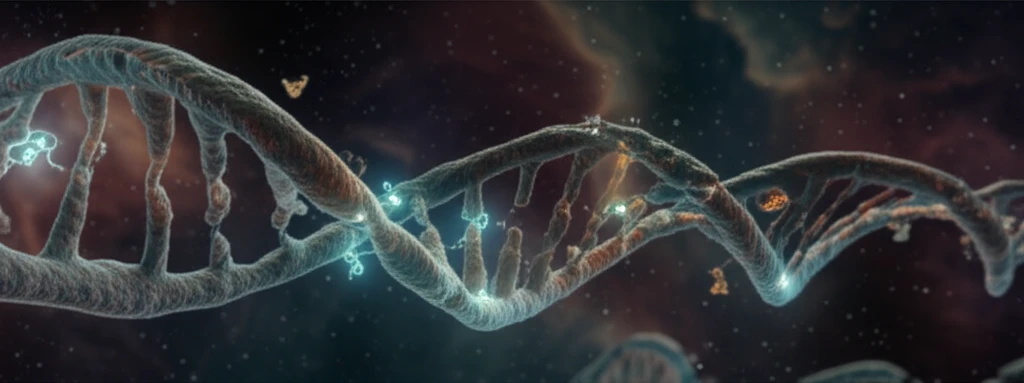
DNA repair process illustrated with glowing proteins fixing damaged strands.

DNA Damage and Repair: Why It Matters for Your Health

"Unraveling the complexities of nucleotide excision repair (NER) and its impact on DNA lesions. How new research sheds light on maintaining genetic stability and preventing disease."


Our DNA, the very blueprint of life, is constantly under attack. From environmental toxins to the sun's harsh rays, various factors can cause damage to our genetic material. Fortunately, our cells have sophisticated repair mechanisms to counteract these threats, and one of the most important is nucleotide excision repair (NER).

NER is a versatile DNA repair pathway that fixes a wide range of structural abnormalities, including bulky DNA lesions caused by exposure to carcinogens and UV radiation. Recent research has focused on understanding how NER operates when DNA is packaged into nucleosomes, the fundamental units of chromatin. These findings have critical implications for understanding cancer development, aging, and other diseases linked to DNA damage.

This article delves into the latest discoveries regarding NER, focusing on how it deals with specific types of DNA damage within nucleosomes. By understanding these processes, we can gain valuable insights into maintaining genomic stability and preventing disease.

Nucleotide Excision Repair (NER): The Body's DNA Clean-Up Crew

DNA repair process illustrated with glowing proteins fixing damaged strands.

NER is a critical mechanism that removes bulky lesions from DNA. These lesions can arise from various sources, including:

  • Exposure to polycyclic aromatic hydrocarbons (PAHs): These chemicals, found in smoke and pollution, can bind to DNA and create bulky adducts.
  • Ultraviolet (UV) radiation: UV light can cause the formation of cyclobutane pyrimidine dimers (CPDs), another type of bulky lesion.
  • Oxidative Damage: Even "non-bulky" lesions such as 5',8-cyclopurine, adenine (cdA) and guanine (cdG) can impact NER.

Focusing on these key areas helps researchers understand how NER navigates the complex structure of DNA within the cell.
The NER process involves several key steps: recognition of the damage, unwinding of the DNA around the lesion, cutting out the damaged section, and filling the gap with newly synthesized DNA. Proteins like XPC-RAD23B play a crucial role in the initial damage recognition, acting as a 'first responder' to kickstart the repair process.

Protecting Your DNA: What You Can Do

While NER operates continuously to repair DNA damage, you can take steps to minimize your exposure to DNA-damaging agents. These include:

<ul><li>Limiting sun exposure: Wear protective clothing and sunscreen to reduce UV radiation exposure.</li><li>Avoiding tobacco smoke: Smoking introduces numerous carcinogens that damage DNA.</li><li>Eating a healthy diet: Consuming antioxidant-rich foods can help combat oxidative stress.</li></ul>

Ultimately, understanding the intricacies of DNA repair mechanisms like NER empowers us to make informed choices that support our long-term health and well-being. Continued research into these fundamental processes promises to unlock new strategies for preventing and treating diseases linked to DNA damage.

About this Article -

This article was crafted using a human-AI hybrid and collaborative approach. AI assisted our team with initial drafting, research insights, identifying key questions, and image generation. Our human editors guided topic selection, defined the angle, structured the content, ensured factual accuracy and relevance, refined the tone, and conducted thorough editing to deliver helpful, high-quality information.See our About page for more information.

This article is based on research published under:

DOI-LINK: 10.1021/acs.biochem.8b01066, Alternate LINK

Title: Nucleotide Excision Repair And Impact Of Site-Specific 5′,8-Cyclopurine And Bulky Dna Lesions On The Physical Properties Of Nucleosomes

Subject: Biochemistry

Journal: Biochemistry

Publisher: American Chemical Society (ACS)

Authors: Vladimir Shafirovich, Marina Kolbanovskiy, Konstantin Kropachev, Zhi Liu, Yuquin Cai, Michael A. Terzidis, Annalisa Masi, Chryssostomos Chatgilialoglu, Shantu Amin, Alexander Dadali, Suse Broyde, Nicholas E. Geacintov

Published: 2018-12-20

Everything You Need To Know

1

What is Nucleotide Excision Repair (NER), and what does it do?

Nucleotide Excision Repair (NER) is a crucial DNA repair pathway that removes bulky DNA lesions. These lesions arise from various sources, including exposure to environmental toxins, and UV radiation. NER's role is vital because these lesions can disrupt normal cellular processes and lead to mutations. If left uncorrected, these mutations can contribute to diseases like cancer.

2

Why is Nucleotide Excision Repair (NER) so important?

The significance of Nucleotide Excision Repair (NER) lies in its ability to maintain the integrity of our genetic material. DNA damage, caused by factors like exposure to polycyclic aromatic hydrocarbons (PAHs) and UV radiation, can lead to genomic instability and diseases. NER acts as a critical defense mechanism, preventing the accumulation of these mutations and ensuring proper cell function. Its efficient operation is fundamental to overall health and disease prevention.

3

How does Nucleotide Excision Repair (NER) work?

The process of Nucleotide Excision Repair (NER) involves several key steps. It begins with the recognition of DNA damage by proteins like XPC-RAD23B, which act as 'first responders'. The DNA around the damaged site is then unwound, the damaged section is cut out, and the gap is filled with newly synthesized DNA. This multi-step process ensures that the DNA damage is completely removed and the original genetic sequence is restored, maintaining the accuracy of the DNA.

4

What are the health implications of DNA damage?

DNA damage can have severe implications for your health, potentially leading to cancer, aging, and other diseases. Exposure to environmental toxins, such as polycyclic aromatic hydrocarbons (PAHs) and UV radiation, can cause bulky DNA lesions, disrupting normal cellular functions. If these lesions are not repaired, they can accumulate, leading to genomic instability, which can result in uncontrolled cell growth and other health complications. Understanding how Nucleotide Excision Repair (NER) addresses this damage is crucial.

5

What can I do to protect my DNA?

You can take steps to minimize your exposure to DNA-damaging agents, which can indirectly support the efficiency of Nucleotide Excision Repair (NER). These include limiting exposure to UV radiation by using sunscreen and avoiding prolonged sun exposure, and reducing exposure to environmental toxins. By minimizing damage, you ease the burden on NER, which is the body's primary defense against DNA damage. This helps to prevent the accumulation of mutations and maintain genomic stability, contributing to better health.

Newsletter Subscribe

Subscribe to get the latest articles and insights directly in your inbox.