
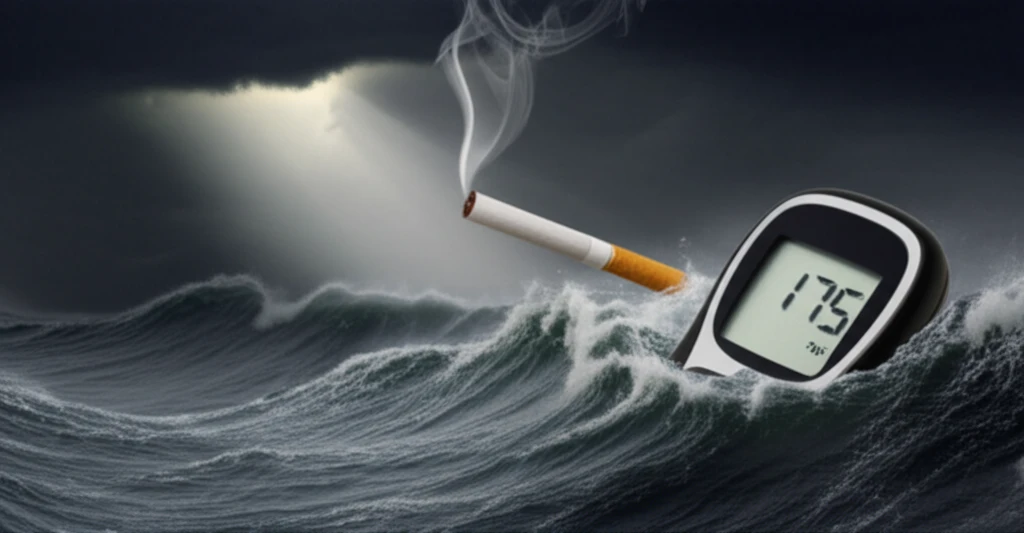
Stormy sea with cigarette and blood glucose meter, symbolizing diabetes and smoking risk.

Diabetes and Smoking: A Perfect Storm for Your Health

"Uncover the dangerous synergy between diabetes and smoking, and how quitting can significantly reduce your cardiovascular risk."


The phrase "perfect storm," popularized by a movie based on a real-life maritime disaster, aptly describes the convergence of multiple risk factors that amplify health risks. When it comes to cardiovascular health, diabetes mellitus (DM) and smoking create just such a dangerous combination.

Cardiovascular diseases (CVDs) are already a leading cause of death and disability worldwide. The Global Burden of Disease study highlights that CVDs account for approximately 18 million deaths and 353 million disability-adjusted life years (DALYs) annually. However, this "cardiovascular tsunami" is not a singular event but a confluence of many contributing factors.

These risk factors, including high cholesterol, hypertension, obesity, and lifestyle choices, act synergistically to increase the likelihood of developing CVDs. Among these, diabetes and smoking stand out as particularly potent contributors, significantly escalating the overall threat.

The Deadly Duo: How Diabetes and Smoking Compound Your Risk

Stormy sea with cigarette and blood glucose meter, symbolizing diabetes and smoking risk.

It has been long established that risk factors for cardiovascular disease have additive effects. The presence of multiple risk factors exponentially raises the risk of developing CVD. This concept is the foundation for cardiovascular risk assessment tools like Framingham, UKPDS risk, SCORE, and REGICOR, designed to quantify an individual's probability of developing CVD.

Diabetes and smoking are major independent risk factors. Globally, diabetes affects 451 million people, causing 1.4 million deaths and 57 million DALYs. Smoking is responsible for 7.1 million deaths and 177 million DALYs. In Spain, over 4.6 million adults have diabetes, contributing to 35,541 deaths and 616,000 DALYs annually. Smoking affects 10.7 million adults in Spain, resulting in 57,216 deaths and 1.1 million DALYs annually.

  • Increased Risk: When diabetes and smoking coexist, the danger is amplified. The INTERHEART study revealed that the combination of diabetes, smoking, and hypertension results in a 13.1-fold increased risk of acute myocardial infarction (AMI), compared to 2.9 for smoking alone, 2.7 for diabetes, and 1.9 for hypertension.
  • Synergistic Effect: The "malignant synergy" between diabetes and smoking is well-documented. There's evidence suggesting that smoking increases the risk of developing diabetes by 30-40% compared to non-smokers. It creates a cycle where one condition exacerbates the other.
  • Risk Assessment Shortcomings: Surprisingly, some risk assessment tools like SCORE don't account for diabetes alongside factors like age, sex, hypertension, cholesterol, and smoking. This omission can underestimate the actual risk for individuals with diabetes.
Recent research continues to reinforce the dangers of this combination. Studies consistently show that quitting smoking has a positive impact on reducing cardiovascular risk in individuals with diabetes. These findings underscore the importance of addressing both diabetes and smoking in comprehensive prevention strategies.

Turning the Tide: Steps You Can Take to Protect Your Heart

The convergence of diabetes and smoking presents a formidable challenge to cardiovascular health, creating a perfect storm of heightened risk. Recognizing this danger is the first step toward mitigating its impact. Individuals with diabetes must understand that smoking cessation is not just a lifestyle choice but a critical intervention for protecting their heart.

Quitting smoking, coupled with diligent management of blood sugar levels and other risk factors, can significantly reduce the threat of cardiovascular events. Healthcare providers play a crucial role in educating patients about the synergistic dangers of diabetes and smoking, and in providing the necessary support and resources for smoking cessation.

By addressing both diabetes and smoking comprehensively, and promoting a holistic approach to cardiovascular health, we can help individuals navigate this perfect storm and chart a course toward a healthier future. Continued research and public health initiatives are essential to further clarify the intricate links between diabetes, smoking, and cardiovascular disease, and to develop more effective strategies for prevention and treatment.

About this Article -

This article was crafted using a human-AI hybrid and collaborative approach. AI assisted our team with initial drafting, research insights, identifying key questions, and image generation. Our human editors guided topic selection, defined the angle, structured the content, ensured factual accuracy and relevance, refined the tone, and conducted thorough editing to deliver helpful, high-quality information.See our About page for more information.

Everything You Need To Know

1

Why is the combination of diabetes and smoking described as a "perfect storm"?

When combined, diabetes and smoking create a "perfect storm" for cardiovascular risk, meaning they significantly increase your chances of developing heart disease. The term "perfect storm" highlights how multiple risk factors, such as high cholesterol, hypertension, and obesity, can worsen health issues. In this case, diabetes and smoking work together, amplifying the threat to your cardiovascular health more than either condition would on its own.

2

How do diabetes and smoking affect the risk of cardiovascular diseases?

The combination of diabetes and smoking greatly increases the likelihood of cardiovascular diseases (CVDs), which are already a leading cause of death worldwide. Risk assessment tools, such as Framingham, UKPDS risk, SCORE, and REGICOR, help to quantify the probability of developing CVDs. While these tools acknowledge various risk factors, some might not fully account for the combined impact of diabetes and smoking, which can lead to an underestimation of an individual's true cardiovascular risk. Therefore, it is important to recognize the additive effects of multiple risk factors like diabetes and smoking.

3

What are the individual and combined risks associated with diabetes and smoking?

Diabetes and smoking are both major independent risk factors for cardiovascular diseases. Globally, diabetes affects hundreds of millions of people, causing millions of deaths and significant disability-adjusted life years (DALYs). Similarly, smoking leads to millions of deaths and a large number of DALYs. The implications include a higher chance of heart attacks and other cardiovascular problems, and the importance of addressing both conditions through lifestyle changes and medical intervention. For example, in Spain, both diabetes and smoking are major contributors to mortality and DALYs.

4

What does the INTERHEART study reveal about the combination of diabetes, smoking, and hypertension?

The INTERHEART study revealed the dangers when diabetes, smoking, and hypertension are combined. This combination creates a significantly higher risk of acute myocardial infarction (AMI) compared to smoking or diabetes alone. This demonstrates a synergistic effect where the combined risk is greater than the sum of each factor. This synergistic effect is described as a "malignant synergy". Understanding this synergy is critical for effective prevention and management strategies to address cardiovascular risk.

5

What can be done to mitigate the risks associated with diabetes and smoking?

Quitting smoking is a crucial step to reduce the risk of cardiovascular issues, particularly for those with diabetes. Studies show that smoking increases the chance of developing diabetes by 30-40%. Recent research consistently reinforces the benefits of smoking cessation for individuals with diabetes. Addressing both diabetes and smoking is vital in creating comprehensive prevention strategies. Recognizing this convergence is the first step towards mitigating its impact.

Newsletter Subscribe

Subscribe to get the latest articles and insights directly in your inbox.