
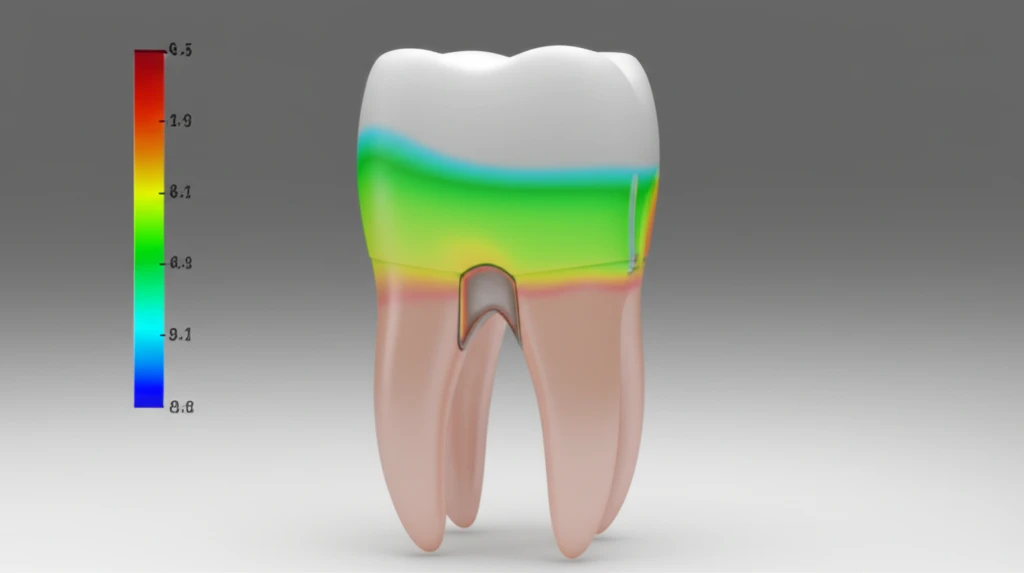
Heatmap of stress distribution in a dental filling

Dental Cavity Design: How it Impacts Your Fillings and Tooth Health

"Unlock the secrets of optimal cavity design for stronger, longer-lasting dental fillings. Learn how the shape of your cavity affects the success of your dental work!"


A strong bond between a tooth and a dental restoration is essential for long-term success. Resin composites, widely used for their tooth-like qualities, require careful preparation to ensure they stay put. But what role does the actual shape of the cavity play in how well a filling holds up?

Traditional methods for testing bond strength, such as microtensile and shear tests, have been used extensively. However, these methods can sometimes fall short in accurately predicting real-world performance. This is where finite element analysis (FEA) comes in – a powerful tool to simulate and analyze stress distribution within teeth and restorations.

Finite Element Analysis offers a unique advantage: the ability to isolate individual factors. This study uses FEA to explore how different cavity shapes affect the stress on dental fillings, providing insights that traditional testing methods might miss.

Why Cavity Shape Matters: Understanding Stress Distribution

Heatmap of stress distribution in a dental filling

The study used computer models to simulate three different cavity shapes, each carefully designed to mimic real-world scenarios. These models, labeled A, B, and C, varied in diameter at the top (occlusal) and bottom (cervical) of the cavity.

Each model was subjected to a simulated force, mimicking the pressure of chewing. The computer then calculated the stress distribution within the tooth, the filling material, and the bonding agent that holds them together. By analyzing these stress patterns, researchers could pinpoint areas of weakness and potential failure.

  • Model A: Wider at the top, creating a flared shape.
  • Model B: Slightly tapered.
  • Model C: Uniform diameter, creating a straight-walled cavity.
The results showed that cavity shape significantly influences how stress is distributed. Model C, with its uniform shape, exhibited the lowest stress levels. In contrast, Model A, with its wider top, showed higher concentrations of stress. This suggests that tapered or flared cavity shapes might be more prone to failure under pressure.

What This Means for Your Dental Health

This research highlights the importance of cavity design in the longevity of dental fillings. By understanding how different shapes affect stress distribution, dentists can make more informed decisions about cavity preparation, ultimately leading to more durable and successful restorations. While further research is needed to validate these findings in real-world clinical settings, this study provides valuable insights into the biomechanics of dental restorations.

About this Article -

This article was crafted using a human-AI hybrid and collaborative approach. AI assisted our team with initial drafting, research insights, identifying key questions, and image generation. Our human editors guided topic selection, defined the angle, structured the content, ensured factual accuracy and relevance, refined the tone, and conducted thorough editing to deliver helpful, high-quality information.See our About page for more information.

This article is based on research published under:

DOI-LINK: 10.4317/medoral.16.e119, Alternate LINK

Title: Biomechanical Behavior Of Cavity Configuration On Micropush-Out Test: A Finite-Element-Study

Subject: General Dentistry

Journal: Medicina Oral Patología Oral y Cirugia Bucal

Publisher: Medicina Oral, S.L.

Authors: I. Cekic-Nagas, A. Shinya, G. Ergun, Pk. Vallittu, Lvj. Lassila

Published: 2011-01-01

Everything You Need To Know

1

What is dental cavity design and why does it matter for fillings?

Dental cavity design refers to the shape and dimensions of the space prepared in a tooth to receive a filling. It's important because the cavity's shape influences how well the filling material bonds to the tooth and withstands chewing forces. A poorly designed cavity can lead to increased stress on the filling, potentially causing it to crack, debond, or fail prematurely. The design needs to balance removing decay and preserving healthy tooth structure to ensure the filling lasts.

2

What is finite element analysis and how is it used in dentistry?

Finite element analysis (FEA) is a computer-based simulation technique used to analyze stress distribution within dental structures like teeth and fillings. It's significant because it allows researchers to predict how different cavity shapes will respond to forces, like chewing, without actually performing physical tests on real teeth. FEA helps optimize cavity design by identifying areas of high stress concentration that could lead to filling failure. This complements traditional testing methods, such as microtensile and shear tests, which may not fully capture real-world conditions.

3

Can you explain the different cavity shapes (Models A, B, and C) used in the study?

The study used three models (A, B, and C) with different cavity shapes to understand how the shape affects stress distribution. Model A had a flared shape (wider at the top), Model B was slightly tapered, and Model C had a uniform, straight-walled shape. The significance is that these different shapes influenced the stress on dental fillings. The models are important as each shape represents a different cavity design that a dentist might use, and analyzing their stress patterns helps determine which designs are most durable.

4

What were the main findings of the study regarding cavity shape and stress on fillings?

The study showed that the shape of a cavity significantly impacts stress distribution within the tooth and filling. Specifically, Model C, with its uniform shape, exhibited the lowest stress levels, while Model A, with a flared shape, showed higher stress concentrations. This is important because it suggests that straight-walled cavity designs may be more resistant to failure under chewing forces compared to flared designs. This information can help dentists make informed decisions about cavity preparation techniques to improve the longevity of fillings.

5

Why is understanding cavity design important when using resin composites for fillings?

Resin composites are tooth-colored filling materials that are widely used due to their aesthetic appeal and ability to bond to tooth structure. They require careful cavity preparation to ensure a strong and durable bond. Understanding how cavity design affects stress distribution is crucial for resin composites because excessive stress can compromise the bond between the composite and the tooth, leading to microleakage, secondary decay, and eventual filling failure. Optimal cavity design, guided by insights from studies using finite element analysis (FEA), can enhance the performance and lifespan of resin composite fillings.

Newsletter Subscribe

Subscribe to get the latest articles and insights directly in your inbox.