
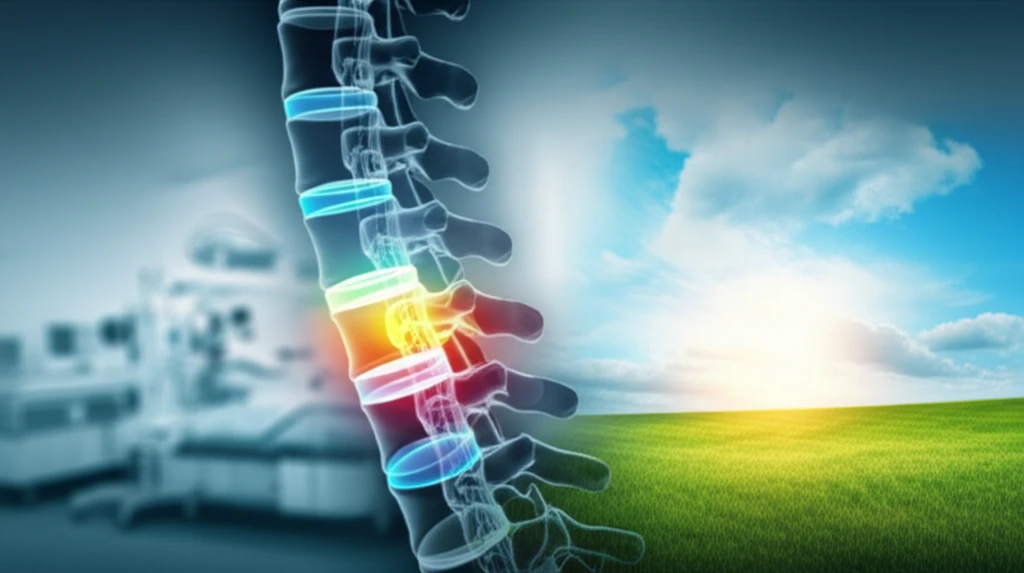
Stylized illustration of a spine representing successful spinal cancer treatment.

Defying the Odds: Long-Term Survival Story of Rare Spine Cancer

"A groundbreaking case report details how a novel surgical approach and targeted therapy led to years of disease-free life for a patient with a rare thoracic spine leiomyosarcoma, offering hope and insights for battling similar cancers."


Spinal tumors, though uncommon, represent a small percentage of all tumors. Leiomyosarcoma, a type of soft tissue sarcoma, is even rarer when it originates in the bone, particularly the spine. This article explores a unique case of a primary leiomyosarcoma in the thoracic spine, highlighting the challenges in diagnosis and treatment.

Diagnosing primary leiomyosarcoma of the spine is complex. Imaging techniques provide clues, but a definitive diagnosis requires a biopsy to rule out other potential sources of the cancer. The treatment approach often involves a combination of surgery, radiation, and careful monitoring to prevent recurrence.

This article delves into a specific case report that showcases an innovative surgical technique and postoperative therapy which led to long-term, disease-free survival in a patient with thoracic spine leiomyosarcoma. This highlights the importance of a well-planned approach and comprehensive care in managing rare and aggressive spinal tumors.

The Fight for Survival: A Case Study in Thoracic Spine Leiomyosarcoma

Stylized illustration of a spine representing successful spinal cancer treatment.

A 60-year-old woman experienced persistent pain in her thoracic spine. Initial X-rays revealed abnormalities in the T11 vertebra, prompting further investigation. The diagnostic journey involved multiple imaging techniques, including CT scans and MRIs, to characterize the lesion.

The complexity of the case necessitated multiple biopsies to confirm the diagnosis. The initial CT-guided biopsy was inconclusive, leading to an open transpedicular biopsy. Ultimately, the lesion was identified as a low-intermediate grade mesenchymal sarcoma, which further testing revealed to be a leiomyosarcoma.

  • X-Rays: Showed a discrete loss of height and asymmetry of the T11 vertebral body, cortical expansion, and sclerosis.
  • CT Scans: Revealed an expanded lobular lytic lesion with partial sclerotic borders.
  • MRI: Displayed a solitary lesion in T11, with hypointense signals on T1-weighted images and hyperintense signals on T2-weighted images.
  • Biopsy: Initially inconclusive, later confirmed leiomyosarcoma after open transpedicular biopsy.
Based on the diagnosis and staging, a total en bloc spondylectomy (TES) was performed. This complex surgical procedure involved the complete removal of the T11 vertebra, followed by reconstruction of the spine to maintain stability. Post-operative radiation therapy was administered to target any remaining cancer cells and minimize the risk of recurrence. Close monitoring over five years revealed no signs of local recurrence or distant metastasis, marking a successful outcome.

Hope and Progress in the Fight Against Rare Spinal Cancers

This case demonstrates that with careful pre-operative planning and aggressive surgical intervention, long-term survival is possible even in rare and challenging spinal tumors like leiomyosarcoma. The success of the total en bloc spondylectomy, combined with radiation therapy and diligent follow-up, offers valuable insights for treating similar cases.

The extended disease-free survival in this patient is particularly noteworthy, as it represents one of the longest reported follow-up periods for primary spinal leiomyosarcoma treated with total en bloc spondylectomy. This outcome underscores the importance of considering aggressive surgical approaches in the management of these tumors.

While leiomyosarcoma of the spine remains a rare diagnosis, this case report provides a beacon of hope for patients and clinicians alike. Continued research and collaboration are crucial to improving our understanding and treatment of these rare cancers, ultimately leading to better outcomes and extended survival.

About this Article -

This article was crafted using a human-AI hybrid and collaborative approach. AI assisted our team with initial drafting, research insights, identifying key questions, and image generation. Our human editors guided topic selection, defined the angle, structured the content, ensured factual accuracy and relevance, refined the tone, and conducted thorough editing to deliver helpful, high-quality information.See our About page for more information.

This article is based on research published under:

DOI-LINK: 10.1016/j.ijscr.2017.08.045, Alternate LINK

Title: Free Disease Long-Term Survival In Primary Thoracic Spine Leiomyosarcoma After Total En Bloc Spondylectomy: A Case Report

Subject: Surgery

Journal: International Journal of Surgery Case Reports

Publisher: Elsevier BV

Authors: José Ramirez-Villaescusa, Adriana Canosa-Fernández, Antonio Martin-Benlloch, David Ruiz-Picazo, Jesús López-Torres Hidalgo

Published: 2017-01-01

Everything You Need To Know

1

What is thoracic spine leiomyosarcoma?

The thoracic spine leiomyosarcoma is a rare form of cancer, specifically a soft tissue sarcoma that originates in the spine. It is considered a primary bone tumor. Its rarity and aggressive nature make it challenging to diagnose and treat. This case study highlights a specific instance of this cancer in the T11 vertebra, showcasing the complexities involved in its management.

2

How is thoracic spine leiomyosarcoma diagnosed?

Diagnosis of thoracic spine leiomyosarcoma is complex, often requiring a combination of imaging techniques and biopsies. Initial imaging, such as X-rays, CT scans, and MRIs, helps identify abnormalities. However, a definitive diagnosis necessitates a biopsy to differentiate leiomyosarcoma from other potential cancers. The case study illustrates this process, with the patient undergoing multiple imaging scans and biopsies before receiving a confirmed diagnosis of leiomyosarcoma.

3

What is the total en bloc spondylectomy (TES), and why is it important in treating this cancer?

The total en bloc spondylectomy (TES) is a complex surgical procedure involving the complete removal of a vertebra, in this case, the T11 vertebra, affected by the leiomyosarcoma. This is followed by reconstruction to ensure spinal stability. TES is a critical component of treatment because it aims to remove the tumor completely, minimizing the chances of local recurrence. Postoperative radiation therapy is often used to target any remaining cancer cells and prevent the disease from returning.

4

What is the role of radiation therapy in the treatment of thoracic spine leiomyosarcoma?

Radiation therapy plays a crucial role in treating thoracic spine leiomyosarcoma. Administered after surgery, it targets any microscopic cancer cells that might remain, thereby reducing the risk of recurrence. In this case, the patient received post-operative radiation therapy following the total en bloc spondylectomy. This, combined with careful monitoring, contributed to the patient's long-term disease-free survival.

5

What is the significance of this case study?

The significance of this case lies in its demonstration of successful long-term survival in a patient with a rare and aggressive spinal tumor, the thoracic spine leiomyosarcoma. The use of an innovative surgical approach, the total en bloc spondylectomy, combined with radiation therapy and diligent follow-up, provides a valuable insight into treating similar cases. This success offers hope and guidance for managing other rare spinal tumors.

Newsletter Subscribe

Subscribe to get the latest articles and insights directly in your inbox.