
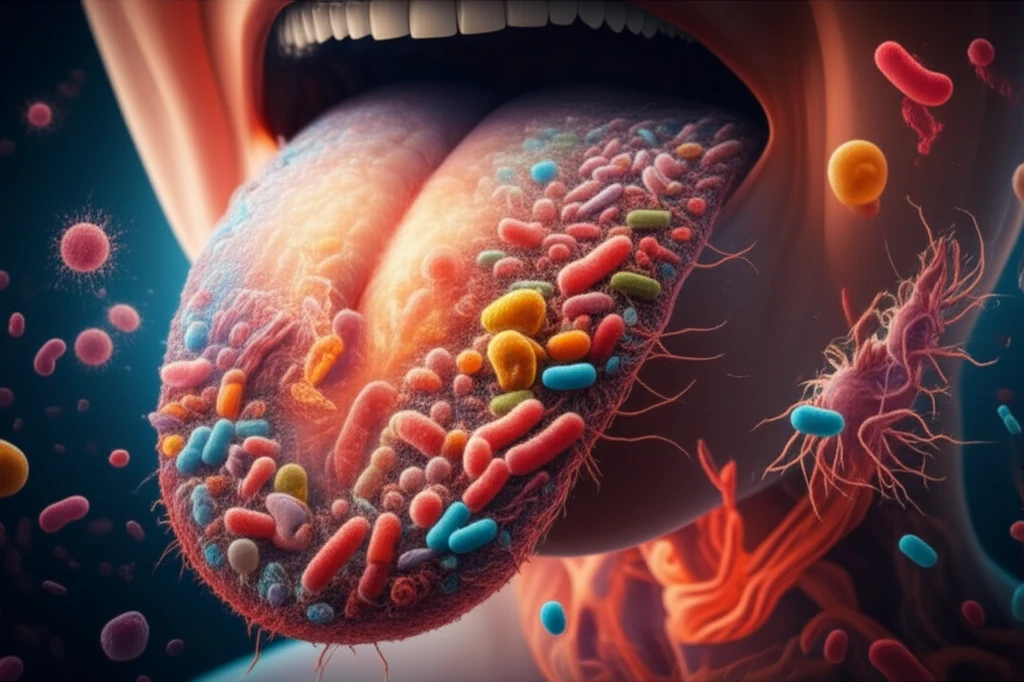
Surreal illustration of a tongue with a microbiome landscape connecting to a gastric scene, symbolizing the link between oral and gastric health.

Decoding Your Tongue: What Tongue Coating Reveals About Gastric Health

"New research explores the link between tongue coating microbiome and gastric cancer, offering potential for early non-invasive diagnostics."


Gastric cancer remains a significant global health challenge, often diagnosed at advanced stages due to subtle early symptoms. Traditional diagnostic methods rely on endoscopy and biopsy, which can be invasive and may not always be appealing for regular screening. This has led researchers to explore alternative, non-invasive methods for early detection.

Traditional Chinese Medicine (TCM) offers a unique perspective through tongue diagnosis, where the color and thickness of the tongue coating are believed to reflect the body's overall health. TCM practitioners use these observations to assess various 'syndromes,' correlating tongue appearance with specific health conditions. But what's the science behind this ancient practice?

Recent research is diving into the microbial composition of tongue coatings to uncover potential biomarkers for gastric cancer. By analyzing the bacteria and fungi present, scientists aim to bridge the gap between TCM's observations and modern diagnostics, potentially paving the way for earlier, non-invasive detection methods. This article explores the groundbreaking findings of a study investigating the link between tongue coating microbiome and gastric cancer, and what it could mean for your health.

The Tongue's Microbial Landscape: A Mirror to Your Gut?

Surreal illustration of a tongue with a microbiome landscape connecting to a gastric scene, symbolizing the link between oral and gastric health.

A recent study published in Microbial Pathogenesis sought to characterize the microorganisms present in different types of tongue coatings in patients with gastric cancer. Researchers categorized 115 gastric cancer patients into four groups based on their tongue coating: White-thin, White-thick, Yellow-thin, and Yellow-thick. They then compared the microbial communities in these groups to a control group of healthy individuals with White-thin coatings, using advanced sequencing techniques to analyze bacterial (16S rRNA) and fungal (18S rRNA) genes.

The study revealed significant differences in the microbial composition across the different tongue coating types. At the bacterial phylum level, Saccharibacteria showed higher abundance in the White-thick group compared to the White-thin group, while Proteobacteria were more abundant in the White-thin group compared to the Yellow-thick group. Fungal genus-level analysis identified Guehomyces and Aspergillus as significantly different among the common tongue coatings.

Key findings highlighted by the researchers:
  • The microbial community plays a role in the variation of tongue coatings in gastric cancer patients.
  • White-thick tongue coatings have the most dramatically different microbiome.
  • Positive correlations dominated the increased bacterial taxa in each tongue coating type.
Through rigorous statistical analysis, the researchers identified 14 significantly increased taxa as potential microbial biomarkers for common tongue coatings. At the species level, Capnocytophaga leadbetteri (bacteria) and Ampelomyces sp. IRAN_1 (fungus) emerged as potential biomarkers for White-thin coatings. Four bacterial species (Megasphaera micronuciformis, Selenomonas sputigena ATCC 35185, Acinetobacter ursingii, and Prevotella maculosa) were identified as potential biomarkers for White-thick coatings. The study also indicated that white coatings generally harbor more complex commensal relationships than yellow coatings.

Looking Ahead: Tongue Coating as a Diagnostic Tool

This research provides a compelling link between the oral microbiome, tongue coating characteristics, and gastric cancer, suggesting that tongue diagnosis, refined by modern microbial analysis, could become a valuable tool for early detection. The identification of specific bacterial and fungal biomarkers opens the door for developing non-invasive screening methods that could complement traditional diagnostic approaches.

While the study offers promising insights, the authors acknowledge the need for further research to validate these findings and account for other influencing factors such as lifestyle, diet, and clinical treatments. Larger studies with detailed participant information are essential to refine the accuracy and reliability of tongue coating analysis as a diagnostic tool.

As the costs of next-generation sequencing continue to decrease and data availability increases, the potential for identifying specific microbial signatures associated with gastric cancer becomes even greater. This could revolutionize early detection efforts, leading to improved treatment outcomes and ultimately saving lives.

About this Article -

This article was crafted using a human-AI hybrid and collaborative approach. AI assisted our team with initial drafting, research insights, identifying key questions, and image generation. Our human editors guided topic selection, defined the angle, structured the content, ensured factual accuracy and relevance, refined the tone, and conducted thorough editing to deliver helpful, high-quality information.See our About page for more information.

This article is based on research published under:

DOI-LINK: 10.1016/j.micpath.2018.11.051, Alternate LINK

Title: Microbial Biomarkers Of Common Tongue Coatings In Patients With Gastric Cancer

Subject: Infectious Diseases

Journal: Microbial Pathogenesis

Publisher: Elsevier BV

Authors: Jing Xu, Chunjie Xiang, Cong Zhang, Boqi Xu, Juan Wu, Ruiping Wang, Yaping Yang, Liyun Shi, Junfeng Zhang, Zhen Zhan

Published: 2019-02-01

Everything You Need To Know

1

How do different types of tongue coatings relate to the microorganisms in our mouths?

Research indicates that variations in tongue coating, such as White-thin, White-thick, Yellow-thin, and Yellow-thick, are linked to distinct microbial compositions. For example, the White-thick tongue coating shows a notably different microbiome compared to others. Specific bacteria like Saccharibacteria and fungi such as Guehomyces and Aspergillus are more prevalent in certain tongue coating types, providing potential biomarkers.

2

What specific bacteria or fungi have been identified as potential indicators for different tongue coatings?

The study identified specific microbial biomarkers for different tongue coatings. Capnocytophaga leadbetteri and Ampelomyces sp. IRAN_1 are potential biomarkers for White-thin coatings, while Megasphaera micronuciformis, Selenomonas sputigena ATCC 35185, Acinetobacter ursingii, and Prevotella maculosa are potential biomarkers for White-thick coatings. These findings suggest that analyzing tongue coating microbiota could offer insights into gastric health.

3

Why is the White-thick tongue coating considered significant in the study of gastric cancer and the oral microbiome?

The study found that White-thick tongue coatings exhibit the most dramatically different microbiome compared to other types. This suggests that significant alterations in the oral microbiome are associated with this particular tongue coating in gastric cancer patients. Further research is needed to understand the specific mechanisms driving these microbial changes and their impact on gastric health.

4

How does this research connect traditional Chinese medicine's tongue diagnosis to modern scientific understanding of the microbiome?

This research bridges traditional Chinese medicine's tongue diagnosis with modern microbial analysis by identifying specific microbial biomarkers associated with different tongue coatings. While TCM assesses tongue appearance to reflect overall health, this study provides scientific validation by linking specific microbial communities to gastric cancer, potentially enhancing diagnostic accuracy through non-invasive methods.

5

What methods were used to categorize patients and analyze the microbiome in the study of tongue coatings and gastric cancer?

The study categorized gastric cancer patients based on tongue coating types (White-thin, White-thick, Yellow-thin, Yellow-thick) and analyzed the microbial communities using 16S rRNA (bacteria) and 18S rRNA (fungi) gene sequencing. By comparing these microbial compositions with those of healthy individuals (with White-thin coatings), researchers identified significant differences and potential microbial biomarkers associated with each tongue coating type. These biomarkers can potentially be used for early non-invasive diagnostic measures.

Newsletter Subscribe

Subscribe to get the latest articles and insights directly in your inbox.