
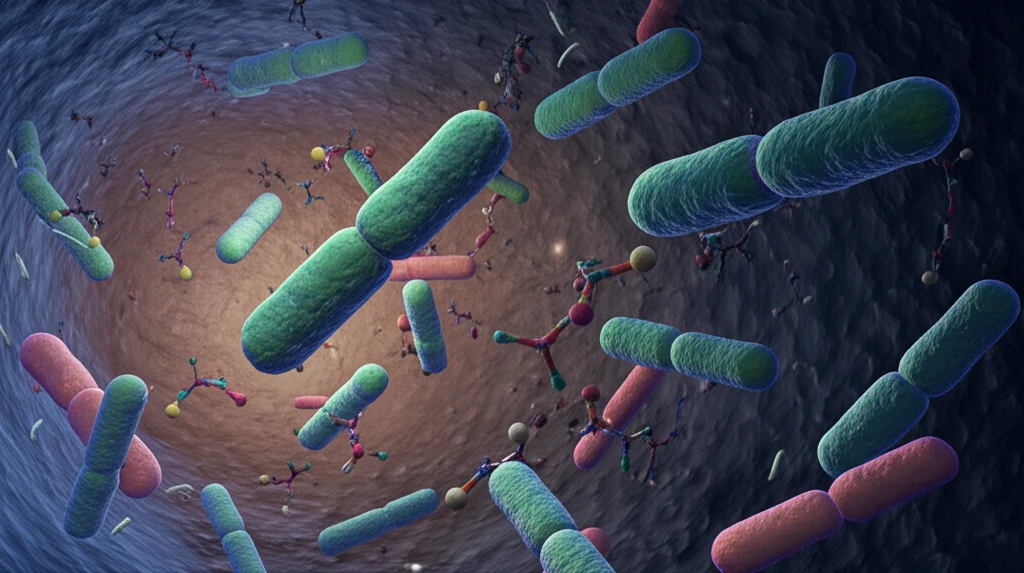
Illustration of gut bacteria producing choline from phosphatidylcholine.

Decoding Your Gut: How Friendly Bacteria Produce Essential Choline

"Scientists uncover how gut microbes create choline, a vital nutrient, impacting everything from heart health to brain function. Discover the implications for your diet and well-being."


Our understanding of the gut microbiome's influence on health is constantly evolving. We know that the trillions of bacteria, fungi, and other microorganisms residing in our intestines play a significant role in digesting food, synthesizing vitamins, and even influencing our mood. Recent research has uncovered another fascinating aspect of this microbial world: the ability of certain gut bacteria to produce choline.

Choline is an essential nutrient that's vital for numerous bodily functions. It's a key building block for cell membranes, supports nerve function, and plays a critical role in brain development and memory. While choline can be obtained through diet, primarily from foods like eggs, liver, and soybeans, this new research highlights that our gut bacteria can also contribute to our choline supply.

This discovery, highlighted in a study in Nature Microbiology, reveals a mechanism by which gut microorganisms hydrolyze phosphatidylcholine (PC), a type of fat, to release choline. This process is mediated by enzymes called phospholipase D (PLD), produced by a variety of gut bacteria. This choline production has significant implications, especially considering its link to the production of trimethylamine (TMA), a compound further metabolized into trimethylamine N-oxide (TMAO), which has been linked to cardiovascular disease.

Choline's Gut Connection: Unpacking the Science

Illustration of gut bacteria producing choline from phosphatidylcholine.

The study by Chittim et al. sheds light on how specific bacteria in our gut can break down phosphatidylcholine (PC) into choline using phospholipase D (PLD) enzymes. This process is particularly interesting because some of these bacteria then use the choline to produce trimethylamine (TMA), a compound the liver converts into trimethylamine N-oxide (TMAO). Elevated TMAO levels have been associated with an increased risk of cardiovascular disease, making this microbial pathway a subject of intense research.

The researchers found that microorganisms possessing the 'cut' gene cluster, responsible for anaerobic TMA formation from choline, were also capable of releasing choline from diverse phospholipids. This suggested that these microorganisms had an unanticipated ability to convert PC. Further investigation pinpointed PLD-encoding genes in bacterial strains capable of transforming PC to TMA, genes absent in those that couldn't.

  • Phospholipase D (PLD) Enzymes: These enzymes, produced by gut bacteria, are the key to breaking down phosphatidylcholine into choline.
  • 'Cut' Gene Cluster: Microorganisms with this gene cluster can convert choline into trimethylamine (TMA).
  • TMAO Connection: TMA is converted into TMAO in the liver, a compound linked to heart disease.
  • Microbial Diversity: Not all gut bacteria can perform these conversions, highlighting the complex interplay within the gut microbiome.
To confirm their findings, the researchers created a PLD knockout strain of Escherichia coli MS 200-1, a human gut isolate. This modified strain was unable to convert PC or form TMA. Restoring the pld gene to the knockout strain restored both the metabolic activity and TMA formation, solidifying the role of PLD in this process.

The Future of Gut Health: Targeting PLD for Therapeutic Interventions

This research opens up new avenues for therapeutic interventions targeting TMA-induced pathologies. The discovery that commensal PLDs differ from both pathogenic and host PLDs suggests the possibility of developing inhibitors that selectively target bacterial PLDs, minimizing potential side effects. Further research is needed to fully understand the role of TMA production in the human gut, its impact on disease, and the potential of targeting gut microorganism PLDs as a therapeutic strategy.

About this Article -

This article was crafted using a human-AI hybrid and collaborative approach. AI assisted our team with initial drafting, research insights, identifying key questions, and image generation. Our human editors guided topic selection, defined the angle, structured the content, ensured factual accuracy and relevance, refined the tone, and conducted thorough editing to deliver helpful, high-quality information.See our About page for more information.

This article is based on research published under:

DOI-LINK: 10.1038/s41564-018-0325-1, Alternate LINK

Title: Gut Commensals Make Choline Too

Subject: Cell Biology

Journal: Nature Microbiology

Publisher: Springer Science and Business Media LLC

Authors: Aaron T. Wright

Published: 2018-12-13

Everything You Need To Know

1

What is the role of Phospholipase D (PLD) enzymes in the context of gut health and choline production?

Phospholipase D (PLD) enzymes, produced by specific gut bacteria, are crucial for breaking down phosphatidylcholine (PC) into choline. This process is a key step in the gut microbiome's ability to produce choline, an essential nutrient. The study by Chittim *et al.* highlights this mechanism, demonstrating that PLD enzymes enable certain gut bacteria to release choline from PC, impacting the availability of this vital nutrient for various bodily functions. Without PLD, PC cannot be broken down into choline by these bacteria.

2

How does the 'cut' gene cluster influence the gut microbiome's metabolic pathways, and what are the implications?

The 'cut' gene cluster, present in certain microorganisms, is responsible for converting choline into trimethylamine (TMA). This process is significant because TMA is further metabolized in the liver into trimethylamine N-oxide (TMAO), which has been linked to an increased risk of cardiovascular disease. The presence of this gene cluster in specific gut bacteria indicates their ability to influence health outcomes through choline metabolism. This suggests that the composition of the gut microbiome, particularly the presence of bacteria with the 'cut' gene cluster, could impact cardiovascular health.

3

Can you explain the connection between choline, trimethylamine (TMA), and trimethylamine N-oxide (TMAO) in relation to cardiovascular health?

Choline, an essential nutrient, is utilized by certain gut bacteria to produce trimethylamine (TMA). TMA is then converted into trimethylamine N-oxide (TMAO) in the liver. Elevated levels of TMAO in the body have been associated with an increased risk of cardiovascular disease. This pathway underscores the importance of understanding how the gut microbiome influences the production and metabolism of these compounds, and how interventions targeting the microbiome may impact cardiovascular health. The study suggests that the PLD enzymes and the 'cut' gene cluster are key to this process.

4

What are the potential therapeutic interventions that could arise from understanding the role of gut bacteria in choline metabolism?

Understanding the role of gut bacteria, particularly their production of PLD and subsequent metabolism of choline, opens new avenues for therapeutic interventions. One possibility is developing inhibitors that specifically target bacterial PLDs. This approach aims to modulate the production of TMA and, consequently, TMAO, potentially reducing the risk of cardiovascular disease. The research indicates that commensal PLDs differ from pathogenic and host PLDs, suggesting the feasibility of creating selective inhibitors that minimize side effects. This could lead to the development of targeted therapies that can modulate the gut microbiome to improve health.

5

How does the diversity of gut bacteria impact the production of choline and its downstream effects?

The diversity of gut bacteria plays a crucial role in choline metabolism and its effects. Not all gut bacteria can perform the conversion of phosphatidylcholine (PC) to choline using Phospholipase D (PLD) enzymes, nor can all bacteria with the 'cut' gene cluster convert choline to trimethylamine (TMA). This highlights the complex interplay within the gut microbiome. The presence or absence of specific bacterial strains, and their associated genes, determines the extent of choline production and the subsequent pathways leading to TMA and TMAO formation. Therefore, the composition and diversity of the gut microbiome significantly influence an individual's choline metabolism and potential risk of cardiovascular disease.

Newsletter Subscribe

Subscribe to get the latest articles and insights directly in your inbox.