
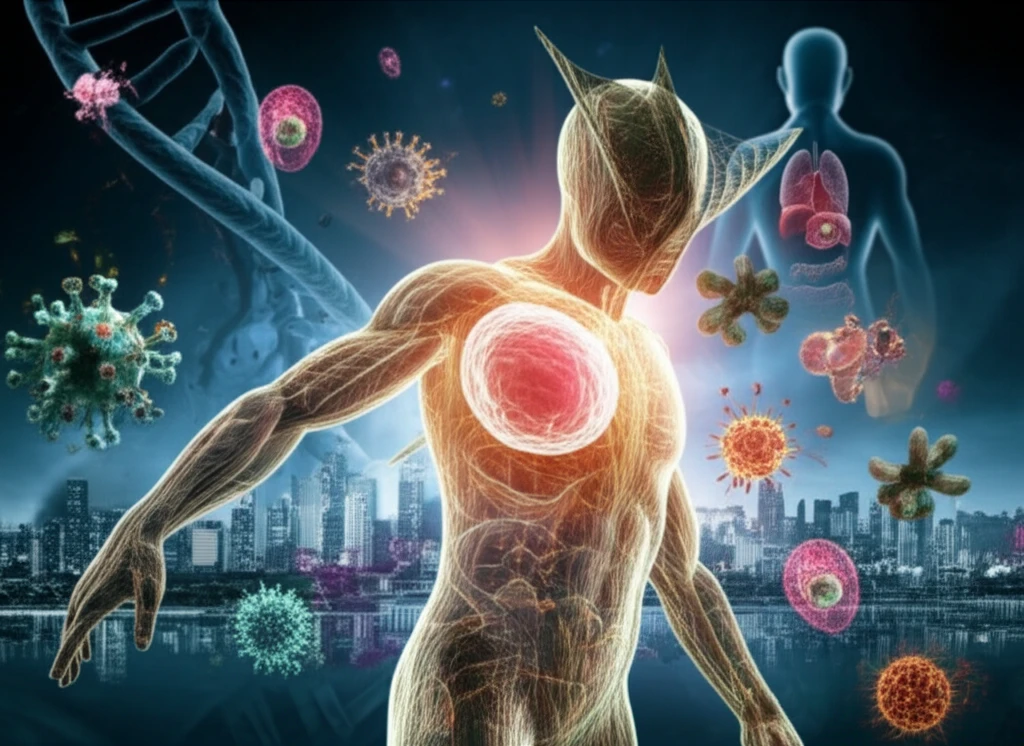
Illustration of a natural killer cell in action, representing the body's immune response and defense against diseases.

Decoding Your Body's Defenders: How Natural Killer Cells Fight for Your Health

"Unlocking the Secrets of Natural Killer Cells: A Deep Dive into Your Immune System's Frontline Warriors"


In the realm of human health, our bodies are constantly under siege. From microscopic viruses and bacteria to the rogue cells that can lead to cancer, the threats are ever-present. Luckily, we have a sophisticated defense system, and at the forefront of this battle are specialized cells known as Natural Killer (NK) cells. These unsung heroes of the immune system are vital in protecting us from a variety of dangers.

Unlike some immune cells that require prior exposure to a threat, NK cells are pre-programmed to recognize and eliminate infected or cancerous cells. They act as the first line of defense, swiftly responding to potential dangers and preventing them from escalating. The development and function of NK cells is a complex and fascinating area of research, and this article will provide a comprehensive overview of these essential immune warriors.

This deep dive will explore the intricate process of NK cell development, the factors that govern their maturation, and the mechanisms they employ to recognize and eliminate threats. We will also delve into the latest research, revealing how NK cells can even develop features of immune memory, offering new possibilities for treating diseases.

From Bone Marrow to Battleground: The Life Cycle of a Natural Killer Cell

Illustration of a natural killer cell in action, representing the body's immune response and defense against diseases.

NK cells, like all blood cells, originate from stem cells in the bone marrow. This is where the journey of an NK cell begins, undergoing a multi-stage differentiation process that leads to their final form. This is a precisely orchestrated process involving a series of developmental stages. The process is tightly controlled by various signals and transcription factors.

As NK cells mature, they acquire a unique set of surface receptors, which act as their recognition tools. These receptors enable NK cells to distinguish between healthy cells and those that are infected or cancerous. Once activated, NK cells release cytotoxic molecules like perforin and granzymes, which induce the target cell to undergo programmed cell death.

  • Common Lymphoid Progenitors (CLPs): The starting point in the bone marrow.
  • Early Innate Lymphoid Progenitors (EILPs): A transitional stage that can lead to both NK cells and other immune cell lineages.
  • NK Progenitor Cells: These cells lack the potential to become other immune cells and start to express key surface markers.
  • Pre-pro NKPs and Pre-NKPs: Early stages of NK progenitors which go through stepwise maturation.
  • Mature NK Cells (mNK): Fully functional NK cells that patrol the body, ready to eliminate threats.
The maturation process is not just a simple progression. It is a dynamic process influenced by various factors, including the local environment and the presence of specific signals. The liver and thymus also play a role in NK cell development, giving rise to unique NK cell populations that reside in specific tissues.

Empowering Your Body's Defenses: The Future of NK Cell Research

The study of NK cells is a rapidly evolving field, with new discoveries constantly expanding our understanding of their function and potential. The insights gained from this research hold great promise for developing novel immunotherapies, particularly for cancer and infectious diseases. As we unravel the intricacies of NK cell biology, we move closer to harnessing the full potential of these remarkable cells to safeguard our health and well-being.

About this Article -

This article was crafted using a human-AI hybrid and collaborative approach. AI assisted our team with initial drafting, research insights, identifying key questions, and image generation. Our human editors guided topic selection, defined the angle, structured the content, ensured factual accuracy and relevance, refined the tone, and conducted thorough editing to deliver helpful, high-quality information.See our About page for more information.

This article is based on research published under:

DOI-LINK: 10.1111/imm.13017, Alternate LINK

Title: Transcriptional Control Of Natural Killer Cell Differentiation

Subject: Immunology

Journal: Immunology

Publisher: Wiley

Authors: Marc Brillantes, Aimee M. Beaulieu

Published: 2018-11-18

Everything You Need To Know

1

What exactly are Natural Killer cells, and why are they important for my health?

Natural Killer (NK) cells are a type of immune cell that acts as the body's first line of defense against threats like infections and cancer. They are pre-programmed to recognize and eliminate infected or cancerous cells without prior exposure, swiftly responding to potential dangers and preventing them from escalating. They're crucial because they provide immediate protection while other immune responses are developing. Without them, the body would be much more vulnerable to diseases. NK cells release cytotoxic molecules like perforin and granzymes, which induce the target cell to undergo programmed cell death.

2

How do Natural Killer cells develop and mature within the body?

NK cells originate from stem cells in the bone marrow and undergo a multi-stage differentiation process to become fully functional. The development starts with Common Lymphoid Progenitors (CLPs) which transition into Early Innate Lymphoid Progenitors (EILPs). These EILPs then differentiate into NK Progenitor Cells, followed by Pre-pro NKPs and Pre-NKPs, and finally into Mature NK Cells (mNK). This maturation process involves acquiring a unique set of surface receptors that enable NK cells to distinguish between healthy cells and those that are infected or cancerous. The liver and thymus also play a role in NK cell development.

3

What is the role of perforin and granzymes in the function of Natural Killer cells?

Perforin and granzymes are cytotoxic molecules released by activated NK cells to eliminate target cells. Perforin creates pores in the target cell membrane, allowing granzymes to enter. Granzymes are enzymes that activate programmed cell death, also known as apoptosis, within the target cell. This process ensures that infected or cancerous cells are destroyed in a controlled manner, preventing further spread of the threat. Without perforin, granzymes wouldn't be able to access the inside of the cell. Other mechanisms that work to kill the infected cells include cytokine production.

4

How is the ongoing research into Natural Killer cells potentially impacting the development of new cancer treatments?

Research into NK cells is rapidly advancing, offering potential for novel immunotherapies, especially for cancer. Understanding how NK cells recognize and eliminate cancer cells can lead to strategies that enhance their activity or redirect them specifically towards tumors. Some approaches involve engineering NK cells to express receptors that target specific cancer markers, or using drugs that stimulate NK cell activation and proliferation. The fact that NK cells can develop features of immune memory suggests that they could potentially be harnessed to provide long-term protection against cancer recurrence. Research into NK cells is also uncovering novel ways to improve treatments for infectious diseases.

5

What are the key differences between Early Innate Lymphoid Progenitors (EILPs) and NK Progenitor Cells in the development of Natural Killer cells?

Early Innate Lymphoid Progenitors (EILPs) represent a transitional stage in the development of NK cells. They are not yet fully committed to becoming NK cells and can potentially differentiate into other types of immune cells as well. In contrast, NK Progenitor Cells are more specialized and have lost the potential to become other immune cells. They are committed to the NK cell lineage and begin to express key surface markers that define them as NK cells. This is a critical step in the maturation pathway, ensuring that the cells develop into functional Natural Killer cells. The development of the NK cell is further refined during the Pre-pro NKPs and Pre-NKPs stages before they become fully mature.

Newsletter Subscribe

Subscribe to get the latest articles and insights directly in your inbox.