
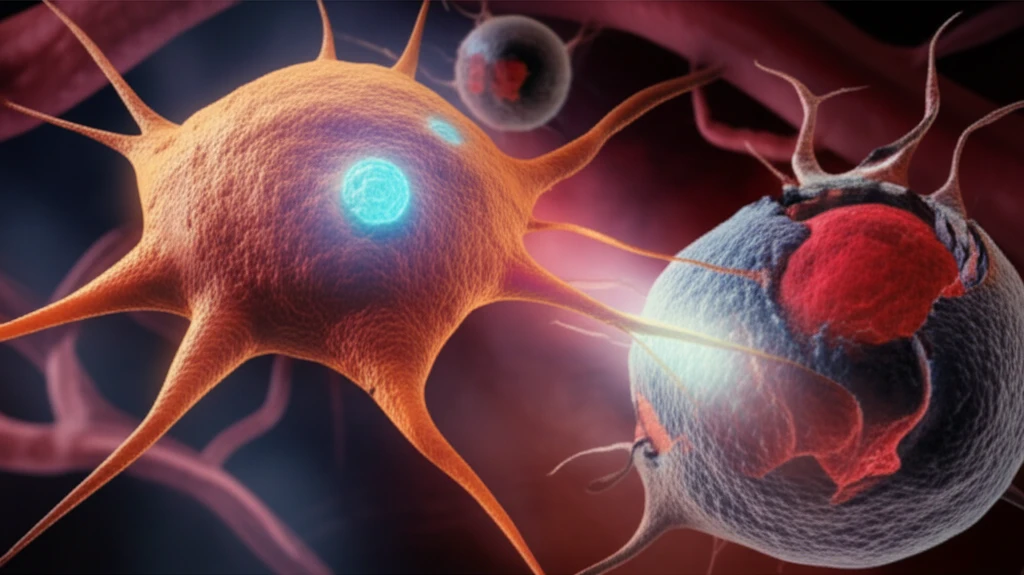
Illustration of a Natural Killer cell attacking a cancer cell, highlighting the immune system's battle against disease.

Decoding Your Body's Defenders: How Natural Killer Cells Fight for Your Health

"Unveiling the Secrets of Immune Cells and Their Potential for Revolutionizing Disease Treatment"


In the intricate theater of your body, a constant battle rages – a war fought on a microscopic scale to protect your health. Leading the charge in this ongoing conflict are specialized cells of the immune system, and among the most fascinating and effective are the natural killer (NK) cells. These aren't your average immune responders; they're the sharpshooters, the first line of defense, always on patrol for any sign of trouble.

NK cells are unique immune cells that play a crucial role in recognizing and eliminating threats, whether they're viral infections or cancerous growths. Unlike other immune cells that need prior training to recognize invaders, NK cells are pre-programmed to identify and destroy infected or abnormal cells without any prior exposure. This rapid response makes them critical in the early stages of infection and cancer development.

This article delves into the world of NK cells, exploring their functions, how they work, and their importance in keeping you healthy. We'll examine the latest research on their role in fighting disease, and shed light on the promising potential of harnessing NK cells for future medical treatments. Prepare to be amazed by the power of these natural bodyguards!

Meet the Natural Killer Cells: Your Body's Built-in Bodyguards

Illustration of a Natural Killer cell attacking a cancer cell, highlighting the immune system's battle against disease.

Natural killer cells are a type of lymphocyte, a category that includes other immune cells like T cells and B cells. They are characterized by their ability to identify and destroy cells that are infected with viruses or have become cancerous. This is a critical role, as it prevents the spread of infection and the development of tumors.

Unlike other immune cells, NK cells do not need to be 'trained' to recognize threats. They have a variety of receptors on their surface that can identify abnormal cells, such as those infected with a virus or that have undergone cancerous changes. Once an NK cell recognizes a target cell, it releases cytotoxic granules containing proteins that induce the target cell to undergo programmed cell death, or apoptosis.

  • Rapid Response: NK cells act quickly to neutralize threats.
  • Targeting Mechanism: They identify abnormal cells through specific receptors.
  • Cytotoxic Action: NK cells release granules to induce apoptosis.
  • No Prior Sensitization: They don't need prior exposure to a threat to act.
The discovery of NK cells has revolutionized our understanding of the immune system. Their ability to recognize and eliminate threats without prior sensitization makes them essential for early immune responses. They are also involved in regulating the immune system by producing cytokines, molecules that help to coordinate the immune response. The study of NK cells is an active area of research, and scientists are constantly uncovering new insights into their function and potential for use in treating diseases.

The Future of NK Cells: Hope for New Treatments

The study of NK cells is continually revealing more about their roles in health and disease. Scientists are exploring ways to harness their power to create new treatments for cancer, infections, and other illnesses. As research continues, NK cells hold the potential to revolutionize the way we approach disease, offering new hope for a healthier future.

About this Article -

This article was crafted using a human-AI hybrid and collaborative approach. AI assisted our team with initial drafting, research insights, identifying key questions, and image generation. Our human editors guided topic selection, defined the angle, structured the content, ensured factual accuracy and relevance, refined the tone, and conducted thorough editing to deliver helpful, high-quality information.See our About page for more information.

This article is based on research published under:

DOI-LINK: 10.18388/abp.2015_1152, Alternate LINK

Title: Cd25 (Il-2R) Expression Correlates With The Target Cell Induced Cytotoxic Activity And Cytokine Secretion In Human Natural Killer Cells

Subject: General Biochemistry, Genetics and Molecular Biology

Journal: Acta Biochimica Polonica

Publisher: Polskie Towarzystwo Biochemiczne (Polish Biochemical Society)

Authors: Karolina Rudnicka, Agnieszka Matusiak, Magdalena Chmiela

Published: 2015-01-01

Everything You Need To Know

1

What are natural killer cells, and why are they important?

Natural killer (NK) cells are unique lymphocytes, a type of immune cell, that act as the body's first line of defense against threats like viral infections and cancerous growths. Unlike other immune cells, NK cells don't need prior training to recognize and eliminate infected or abnormal cells. They are pre-programmed to identify and destroy these cells, making them essential for rapid responses in the early stages of infection and cancer development. Their ability to act quickly without prior sensitization is crucial for maintaining health and preventing disease progression.

2

How do natural killer cells recognize and eliminate threats in the body?

Natural killer (NK) cells have receptors on their surface that can identify abnormal cells, such as those infected with a virus or that have undergone cancerous changes. Once an NK cell recognizes a target cell, it releases cytotoxic granules containing proteins. These granules induce the target cell to undergo programmed cell death, also known as apoptosis. This process effectively neutralizes the threat by eliminating the infected or cancerous cell. This targeted action ensures that only compromised cells are destroyed, minimizing damage to healthy tissues.

3

In what ways are natural killer cells different from other immune cells like T cells and B cells?

Natural killer (NK) cells differ significantly from T cells and B cells in their method of threat recognition and response. Unlike T cells and B cells, which require prior sensitization or training to recognize specific antigens on infected or cancerous cells, NK cells are pre-programmed to identify and destroy abnormal cells without any prior exposure. This allows NK cells to respond rapidly to threats, providing an immediate defense. Additionally, NK cells induce cell death through the release of cytotoxic granules, whereas T cells may use other mechanisms, and B cells primarily produce antibodies to neutralize pathogens.

4

How has the discovery of natural killer cells changed our understanding of the immune system?

The discovery of natural killer (NK) cells has revolutionized our understanding of the immune system by revealing a critical component of innate immunity. Their ability to recognize and eliminate threats without prior sensitization demonstrates the existence of a rapid and pre-programmed defense mechanism. Furthermore, NK cells play a role in regulating the broader immune response by producing cytokines, signaling molecules that coordinate immune cell activity. This discovery has highlighted the complexity and sophistication of the immune system, paving the way for new approaches to treating diseases by harnessing the power of NK cells.

5

What is the future potential of using natural killer cells in medical treatments?

The future holds great promise for using natural killer (NK) cells in medical treatments, particularly for cancer, infections, and other illnesses. Scientists are actively exploring ways to harness their natural ability to recognize and eliminate diseased cells to develop novel therapies. The potential lies in enhancing NK cell activity, either through adoptive transfer (infusing patients with modified or expanded NK cells) or by developing drugs that stimulate their function. While still in the research phase, these approaches offer hope for more effective and targeted treatments with fewer side effects compared to traditional therapies. Further research is needed to fully unlock the therapeutic potential of NK cells and translate these findings into clinical applications.

Newsletter Subscribe

Subscribe to get the latest articles and insights directly in your inbox.