
Decoding Wrist Pain: How Lunate Shape Affects Your Four-Corner Kinematics

"Uncover the connection between lunate morphology and wrist pain. Learn how different lunate types impact carpal kinematics and what it means for your wrist health."
Wrist pain can be a frustrating and limiting condition, affecting everything from typing to exercising. While many factors can contribute to wrist discomfort, a surprising culprit might be the shape of one of your carpal bones: the lunate.
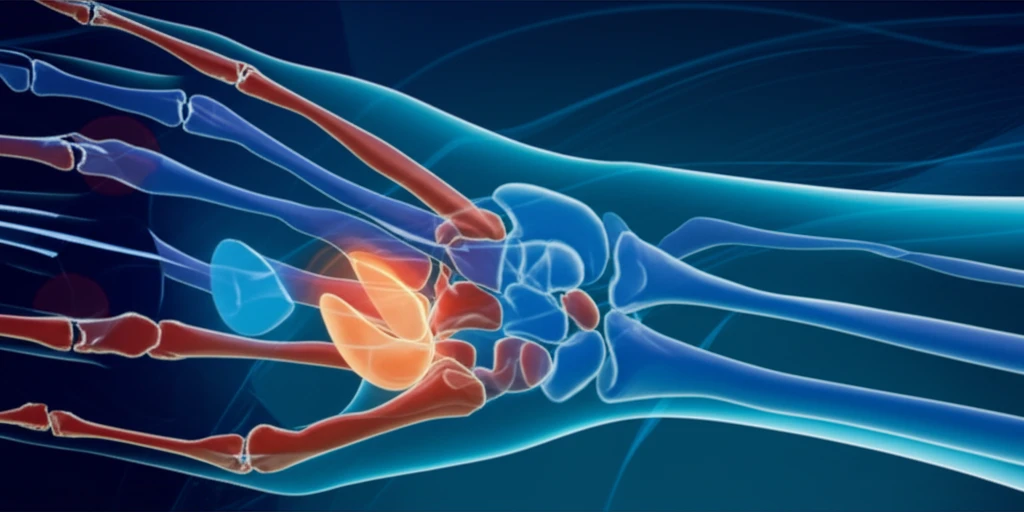
The lunate, a small, crescent-shaped bone in your wrist, plays a crucial role in wrist movement and stability. Interestingly, the lunate comes in different shapes, primarily classified as type 1 and type 2. These variations in morphology can influence how the bones in your wrist move together, potentially leading to pain and other issues.
This article delves into the fascinating relationship between lunate morphology and four-corner carpal kinematics – the movement of the lunate, capitate, hamate, and triquetrum bones. We'll explore how type 1 and type 2 lunates affect wrist motion and how these differences may contribute to wrist pain, offering valuable insights for both understanding and addressing wrist discomfort.
The Lunate's Impact: Type 1 vs. Type 2 and Your Wrist
Researchers have been investigating the connection between lunate morphology and wrist pain, particularly concerning the four-corner carpal bones. A recent study used three-dimensional (3-D) analysis to examine the kinematics of these bones in individuals with type 1 and type 2 lunates. The study involved analyzing wrist flexion-extension, radioulnar deviation, and dart-throwing motion in normal participants to understand how the different lunate shapes influence carpal bone movement.
- Lunate-Triquetrum Step-Off: During radioulnar deviation (moving your wrist side to side), individuals with type 2 lunates exhibited a greater “step-off” between the lunate and triquetrum bones compared to those with type 1 lunates. This increased step-off may indicate higher shear stress on the lunotriquetral interosseous ligament, a crucial stabilizer of the wrist.
- Lunate-Hamate Impaction: The hamate bone, located next to the lunate, showed increased impaction (or contact) with type 2 lunates, especially during ulnar deviation and ulnar flexion. This increased impaction could potentially contribute to proximal hamate arthritis, a painful condition affecting the wrist joint.
What Does This Mean for Your Wrist Pain?
If you're experiencing unexplained wrist pain, especially pain that seems to worsen with side-to-side movements or certain wrist positions, the shape of your lunate bone might be a contributing factor. While this research doesn't provide a direct diagnosis, it sheds light on how subtle anatomical variations can influence wrist biomechanics and potentially lead to discomfort.
It's important to remember that lunate morphology is just one piece of the puzzle. Other factors, such as ligament integrity, muscle strength, and overall wrist mechanics, also play a significant role in wrist health. A comprehensive evaluation by a qualified hand specialist is crucial for determining the underlying cause of your wrist pain and developing an appropriate treatment plan.
If you suspect your wrist pain might be related to your lunate shape, discuss this research with your doctor. Further imaging or specialized tests might be necessary to assess your individual anatomy and identify the best course of action for managing your symptoms and improving your wrist function. Simple X-rays are not likely to show the difference, advanced imaging and a specialist is needed. Lifestyle changes and specific exercises can improve mobility and reduce stress on joint.