
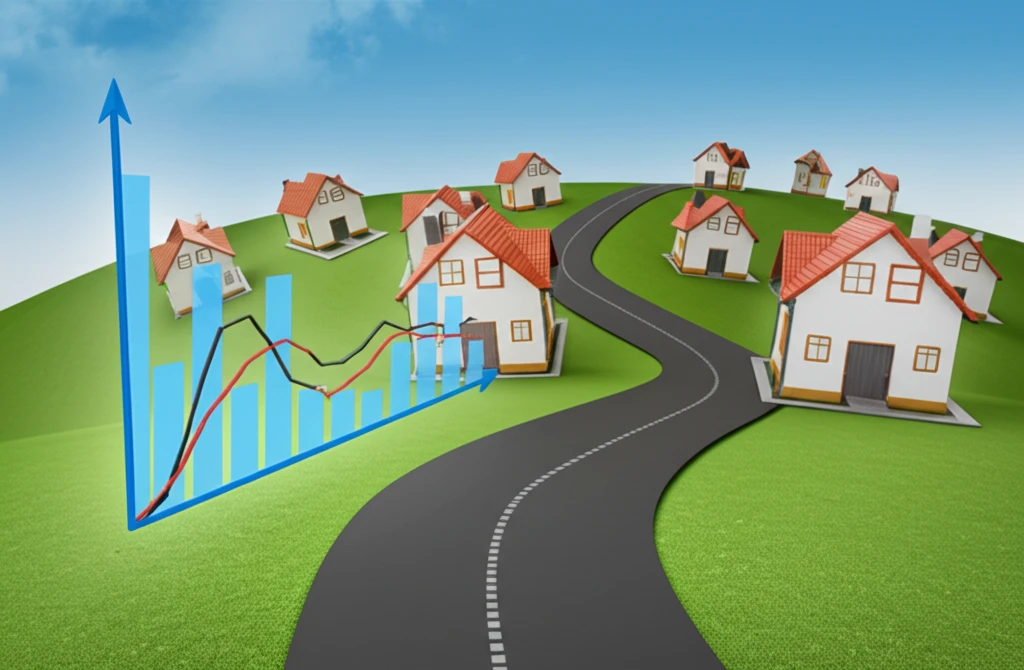
A surreal landscape illustrating wealth distribution with houses of different sizes and a graph overlay.

Decoding Wealth: How the Generalized Beta Prime Distribution Reveals Economic Inequality

"Unveiling the Secrets of Income Disparity: A Fresh Look at Economic Models and What They Tell Us About Wealth Distribution."


The distribution of wealth and income has long been a topic of intense interest and debate. Understanding how economic resources are spread across a population is crucial for addressing issues of fairness, opportunity, and social stability. While numerous models have been proposed to describe wealth distribution, the Generalized Beta Prime (GB2) distribution has emerged as a particularly successful and versatile tool. Its ability to capture various features of real-world income data has made it a favorite among economists.

However, the reasons behind GB2's effectiveness have not always been clear. Is it simply a convenient mathematical function, or does it reflect deeper underlying economic processes? This article explores the connection between GB2 and a plausible model of economic exchange, shedding light on why this distribution is so well-suited for describing wealth and income.

We'll also delve into the properties of various inequality indices, such as the Gini coefficient, the Hoover index, and Theil's indices, examining how they relate to GB2 and how they can be used to measure and compare wealth distributions. Furthermore, we introduce a new inequality index, DMMS, offering a fresh perspective on assessing economic disparities. Using housing sale prices as a proxy for wealth, we'll illustrate these concepts with real-world data and explore the implications for understanding and addressing economic inequality.

Why is the Generalized Beta Prime Distribution So Effective at Modeling Wealth?

A surreal landscape illustrating wealth distribution with houses of different sizes and a graph overlay.

The Generalized Beta Prime (GB2) distribution's prowess in modeling wealth and income stems from its roots in a stochastic model of economic exchange. Imagine a dynamic system where individuals engage in transactions, with money flowing between them. The GB2 distribution emerges as the stable, long-term outcome of such a process, making it more than just a curve that happens to fit the data. It reflects the fundamental way wealth accumulates and disperses in an economy.

Unlike simpler distributions, the GB2 boasts remarkable flexibility. By tweaking its parameters, it can mimic a wide range of wealth patterns, from relatively equal distributions to those with extreme concentrations of wealth in the hands of a few. This adaptability is crucial for capturing the nuances of real-world economies, where historical factors, policy choices, and individual circumstances all shape the distribution of resources.

  • Mimicking Real-World Trends: The GB2 distribution is able to capture various patterns in wealth distribution.
  • Adaptability: Parameters can be adjusted to model a wide range of distribution.
  • A Dynamic View: It reflects the fundamental ways in which wealth accumulates and disperses.
This flexibility arises from its ability to represent different economic realities. The GB2 can model scenarios where luck and chance play a significant role, as well as situations where skill, effort, and strategic choices are the primary drivers of wealth accumulation. It can also capture the impact of government policies, such as progressive taxation or social safety nets, which tend to compress the distribution of income and wealth.

The Future of Wealth Distribution Analysis

As we move forward, a deeper understanding of wealth distribution will be crucial for addressing the challenges of the 21st century. By combining sophisticated statistical models like the Generalized Beta Prime distribution with insights from economic theory, we can gain a more nuanced picture of how wealth is created, distributed, and sustained. This knowledge will empower us to design policies that promote greater economic opportunity, reduce inequality, and build a more just and prosperous society for all.

About this Article -

This article was crafted using a human-AI hybrid and collaborative approach. AI assisted our team with initial drafting, research insights, identifying key questions, and image generation. Our human editors guided topic selection, defined the angle, structured the content, ensured factual accuracy and relevance, refined the tone, and conducted thorough editing to deliver helpful, high-quality information.See our About page for more information.

Everything You Need To Know

1

What is the Generalized Beta Prime (GB2) distribution, and why is it used to study wealth distribution?

The Generalized Beta Prime (GB2) distribution is a mathematical model used to describe the distribution of wealth and income within a population. It's favored by economists because of its flexibility in capturing various patterns of wealth distribution, from relatively equal distributions to those with extreme wealth concentration. Unlike simpler models, the GB2's adaptability allows it to reflect the nuanced realities of different economies by adjusting its parameters, making it a powerful tool for understanding economic inequality. Moreover, the GB2 emerges from a stochastic model of economic exchange, reflecting how wealth accumulates and disperses in an economy.

2

How does the Generalized Beta Prime (GB2) distribution relate to economic exchange and wealth accumulation?

The GB2 distribution is linked to a stochastic model of economic exchange, where individuals exchange money. The GB2 emerges as the stable, long-term outcome of this process. This means that the GB2 doesn't just fit the data; it reflects the fundamental ways wealth is created and distributed. This model views wealth as a dynamic process, influenced by various factors, including luck, skill, effort, and policy decisions. This dynamic view helps explain why the GB2 can effectively model real-world scenarios.

3

What are the key features of the Generalized Beta Prime (GB2) distribution that make it effective in modeling wealth?

The GB2 distribution's effectiveness stems from several key features: It can capture various patterns in wealth distribution, from relatively equal distributions to those with extreme wealth concentration; parameters can be adjusted to model a wide range of distributions; and it reflects the fundamental ways in which wealth accumulates and disperses through economic exchange. This flexibility allows the GB2 to accurately represent different economic realities. It models scenarios where luck plays a role as well as situations where skill and effort are primary, while also capturing the impact of government policies like progressive taxation.

4

Besides the Generalized Beta Prime (GB2) distribution, what other tools are used to analyze wealth distribution, and how do they relate?

Besides the GB2 distribution, several inequality indices are used to analyze wealth distribution. These include the Gini coefficient, the Hoover index, and Theil's indices. Each index provides a different perspective on the concentration of wealth. The article also introduces a new inequality index, DMMS. These indices are used in conjunction with the GB2 distribution, which helps to understand the underlying patterns of wealth distribution that these indices quantify. For instance, the GB2 can be used to model the distribution, and then these indices can be calculated based on the GB2's parameters to measure the level of inequality.

5

How can the Generalized Beta Prime (GB2) distribution and insights from economic theory be used to address economic inequality?

By combining the GB2 distribution with insights from economic theory, we can gain a more nuanced understanding of how wealth is created, distributed, and sustained. This knowledge can be used to design policies that promote greater economic opportunity and reduce inequality. For example, by understanding the parameters of the GB2, policymakers can identify factors contributing to inequality and tailor interventions, such as progressive taxation or social safety nets, to shift the distribution towards a more equitable outcome. Furthermore, analyzing real-world data using the GB2 can reveal the impact of specific policies and economic conditions on wealth distribution, informing evidence-based decision-making.

Newsletter Subscribe

Subscribe to get the latest articles and insights directly in your inbox.