
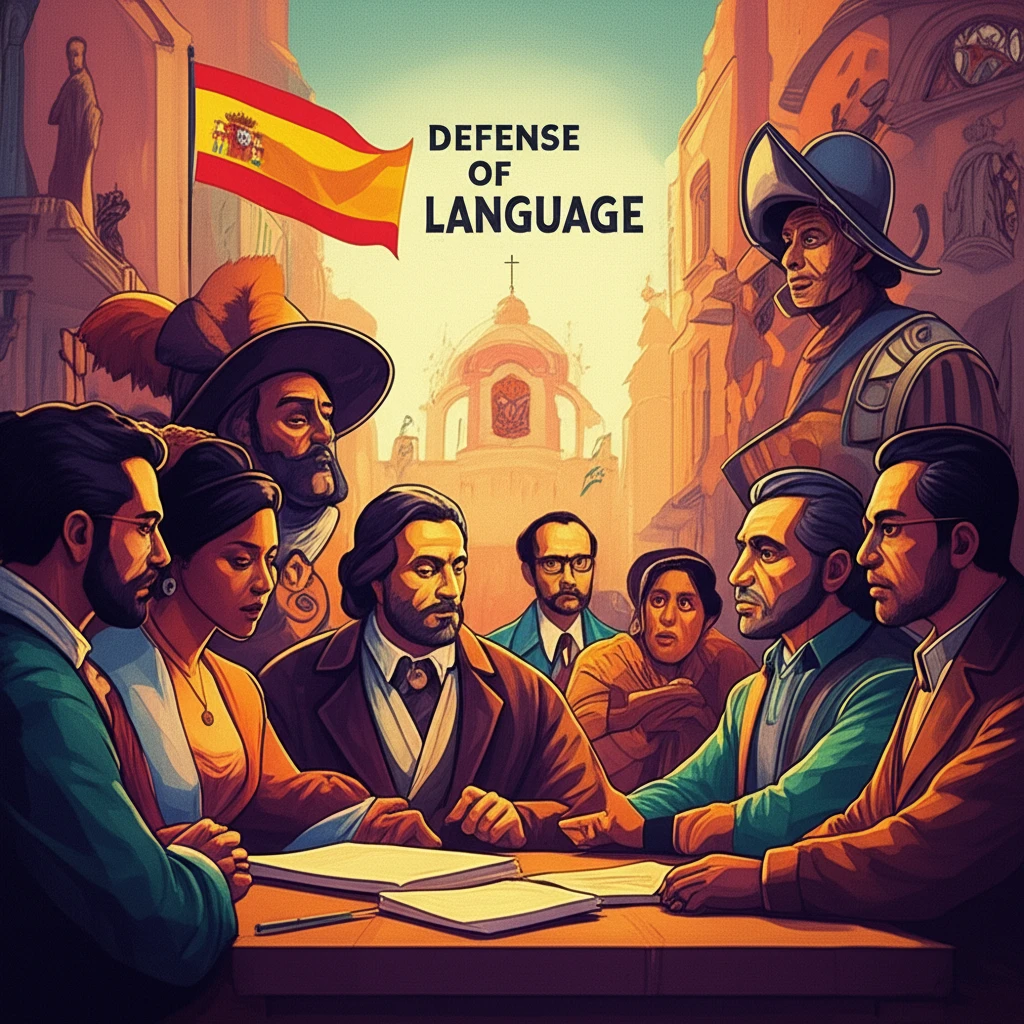
Surreal illustration representing the defense of the Spanish language, with a group of figures debating the topic. The scene captures historical Mexican context with symbolic representation of the challenges the commission faced.

Decoding the Spanish Language's Defense: A Look Back at Mexico's Bold Linguistic Experiment

"Explore the story of Mexico's "Commission for the Defense of the Spanish Language" (CPDIE) and its impact on the evolution of the language."


In the vibrant tapestry of global languages, Spanish holds a prominent thread, spoken by millions across continents. However, like any living language, Spanish constantly evolves, absorbing influences and facing challenges. One compelling chapter in this story is Mexico's response to these shifts, a period where the nation actively sought to defend its linguistic heritage. This involves a deep dive into the actions of the CPDIE.

This exploration centers on Mexico's 'Commission for the Defense of the Spanish Language,' a group established in the 1980s. This commission aimed to safeguard the purity and integrity of the Spanish language against the perceived threats of external influences. During its period, the commission confronted the incursion of Anglicisms, a term for English borrowings, and the complexities of linguistic change in a rapidly globalizing world.

Through examining the CPDIE's strategies, its successes, and its ultimate fate, we gain invaluable insights into language planning, cultural preservation, and the dynamic relationship between language and society. This article delves into the historical context, the commission's specific actions, and its lasting legacy on the evolution of the Spanish language in Mexico, all while providing some surprising data points on the impact of English on Mexican society.

The Birth of the Commission: A Response to Linguistic and Cultural Change

Surreal illustration representing the defense of the Spanish language, with a group of figures debating the topic. The scene captures historical Mexican context with symbolic representation of the challenges the commission faced.

The establishment of the 'Commission for the Defense of the Spanish Language' (CPDIE) in 1981, under President José López Portillo, occurred during a period of significant societal and cultural transformation. Mexico, like many nations, was grappling with the rise of globalization, the increasing influence of the United States, and the accompanying influx of foreign words and cultural elements.

The commission's core concern was the "displacement of the maternal language and culture through assimilation of foreign influences," particularly from English. The group aimed to protect against what it viewed as the erosion of the Spanish language. They viewed the use of Spanish and the need to address an influx of Anglicisms from the perspective of cultural purity.

  • The primary objective: to safeguard the use of the Spanish language as spoken and written in Mexico.
  • Coordinate efforts to defend the language, focusing on border regions and areas with challenging cultural adaptation.
  • Establish a unified language for all Mexicans.
The commission's efforts included the promotion of standardized Spanish, the discouragement of English borrowings, and the critical examination of local linguistic practices. While the commission's methods could be viewed as prescriptive, its objectives aimed to protect the essence of Mexican identity. The team focused on standardizing Spanish, an important step to unify the Mexican peoples through language.

The Enduring Impact of Linguistic Preservation Efforts

The CPDIE's story offers valuable lessons for any society trying to preserve its cultural and linguistic integrity. While the commission faced various obstacles, including financial constraints and shifting political priorities, its efforts to defend the Spanish language shed light on a larger issue—the ongoing dynamic between language, culture, and globalization. Examining this history gives us a deeper understanding of the challenges in an ever-changing world, and what it takes to preserve a cultural identity.

About this Article -

This article was crafted using a human-AI hybrid and collaborative approach. AI assisted our team with initial drafting, research insights, identifying key questions, and image generation. Our human editors guided topic selection, defined the angle, structured the content, ensured factual accuracy and relevance, refined the tone, and conducted thorough editing to deliver helpful, high-quality information.See our About page for more information.

Everything You Need To Know

1

What was the main goal of Mexico's Commission for the Defense of the Spanish Language (CPDIE)?

The main goal of the Commission for the Defense of the Spanish Language (CPDIE), established in Mexico, was to safeguard the Spanish language from external influences, particularly English. The CPDIE sought to preserve the "purity and integrity" of Spanish, addressing concerns about the "displacement of the maternal language and culture through assimilation of foreign influences."

2

Why did Mexico establish the Commission for the Defense of the Spanish Language (CPDIE) in the 1980s?

Mexico established the Commission for the Defense of the Spanish Language (CPDIE) in 1981, under President José López Portillo, in response to increasing globalization and cultural changes. There was a concern about the growing influence of the United States and the influx of Anglicisms (English borrowings) into the Spanish language. The CPDIE aimed to protect Mexican cultural identity by defending the Spanish language against what it viewed as linguistic erosion.

3

What were some of the specific strategies employed by the Commission for the Defense of the Spanish Language (CPDIE) to achieve its objectives?

The Commission for the Defense of the Spanish Language (CPDIE) employed several strategies, including promoting standardized Spanish throughout Mexico. It discouraged the incorporation of Anglicisms into the language and critically examined local linguistic practices. The CPDIE also focused on unifying the language for all Mexicans, especially in border regions and areas with cultural adaptation challenges.

4

What were some of the challenges faced by the Commission for the Defense of the Spanish Language (CPDIE), and what was its ultimate fate?

The Commission for the Defense of the Spanish Language (CPDIE) faced challenges that included financial constraints and shifting political priorities. While its specific fate isn't detailed, the implication is that, like many such initiatives, it likely faced obstacles in maintaining momentum and resources over time. Despite these challenges, its efforts offer valuable lessons about the dynamics between language, culture, and globalization, and the difficulties inherent in preserving linguistic integrity.

5

In what ways does the story of Mexico's Commission for the Defense of the Spanish Language (CPDIE) reflect broader global issues related to language and cultural preservation?

The story of the Commission for the Defense of the Spanish Language (CPDIE) reflects the broader global issues of language planning, cultural preservation, and the tension between linguistic purity and the natural evolution of languages. The concerns over Anglicisms echo similar concerns in other countries about the dominance of certain languages and cultures and the potential loss of unique linguistic identities. The CPDIE's actions highlight the inherent challenges in balancing the desire to protect a language and culture with the inevitability of linguistic change and the influences of globalization.

Newsletter Subscribe

Subscribe to get the latest articles and insights directly in your inbox.